
Remembering Typhoon Tino: Talisay City from the air, five days after
Typhoon Tino hit Cebu on 4 November 2025 and killed 269 people across the Philippines. The aerial frames here show Talisay City five days later.
Reported by Suroy Newsdesk. Edited by Janette Arceo. How we report.
Typhoon Tino made landfall in Borbon, northern Cebu, at 5:10 a.m. on 4 November 2025, about five hours after its first landfall in Silago, Southern Leyte. By 17 November the Office of Civil Defense had counted 269 dead across the Philippines, 150 of them in Central Visayas, and 113 people still missing.
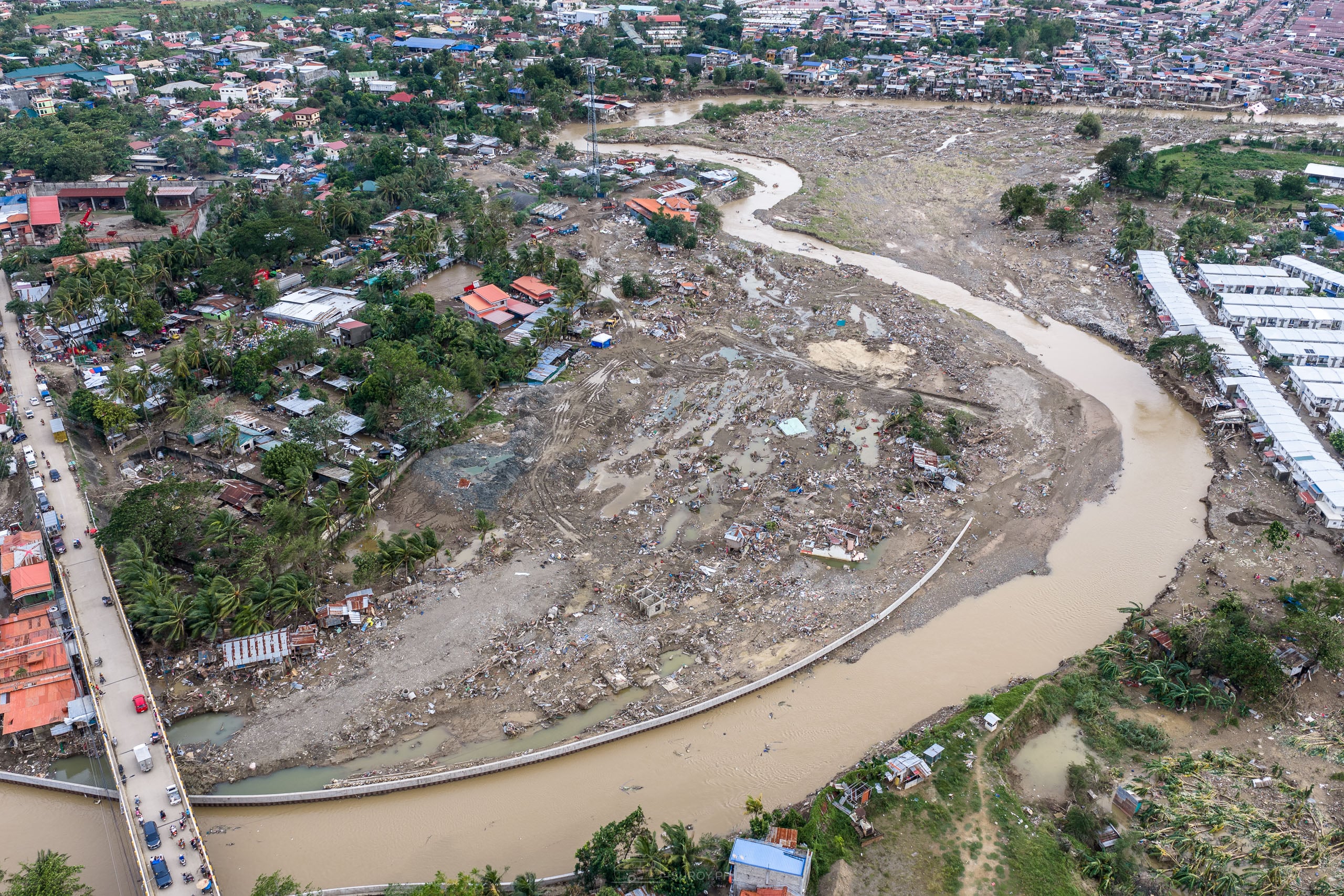
In Talisay City, just south of Cebu City, the Mananga River overflowed and destroyed the houses built beside it and on its bed. The drone frames on this page were taken over Talisay’s riverside between 4:37 and 4:52 p.m. on 9 November 2025, five days after the water came through.
What Typhoon Tino did to Cebu
PAGASA recorded 183 millimeters of rain in Cebu in the 24 hours to the morning of 4 November, against a normal of 131 millimeters for the whole of November, and parts of the eastern coast had already taken up to 300 millimeters over the three days before, SunStar Cebu reported on 5 November. The ground was already saturated. Soil moisture across Central Visayas had been in the 80th to 95th percentile since September, per the same PAGASA data, and weeks of heavy October rain had kept it there.
Local death tolls moved all month and rarely matched each other. A month after the storm, Cebu Daily News put the provincial count at 96 and Cebu City’s at 33, as of late November. This page uses the Office of Civil Defense figures above. The same Cebu Daily News tally, published 5 December 2025, counted 49,670 damaged houses in Central Visayas, 6,733 of them destroyed outright, and 166,634 people still in 304 evacuation centers across Cebu.
On 6 November 2025, Proclamation No. 1077 put the whole country under a state of national calamity for one year.
Typhoon Tino · Cebu
The storm, by the numbers
Pick a view.
183 mm in a day
The rain
PAGASA recorded 183 mm of rain in Cebu in the 24 hours to the morning of 4 November 2025, against a normal of 131 mm for the whole of November. Parts of the eastern coast had already taken up to 300 mm in the three days before.
269 dead nationwide
The toll
The Office of Civil Defense counted 269 dead across the Philippines by 17 November 2025, 150 of them in Central Visayas, with 113 missing. In Talisay the city counted seven dead by 9 November.
49,670 damaged
The houses
By early December 2025, 49,670 houses in Central Visayas were damaged and 6,733 destroyed outright. Talisay alone had more than 4,500 damaged houses by 20 December.
Works, then a gap
The year after
The Mananga dredging began by late January 2026, was more than half done in March and was reported near completion in June. No completion date, and no update on the Candulawan relocation or the tent city, had been published by 30 September 2026.
PAGASA via SunStar Cebu (5 Nov 2025); Office of Civil Defense via the Inquirer (17 Nov 2025); Cebu Daily News (5 and 20 Dec 2025); DPWH and city reports through June 2026. Checked 30 September 2026.
What the Mananga River did to Talisay
The Mananga runs through Talisay to the sea. On 4 November it overflowed and swept away the houses standing beneath and beside the Mananga Bridge, SunStar Cebu reported the next day. Mananga Bridge II was damaged and closed, stretches of riprap wall collapsed, and residents told Bulatlat on 9 November that the river had widened and that some sections of bank had walls while others had none.
By 9 November the city’s disaster office had counted seven dead and six injured in Talisay. Its head, Alvin Santillana, told SunStar Cebu that day that the worst losses were where families had been living on the riverbed itself, not only along its banks. The communities named were Sitio Isla Verde in Barangay San Isidro, Lawaan II and III, and Sitio Paglaum in Dumlog. On relocation he was plain: the city had nowhere to move them, because it did not have enough lots.
Within two weeks the city had drawn a line. More than 700 families from Sitio Isla Verde were barred from rebuilding in the flood zone, GMA Regional TV reported on 18 November, with just over a hectare in Barangay Candulawan identified for permanent relocation and Barangay Biasong for temporary shelter. By 20 December, Cebu Daily News counted more than 4,500 damaged houses in Talisay alone, and Isla Verde had been declared a no-build zone.
What families got instead, for now, was a tent city at Sitio Quimba, Barangay San Roque, with room for about 200 families. The first 100 households had moved in by 15 December. One of them, Celia Canunayon, 39, told Cebu Daily News she had lost a home to Typhoon Odette in 2021 and then lost another to Tino. Residents had been told to expect about three months there.
Talisay from the air, 9 November 2025
The frames below were shot on a DJI Mavic 4 Pro in a fifteen minute window late that afternoon. The pattern repeats from one to the next. Concrete houses stand as hollow-block shells with no roof and nothing inside. Wooden houses are simply gone, and their roofing lies folded across the mud. The flood left one brown surface over what had been lanes, yards and gardens, broken by pools that had still not drained five days on. In several frames people are walking across it.

Photo · Suroy.ph · Original

Photo · Suroy.ph · Original

Photo · Suroy.ph · Original

Photo · Suroy.ph · Original

Photo · Suroy.ph · Original

Photo · Suroy.ph · Original
Padayon, Cebu.
What has changed since
| When | What happened |
|---|---|
| 6 November 2025 | Proclamation No. 1077 declares a state of national calamity for one year. |
| 18 November 2025 | Talisay bars more than 700 Isla Verde families from rebuilding in the flood zone and names a relocation site in Barangay Candulawan. |
| 15 December 2025 | The first 100 households move into the tent city at Sitio Quimba, Barangay San Roque. |
| Late January 2026 | Dredging and widening of the Mananga is under way at its mouth, in Dumlog and Biasong, by the Department of Public Works and Highways. |
| 19 March 2026 | PAGASA retires the name Tino, with Uwan and five other names from the 2025 season. |
| 25 March 2026 | Public Works Secretary Vince Dizon puts the Mananga works at more than half done and aims to finish before the June rains. Cleared banks in Lawaan II become a no-build zone, and the city plans parks and a bike lane there. |
| Early May 2026 | The Cebu Provincial Board lifts the province’s own state of calamity. |
| 22 June 2026 | President Marcos inspects the works in San Isidro. The rehabilitation is reported near completion. |
The work along the river, as the Philippine Information Agency described it on 26 June, is revetments, riprap and gabion walls with drainage outlets behind them, across five barangays: San Isidro, Lawaan II, Mohon, Dumlog and Biasong. Dams on Cebu’s major rivers have been proposed for the 2027 national budget. Gina Gempisao, 58, has lived beside the Mananga in San Isidro for nearly thirty years and four of her children lost their homes to Tino. She is one of the residents the agency interviewed for that report.
What is still not known
No completion date for the Mananga works had been published as of 30 September 2026. Near completion in June is the last public status found.
No public update was found on the Candulawan relocation site, or on how many families are still in the San Roque tent city, as of the same date. Across the city line, Cebu City still had 29 families from Sitio Common in Barangay Bacayan living in two evacuation centers in Pit-os in August, nine months after the storm, SunStar Cebu reported on 9 August 2026.
The national state of calamity under Proclamation No. 1077 runs to 6 November 2026 unless it is lifted earlier. No announcement either way had been found as of 30 September 2026.
If you are heading south of Cebu City
The main roads south to Moalboal, Badian and Oslob run through Talisay. For the current status of Kawasan Falls and the canyoneering route, which were both closed for clearing after Tino, see the Osmeña Peak to Kawasan guide. November is still typhoon season, and if a storm is forecast for your dates, the rain-day swap system has a plan B for most Cebu itineraries.
Quick answers
When did Typhoon Tino hit Cebu? It made landfall in Borbon, northern Cebu, at 5:10 a.m. on Tuesday, 4 November 2025, according to PAGASA.
What was Typhoon Tino’s international name? Kalmaegi.
How many people died in Typhoon Tino? 269 across the Philippines, with 113 missing and 523 injured, in the Office of Civil Defense count of 17 November 2025. 150 of the deaths were in Central Visayas.
Will there be another typhoon named Tino? No. PAGASA retired the name on 19 March 2026, along with six other names from the 2025 season.
Sources
Casualty figures: Office of Civil Defense, as carried by the Philippine Daily Inquirer, 17 November 2025. Landfall: PAGASA, as carried by SunStar Cebu and The Manila Times, 4 November 2025. Rainfall and soil moisture: PAGASA, as carried by SunStar Cebu, 5 November 2025. Proclamation No. 1077, 6 November 2025. Talisay: SunStar Cebu, 5 and 9 November 2025. Bulatlat, 9 November 2025. GMA Regional TV, 18 November 2025 and 28 January 2026. Cebu Daily News, 5 and 20 December 2025 and 25 March 2026. SunStar Cebu, 26 March 2026. Philippine Information Agency, 26 June 2026. The Manila Times, 23 June 2026. Name retirement: Manila Bulletin, 19 March 2026, and Cebu Daily News, 20 March 2026. Provincial state of calamity: The Manila Times, 8 May 2026. Cebu City evacuees: SunStar Cebu, 9 August 2026.
Reported by Suroy Newsdesk. Edited by Janette Arceo. Facts checked 30 September 2026. Aerial photographs by Suroy.ph, 9 November 2025.