

Renting a Car or Motorbike in Cebu: Licenses, Deposits and the Passport Clause
Your home driving license is valid in the Philippines for 90 days from the date you arrive. That is the single fact that decides whether renting in Cebu is simple or complicated, and it comes from the Philippine government rather than from a rental desk. Everything after it is about deposits, insurance that covers less than you think, and a helmet law with real teeth.
This is what the law actually requires, what the market actually charges, and the one clause in almost every rental contract that deserves a conversation before you sign.
Can you legally drive here
Yes, on your own license, for 90 days from arrival. The Philippine foreign service states it plainly: travelers planning to stay and drive longer than 90 days must get a Philippine license from the Land Transportation Office.
An International Driving Permit is not strictly mandatory but it is strongly recommended, and it has to be obtained before you arrive because no Philippine office issues one to a visitor. Where your license is not in English, a translation is required. Carry the original alongside the permit; the permit is a translation, not a license.
Rental companies are free to be stricter than the law, and several are. At least one Cebu motorcycle operator requires either a license with a motorcycle entitlement or an IDP for tourists. If your car license does not cover motorcycles at home, it does not cover them here either, and a scooter is a motorcycle.
Helmets: the law with the biggest fine attached
Republic Act 10054, the Motorcycle Helmet Act, approved 23 March 2010. All riders, driver and back rider, must wear a standard protective helmet at all times. The helmet must carry a Philippine Standard mark or an Import Commodity Clearance sticker from the Bureau of Product Standards, and the implementing rules require compliance with the PNS UN-ECE 22:2007 standard. Tricycle drivers are exempt.
The penalties escalate hard:
- First offence ₱1,500
- Second ₱3,000
- Third ₱5,000
- Fourth and after ₱10,000 plus confiscation of your driver’s license
Selling substandard or unmarked helmets carries its own penalties, and tampering with the standards marks carries ₱10,000 to ₱20,000. The practical point for a renter: look for the sticker on the helmet you are handed. A rental helmet without an ICC or PS mark is a fine waiting to happen and it is your fine, not the shop’s.
What it costs
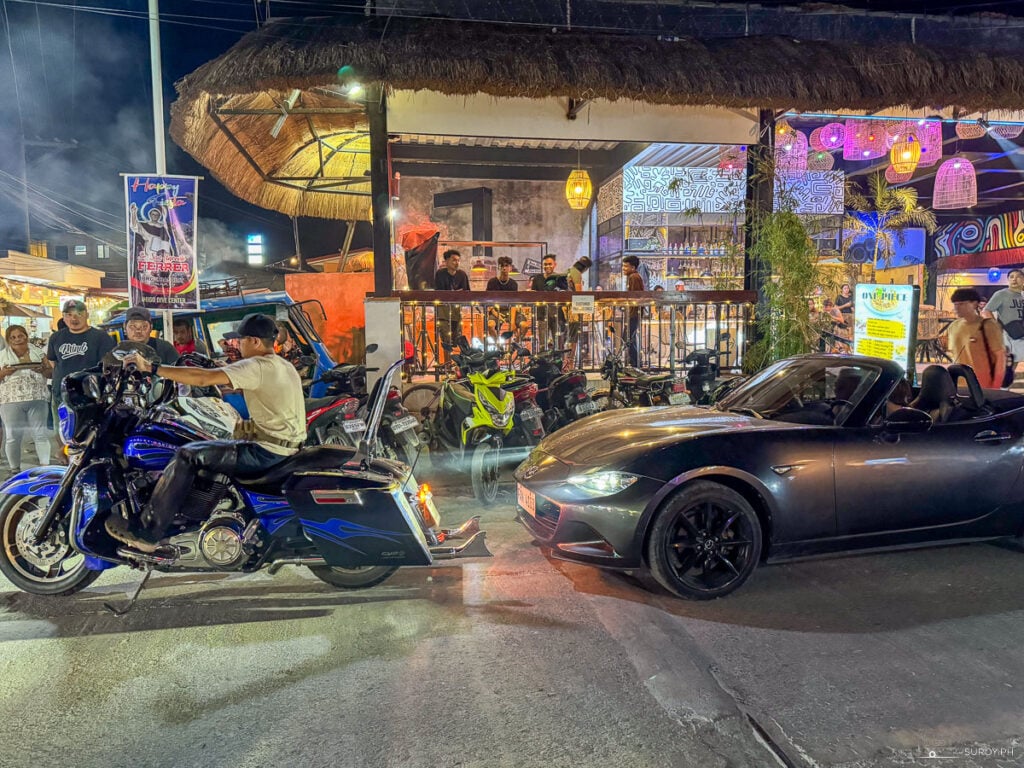
Motorcycles and scooters, Cebu City
Per day, from a Cebu City operator’s published list: Honda Beat 110 ₱499, Honda Click V3 125 ₱599, Honda Click 160 ₱700, Yamaha Aerox V2 155 ₱750, Honda PCX 160 ₱800, Suzuki V-Strom 160 ₱849, Yamaha NMax V3 155 ₱850, Honda ADV 160 ₱900. The Beat runs ₱2,800 a week and ₱8,500 a month.
Stated inclusions on that list are delivery, a helmet, a phone holder, basic insurance, a full tank on pickup and messaging support. Aggregator averages across Cebu City work out around ₱700 a day for a scooter, with individual listings from roughly ₱350 to ₱900.
Moalboal is a gap. No dated 2026 source publishes a current rate there. The ₱500 figure that circulates comes from a 2016 post. Call ahead or expect to negotiate on arrival.
Cars, self-drive
Published Cebu rates: sedan, manual, five seats ₱1,500 a day. Minivan or MPV, automatic, seven seats ₱3,000. Passenger van, manual, fourteen seats ₱3,500. Premium van, eleven seats ₱4,000. Plus a ₱5,000 refundable cash bond.
Cars with a driver
Eight hour rates including driver and fuel: sedan for one to three passengers ₱3,500, excess ₱300 an hour. MPV for four to six ₱4,000, excess ₱350. Van for seven to fourteen ₱4,800, excess ₱400. Parking, entrance tickets and tolls are extra.
Watch the uphill surcharges, which are real and specific: ₱1,000 extra for Tops, Sirao Garden or the Temple of Leah, and another ₱1,000 for the 10,000 Roses in Cordova. If your day is the Busay circuit, that is your budget moving.
All figures checked September 2026. For a hilly, ferry-heavy Cebu itinerary, a driver often costs less than a self-drive plus your own mistakes. For the Transcentral run and the west coast loop, self-drive is the point.
The passport clause
Here is the practice: at least one Cebu self-drive operator requires your original valid passport, collected on pickup and held for the rental, alongside a photocopy of your license, proof of billing, full payment on booking and the separate ₱5,000 cash bond. Motorcycle platforms typically ask for a passport or ID for verification plus a card-held deposit.
And here is where the internet gets it wrong in both directions.
What the law says. Republic Act 8239, the Philippine Passport Act of 1996, section 11: a Philippine passport remains at all times the property of the Government, the holder being a mere possessor, and it may not be surrendered to any person or entity other than the government or its representative. Handing over a Philippine passport as security is not lawful.
What the law does not say. That statute governs Philippine passports. We could find no Philippine statute prohibiting a rental company from holding a foreign passport, and anyone telling a visitor “it is illegal under RA 8239” is misreading it. It may be a bad idea. It is not that law.
So what do you do. Offer the cash bond and a photocopy first. Many operators accept that once asked. If a company insists on holding the original, get the terms in writing, photograph every page before you hand it over, and think hard about whether you want your passport in a drawer in another building while you are on a mountain road. Filipino renters have a straightforward answer available to them: their passport is not theirs to give.
Insurance, and what CTPL is not
This is the most misunderstood line on a Philippine rental agreement.
CTPL, Compulsory Third Party Liability, covers third parties only. It does not cover your injuries. It does not cover damage to the vehicle you rented. It is the minimum the vehicle must carry to be registered, and it is protection for the person you hit.
The original schedule sits in Insurance Memorandum Circular 4-2006. Third party liability was capped at ₱100,000, death indemnity ₱70,000, burial ₱30,000, and a no-fault indemnity of ₱15,000 payable without proving fault, alongside itemised hospital limits.
Those figures were raised by Insurance Memorandum Circular 2024-01, announced 13 March 2024: third party liability to ₱200,000, death indemnity to ₱200,000, burial to ₱200,000, no-fault indemnity to ₱30,000, plus incidental expenses up to ₱10,000. The effectivity date is not stated in the coverage we could reach, so treat the increase as in force and verify the schedule with the insurer if a claim is live.
“Basic insurance included” in a rental listing means CTPL. If you want the bike or the car itself covered, you want comprehensive, and you should ask what the excess is before you ride away. No Philippine regulator publishes a minimum scope for the comprehensive product, so the policy document is the only thing that tells you what you bought.

Passengers and children
No LTO prohibition exists on carrying an adult pillion. Both heads need compliant helmets.
Children are governed by Republic Act 10666, the Children’s Safety on Motorcycles Act of 2015. The statute exists and it is the law that applies. We were not able to retrieve its exact conditions or fine schedule from a primary source, and we are not going to print numbers we could not verify. If you are riding with a child, read the statute itself rather than a blog, this one included.
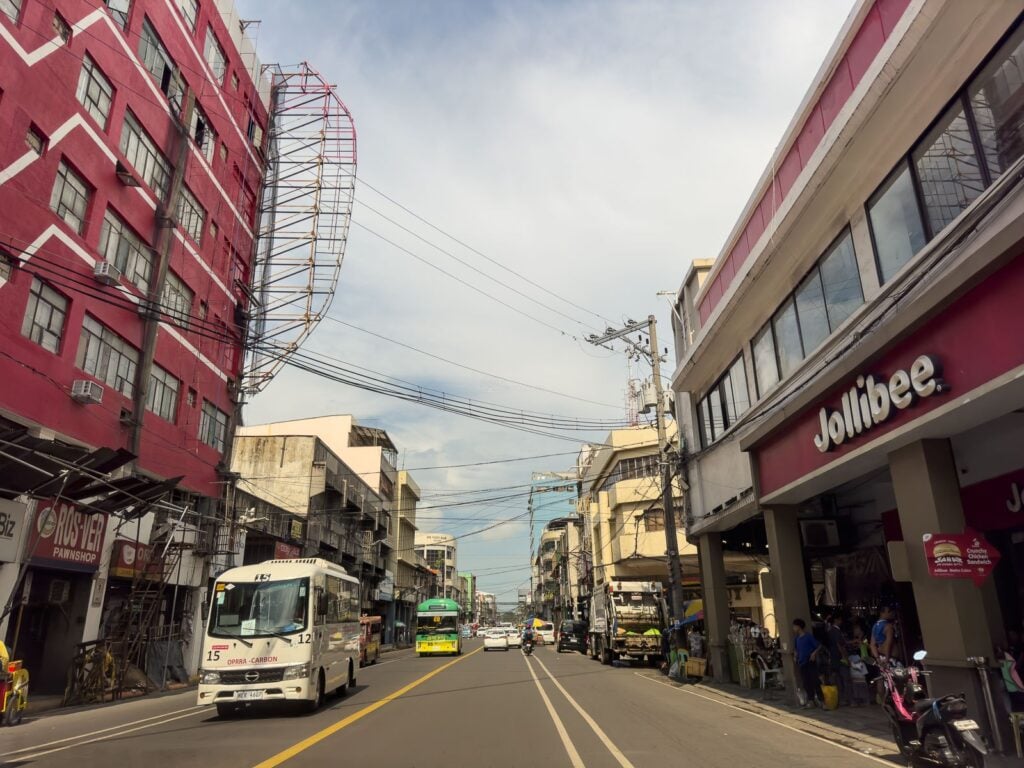
Cebu City rules worth knowing
- Motorcycle lane discipline on the Gov. Cuenco Avenue corridor through Banilad, Talamban, Pit-os and Bacayan, enforced from July 2026. Keep right except for legal turns. ₱1,000, escalating to as much as ₱3,000 if unpaid within three days.
- Parking. The city traffic code was amended in June 2025. On-street parking hours now run 6am to 10pm, and parking bans apply on the South Coastal Road, F. Vestil Street, Natalio Bacalso Avenue, M.J. Cuenco Avenue, Osmeña Boulevard and Serging Osmeña Avenue.
- Mufflers. Joint enforcement on the Transcentral Highway from July 2026 targets illegal and modified mufflers under the city noise ordinance. A loud aftermarket pipe on a rental is your problem at the checkpoint.
Before you sign
- Photograph every panel, the tank, the odometer and the existing damage, with the shop staff watching.
- Check the helmet for a PS mark or ICC sticker.
- Ask whether “insurance” means CTPL or comprehensive, and what the excess is.
- Agree the fuel policy in writing. Full-to-full is cleanest.
- Offer the cash bond before you offer the passport.
- Get an emergency number that a human answers at nine on a Sunday night.
Can tourists drive in the Philippines on a foreign license?
Yes, for 90 days from the date of arrival. After that a Philippine license from the LTO is required. An International Driving Permit is not strictly mandatory but is strongly recommended, and a translation is required where the license is not in English.
Is it legal for a rental company to hold your passport in the Philippines?
RA 8239 makes a Philippine passport government property that may not be surrendered to anyone but the government, so a Filipino renter cannot lawfully hand one over. No Philippine statute was found prohibiting a company from holding a foreign passport. Offer a cash bond and a photocopy first, and get any holding arrangement in writing.
What does CTPL insurance actually cover?
Third parties only. It does not cover your own injuries or damage to the vehicle you rented. Limits were raised by Insurance Memorandum Circular 2024-01 to ₱200,000 third party liability, ₱200,000 death indemnity and ₱30,000 no-fault indemnity. “Basic insurance included” on a rental listing means CTPL.
How much is a scooter rental in Cebu?
Around ₱499 a day for a Honda Beat 110 and up to ₱900 for a Honda ADV 160, from a Cebu City operator’s published list, with weekly rates from ₱2,800. Self-drive cars start around ₱1,500 a day for a manual sedan plus a ₱5,000 refundable bond. Checked September 2026.
Suroy Wear

Ninety days, and the keys.
Everything on this island starts at CEB. The Airport Series CEB Tee carries the airfield you landed on. ₱1,299.