
Chocolate Hills: The New Fee and When They Actually Turn Brown
Three things about the Chocolate Hills changed in the last two years and most guides still have not caught up. The entrance fee went up on 1 October 2025. Sagbayan Peak, the alternative viewpoint half the internet still recommends, has been closed since at least April 2025. And the hills are not reliably brown in January, whatever the planning posts say.
Here is what a visit involves now.

What it costs
Carmen raised the fee under Municipal Ordinance No. 27, Series of 2023, which took effect 1 October 2025.
| Visitor | Fee |
|---|---|
| Adult, non-Bohol | ₱150 |
| Adult, Bohol resident | ₱75 |
| Child 6 to 12, non-Bohol | ₱75 |
| Child 6 to 12, Bohol resident | ₱25 |
| Child 5 and under | Free |
The increase was not uncontroversial locally. In September 2025 the provincial governor publicly asked Carmen to hold the old rate, arguing the hills are a national and not merely a municipal asset. Carmen went ahead.
One conflict worth knowing. At least one guide lists the Bohol resident adult rate as ₱100 rather than ₱75. The ₱75 figure comes from the reporting on the ordinance. If you are a resident, have your ID out and check what you are charged.
No separate environmental fee appears at the complex, and Bohol has no island-wide arrival fee of the Boracay kind. The province did pass a Sustainable Tourism Development Code in December 2025 whose implementing rules were due around the middle of this year, so that is the most likely place a new charge appears. Nothing announced as of this update in August 2026.
Bring cash. Carmen is a small town.
Which viewpoint, and the one that is shut
This is where the current advice online is worst.
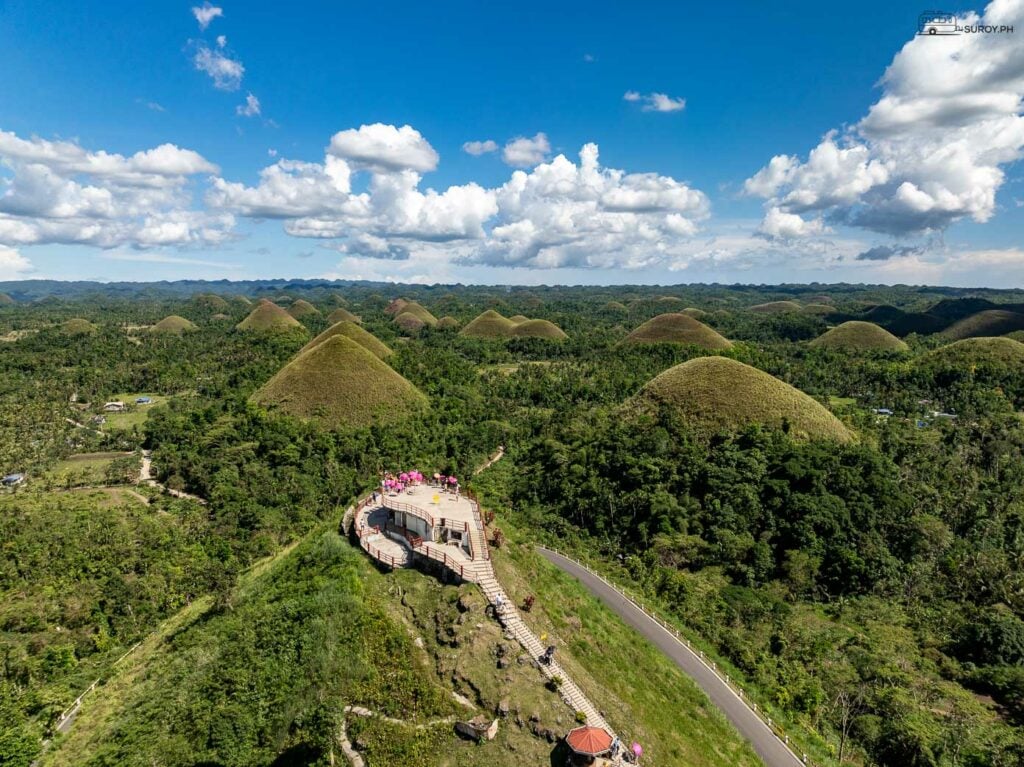
Chocolate Hills Complex, Carmen. The government viewing deck. This is the one that means the Chocolate Hills and it is open. Commonly listed at 8:30 to 17:30 daily, though sources disagree and no official page states hours plainly, so treat the early end as soft.
Chocolate Hills Adventure Park, also Carmen. A separate private attraction with its own gate and its own ticket. Guides blur the two constantly. If you want the classic view from a deck, you want the complex, not the park.
Sagbayan Peak. Closed. A notice at the site reads that it is closed to all commercial activities for non-compliance, and it has been since at least April 2025. Its reviews stop in early 2020. Guides updated as recently as August 2026 still list it at ₱50 and recommend it as the quieter alternative. It is not an alternative. Do not build a day around it.
Captain’s Peak, Sagbayan. Closed since 14 March 2024 and derelict since, the slides dismantled and the pool grown over.
Bud Agta. The scaffolding-and-timber staircase to the viewing deck was demolished in 2024.
That leaves the complex. Confirm Sagbayan Peak yourself if it matters to your plan, because a reopening would not necessarily be announced anywhere a search engine sees.

The access road
A 139.45 meter section of the road up to the view deck was wrecked by heavy rain from three consecutive typhoons, Tino, Uwan and Verbena, across late 2025. A ₱6.3 million rehabilitation started in January 2026 on an 81 day timeline, which puts nominal completion around late March. During the works traffic ran single lane, alternating.
Whether it is finished has not been confirmed. The timeline says yes. Ask when you book a driver.
When they are actually brown
The honest version, which nobody publishes: Bohol has no pronounced dry season.
The island takes roughly 2,685 mm of rain a year. The driest month, April, still gets about 119 mm. The wettest, June, about 297 mm. March, April and May have the fewest rainy days, and that is the whole extent of the seasonality.
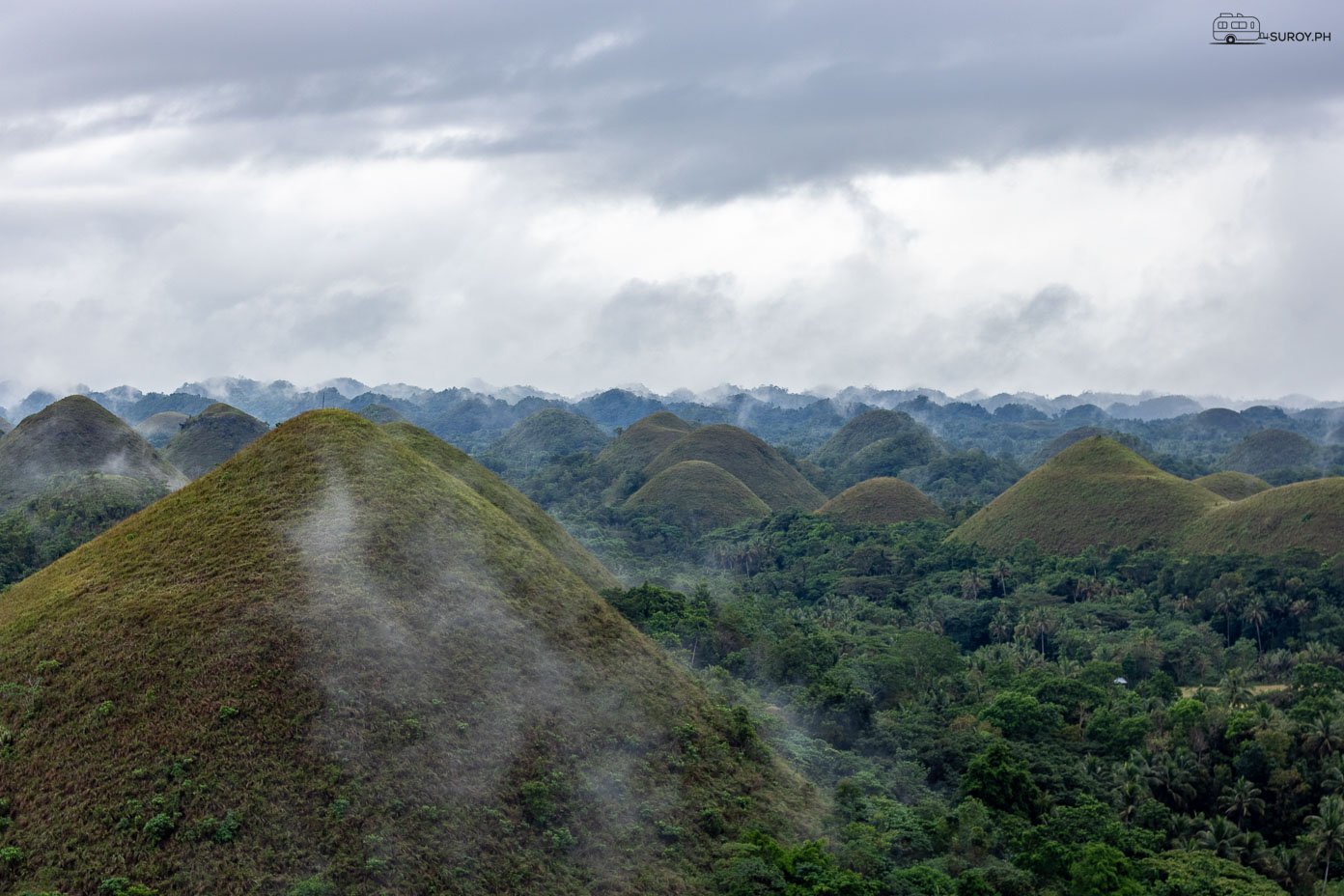
So the browning window is roughly late February through May, with April the safest single month. Not January. Not December. And not guaranteed in any given year, because in a wet season the grass simply does not cure and the hills stay green through the supposed peak.
Guides give you November to April, December to May, January to May and January to April, none of them citing rainfall. One major science outlet has it backwards entirely, describing February to May as the rainy season when it is the drier part of the year.
If the color is the reason you are going, go in April, and accept that the hills answer to the weather rather than the calendar.


Getting there
From Tagbilaran. Buses from Dao Terminal, roughly ₱50 to ₱60. Journey time is quoted anywhere from 45 minutes to an hour and a half, which is a wide enough gap to plan around the longer figure. About 55 kilometers. From Carmen town it is a short habal-habal or tricycle hop to the complex.
From Panglao. About 70 kilometers, roughly an hour and a half by road. Scooter rental runs ₱250 to ₱500 a day. A private transfer from Panglao airport is ₱1,200 to ₱2,000.
There is no direct public transport from Panglao. Not one ranking guide says this. You backtrack to Dao Terminal in Tagbilaran and start again from there, which turns a 90 minute drive into most of a morning. If you are staying on Panglao without your own wheels, hire the transfer.
From Tubigon port, arriving from Cebu, take a multicab or bus to Carmen town, then continue toward Tagbilaran and ask to be dropped at the complex.
From Jagna, the routing published by the big journey planners looks wrong and sends you through Alicia on two transfers. Ask locally or hire a van.
The steps
Around 214 to the viewing deck, which is the figure most repeated. Some sources say 200. There is no official count from the LGU or the DENR, so treat it as approximate.
It is five minutes of climbing and the deck is the payoff. Nothing about it requires fitness beyond ordinary stairs.


How many hills, and the UNESCO thing
1,776. That is the number written into Proclamation No. 1037, signed 1 July 1997, which set the hills aside as the Chocolate Hills Natural Monument across 14,145 hectares. It is corroborated by peer-reviewed karst geomorphology, and it is the figure live legislation still uses.
Older travel sources give 1,268. That number has no traceable survey behind it and the site that popularised it hedges in its own wording. Worth saying plainly: no modern LiDAR census of the hills is public, and in karst terrain where one hill ends and the next begins is a judgement call. 1,776 is the legal count, not a satellite-verified one.
And the correction most guides need: the Chocolate Hills are not a UNESCO World Heritage Site. They were put forward for consideration in 2006 and remain on the tentative list. What they are is a geosite within the Bohol Island UNESCO Global Geopark, designated in May 2023, the first in the Philippines. Different program, different meaning, and the distinction matters to the people who fought for the designation.

Suroy Wear · Island Series
The hills, and the thing watching from the trees
The Bohol Icon tee puts these hills next to the tarsier, which is the other reason people come and usually the same day trip.
Bohol Icon Tee
Quick answers
How much is the Chocolate Hills entrance fee in 2026?
₱150 for adult non-residents, ₱75 for Bohol resident adults, ₱75 for children 6 to 12, ₱25 for resident children, free under 5. Effective 1 October 2025 under Carmen Ordinance No. 27 s. 2023. Cash.
Is Sagbayan Peak open?
No. Closed to commercial activities since at least April 2025 for non-compliance. Guides still recommending it have not checked.
When are the Chocolate Hills brown?
Roughly late February to May, with April the best single bet. Bohol has no true dry season, so it is a tendency rather than a schedule, and in a wet year they stay green.
How do I get to the Chocolate Hills from Panglao?
About 90 minutes by road. There is no direct public transport. Either hire a transfer at ₱1,200 to ₱2,000, rent a scooter, or backtrack to Dao Terminal in Tagbilaran and take a Carmen bus.
How many steps to the viewing deck?
About 214. No official count exists.
Are the Chocolate Hills a UNESCO World Heritage Site?
No. They are on the tentative list and have been since 2006. They sit inside the Bohol Island UNESCO Global Geopark, designated 2023.
How many hills are there?
1,776, per the 1997 proclamation that protects them.
Planning BoholThe Bohol travel guide has the countryside loop in running order, the east side the day tours skip, and the three viewpoints that are closed. Price your own trip with the Bohol budget calculator.