

Moalboal Travel Guide 2026: The Sardine Run, the ₱100 Fee, and the Beach That Isn’t
The floor drops away about twenty meters from shore.
That is Moalboal in one measurement, and it explains almost everything else about the town. There is no long wade here, no boat ride out to the good part. You cross a shelf of rock in front of the dive shops, put your face in the water, and the reef edge simply ends. Below it is open blue, and somewhere in that blue, most days, is a wall of sardines the size of a building.
It also explains why Moalboal disappoints the people who come for the wrong thing. This is not a beach holiday. The famous strip has almost no sand on it. Come for the water and it is one of the best value stretches of coast in the country. Come for a sun lounger and a cocktail on powder, and you have booked the wrong barangay.
Here is the current version, with the fees and fares checked in August 2026.
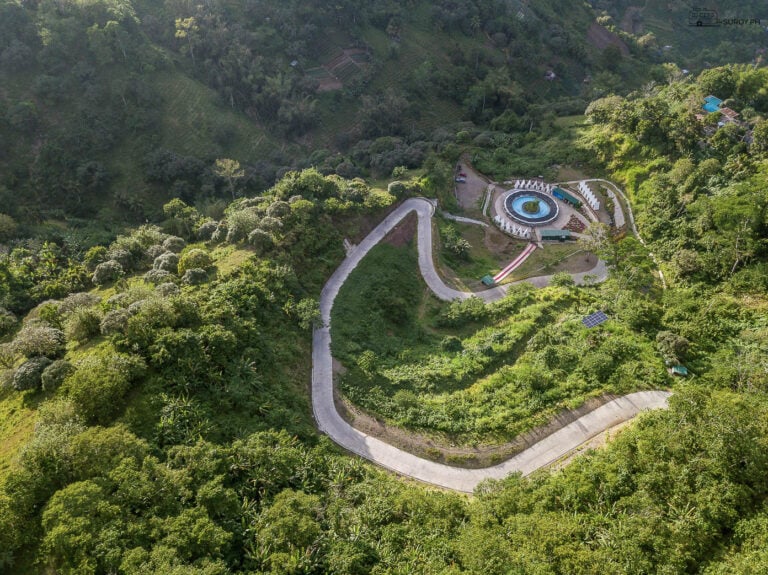
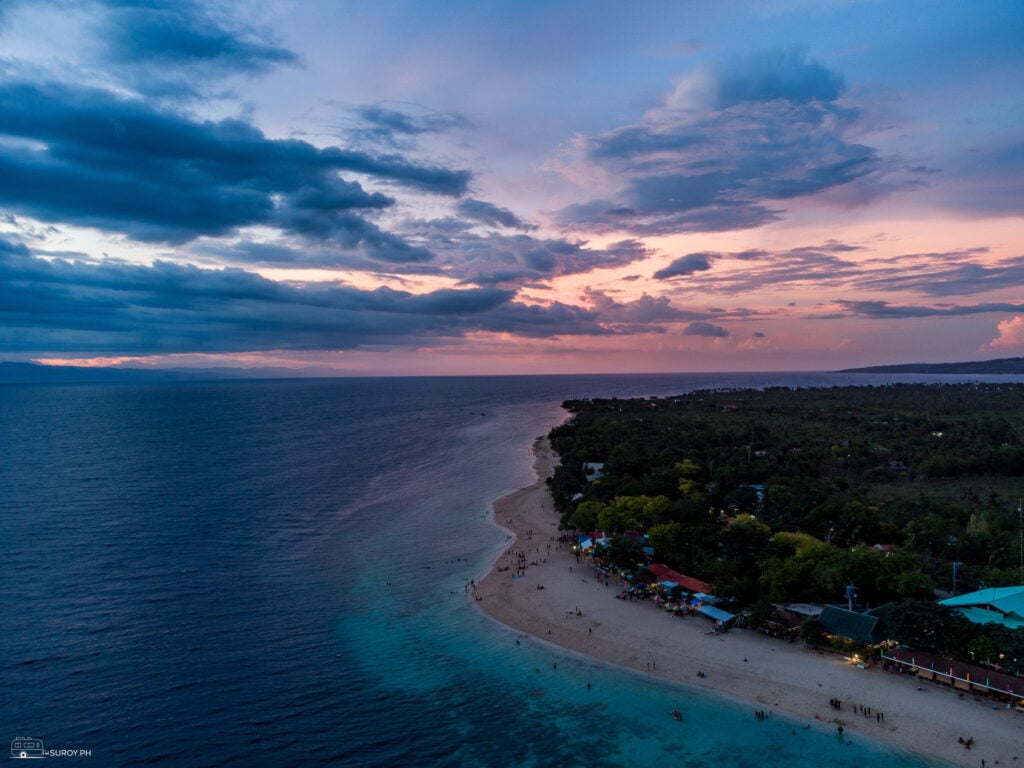
Basdaku, Saavedra, Moalboal · 9.9837° N, 123.3682° E · DJI Mavic 4 Pro, 1 March 2026, 5:42 PM
The sardines, and the part nobody tells you
They are there right now. They are there most days, all year, and they have been for about fifteen years.
That is the first correction, and it is small. Calling it a “run” borrows the name from South Africa, where sardines genuinely migrate up the coast on a season. Moalboal’s fish do not run anywhere. They hang off the drop-off at Panagsama as a resident baitball, and the reason guides give you a best season is water clarity and crowd size, not whether the fish will be home. November to May is the calmer, clearer half of the year. The sardines do not care.

The second correction is much bigger, and it is the reason to go sooner rather than later.
They have vanished before. In December 2011 the school disappeared from Moalboal and stayed gone for roughly seventeen months before turning up again out at Pescador Island. In August 2023 they were absent for weeks. Rumours in early 2023 that they had left for good were serious enough that dive operators on the strip had to publicly deny them.
And they are not an ancient fixture. Bait balls of this kind were not documented at Moalboal in the early 2000s. The aggregation is an anomaly nobody has fully explained: the leading guesses are plankton shifts driven by warming water, or reduced predation because the bigger fish were caught out of the system. Nobody knows why they came. Nobody knows how long they stay.
Which is a strange thing to love about a place: the best thing in the water is the thing with no guarantee attached. That is most of why it ended up on a shirt, the Moalboal Sardines Run Tee.
You will also read that a typhoon pushed them in from Pescador. Nothing published names the typhoon or dates the move. It is a story people tell, and we are not going to repeat it as a fact.
The species is the Indian oil sardine, tuloy locally. There is a closed fishing season on them from 15 November to 15 February. In September and November 2024 large numbers beached themselves at Panagsama, twice, which sounds alarming and which BFAR-7 read as a sign of a replenishing population rather than a collapse.
How to actually see them. Swim out from the Panagsama seawall, twenty to thirty meters, to where the reef edge falls away. The fish sit shallow, roughly one to ten meters down, so a snorkel is genuinely enough. No boat needed, no guide needed, though a guide runs ₱300 to ₱500 if you want one. Go before seven. The water is flatter, the strip is asleep, and you get the drop-off to yourself. (Checked August 2026.)

Panagsama, Basdiot, Moalboal · 9.9482° N, 123.3680° E
What it costs to get in the water, and the rule with a fine attached
There is a ₱100 environmental user fee to swim at Panagsama. Not to lie on the sand, to enter the water. A separate ₱25 beach fee is collected in places, and published accounts differ on whether the two are alternates or stack, so carry ₱125 and expect one or both.
Collection is inconsistent. Get in before about half six and there is often nobody at the desk yet. That is an observation, not a loophole, and pages still telling you swimming here is free are describing 2021.
The fee exists because of a municipal ordinance passed on 27 September 2021, which regulates snorkelling and island hopping across Pescador Island and the municipality’s marine protected areas. It is worth knowing what else is in it.
Section 20 lists thirteen violations. Touching any marine life is one of them. The fine is ₱2,500.
That is not decoration. In March 2024 a video circulated of a tourist handling a green sea turtle at Panagsama, and Mayor Inocentes Cabaron issued a public warning off the back of it. The rule gets enforced when someone gets filmed.
All of this sits inside the Tañon Strait Protected Seascape, 5,182 square kilometers, the largest marine protected area in the Philippines. The strait is the water between Cebu and Negros, and you can see the far side from the beach.
There is no published cap on how many people can be in the water at once, and no rule against swimming through the baitball. We looked. (Checked August 2026.)
Panagsama is not a beach
Say it plainly, because a lot of people book here on the strength of photographs and arrive confused.
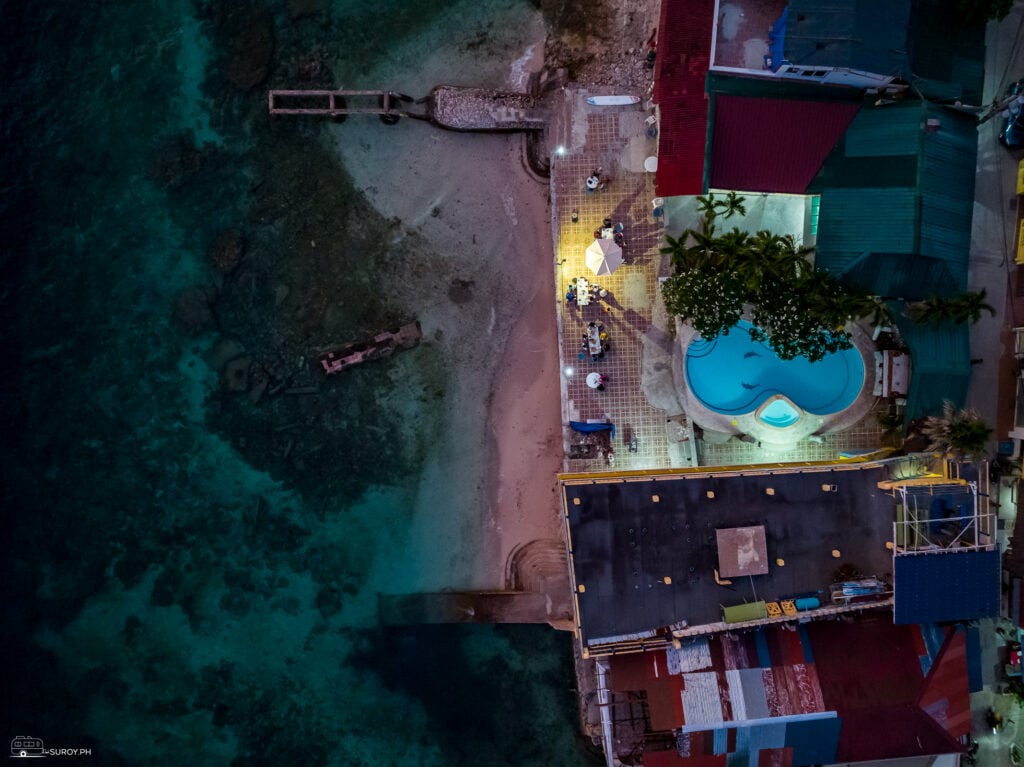
Panagsama, in Barangay Basdiot, is a dive-and-bar strip along a seawall. There are pockets of sand in a couple of small coves and that is the extent of it. Water entry is over rock. There is no lifeguard, and there is real boat traffic just off the wall, so keep your head up when you surface.
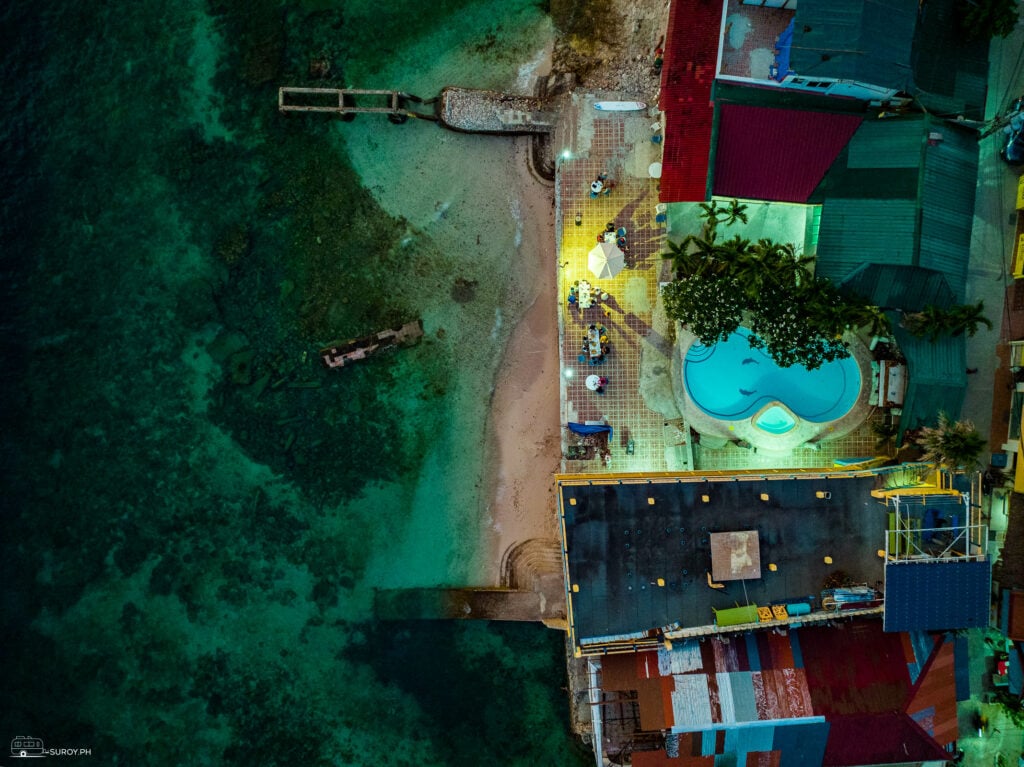
What is actually there is the reason to stay: the dive centers, most of them within five hundred meters of each other, the restaurants, the bars, the guesthouses, and a house reef you can walk into. Some accounts say a typhoon in 1984 took the original sand away, though the only telling of that is undated and we would not print the year as settled.
There is a nice local reading of the two names, and it holds up even if no official record confirms it. Bas is sand. Diot is small, daku is big. Basdiot, small sand. Basdaku, big sand. The names tell you exactly what you are getting.
Basdaku, the beach that is a beach
Barangay Saavedra, not Basdiot, and roughly seven kilometers up the coast from Panagsama, about fifteen minutes on a motorbike.

This is the white sand everyone pictures when they say Moalboal. Somewhere between one and two kilometers of it depending on where you take the measurement, powdery, west facing, with the sun going down into the Tañon Strait and Negros on the horizon.
There are several private frontages rather than one gate, so rates vary a little by where you walk in:
| Entrance | ₱10 to ₱20 |
| Environmental fee | ₱25, one time |
| Car parking | ₱50 |
| Motorbike parking | ₱20 |
| Table or cottage | ₱100 to ₱2,500, around ₱1,000 for a ten-seater |
| Mat or blanket | ₱100 to ₱200 |

It fills up at sunset and on weekends when the day-trippers come down from the city. A weekday late afternoon is a different beach entirely. (Checked August 2026.)
Turtles
Green sea turtles live on the same shelf as the sardines, grazing the seagrass in the shallows off Panagsama. Swim parallel to the wall rather than straight out and you will usually find one.

Usually. Any page giving you a percentage made it up.
Approach from the side, never from above, and do not touch. That is the ₱2,500 one.
Pescador Island
Three to three and a half kilometers offshore, about fifteen minutes by boat from Panagsama. Declared a marine park and fish sanctuary by the municipality in 1990.

The draw is the wall, which drops to around thirty five meters, and the Cathedral, an open-topped underwater cave on the west side that recreational divers can get into. Snorkelling works on the shallow reef top, though the shallows above about ten meters were scoured by Typhoon Odette in December 2021 and there was still little regrowth in September 2025. The deeper wall came through it far better.
The park fee is the same ₱100 per person per dive, collected by the dive shops on the ticket system. Boat hire for a snorkel run was ₱200 to ₱500 depending on demand, or around ₱550 per person for a ninety minute trip with gear, though that figure is from 2024 and worth confirming on the strip. There is no published visitor cap. (Checked August 2026.)
Diving
Moalboal is a cheap place to dive well, which is most of why the town exists in its current form.
A fun dive runs ₱1,400 to ₱2,100 depending on operator and whether it is shore or boat, plus the ₱100 park fee, plus gear if you need it at roughly ₱350 a dive or ₱750 a day. Savedra sits at the lower end, Cebu Fun Divers at the upper. Open Water certification is quoted anywhere from ₱17,500 to ₱24,900, which is a genuine spread rather than a typo, so it is worth asking two shops.

The house reef is a walk-in, which is unusual and which is why people end up staying longer than planned. Named sites along the strip: the sardine ball itself, Panagsama Wall, Pescador, the airplane wreck, Sunken Island.
We are not going to tell you how many dive shops there are. Nobody has counted and every page that gives a number invented it. (Checked August 2026.)
Kawasan Falls is not in Moalboal
It is in Barangay Matutinao, Badian, a different municipality, eighteen to twenty one kilometers south, thirty to forty five minutes away. The canyoneering route usually starts further along in Alegria, on the Kanlaob River, and comes out at Kawasan. So the activity everyone books from Moalboal spans two municipalities and neither of them is this one.
Worth knowing, because it changes how you plan the day and because the pricing is regulated by ordinances that do not apply where you are staying.
The canyoneering rate is ₱2,000 per person. Fixed by Badian Municipal Ordinance No. 11-2022 and Cebu Provincial Ordinance No. 2024-04, raised from ₱1,500 on 26 October 2023. The breakdown is published: ₱600 administrative and environmental, ₱600 to the guide, ₱400 to the operator, ₱150 food and drinks, ₱150 protective equipment, ₱100 water and energy bar. Transport is on top, roughly ₱100 in and out. Budget ₱2,100 all in.
If someone quotes you ₱1,500, they are quoting an illegal rate. Undercutting carries municipal penalties starting at ₱1,000 per person plus community service and permit suspension, and provincial penalties up to ₱5,000 and a year’s imprisonment. Guides can lose accreditation. A cheap quote is not a bargain, it is a shop putting its license and your guide’s livelihood on the table.
Kawasan Falls on its own, no canyoneering, is ₱200 for access to the first basin, covering about three hours. Pages still saying ₱50 or ₱100 are years out of date.
And the safety record, because no other guide carries it.
- May 2024: a 26 year old Irish visitor collapsed after two jumps at Barangay Sulsogan and died of acute myocardial infarction. The rescue took around two hours and the local disaster office publicly identified poor mobile signal in the canyon as the key failure, requesting handheld radios and antennas.
- 23 October 2025: a boulder fell fifteen to twenty feet onto the Matutinao route and struck a guide, Ritjel Baldivino Aspacio. Abrasions and bruised ribs, no fractures.
- 26 October 2025: canyoneering suspended for inspection and clearing. One day cost an estimated ₱1.2 million across 44 operators and 1,303 registered guides. Kawasan itself stayed open. Reopened 28 October.
- 4 November 2025: Typhoon Tino. Southern Cebu tourism resumed within days and Moalboal reported no casualties, but Kawasan and canyoneering were still closed for clearing on 6 November.
- 22 June 2026: Kawasan open, inside a ₱110 million provincial rehabilitation program following Tino. No completion date has been published.
Accredited guides, helmets and life vests are mandatory, and activities suspend on heavy rain or flood risk, with a last start of about 2:00 PM.
Confirm before you go. Canyoneering’s operational status for August 2026 has not been published anywhere we could find. Badian Tourism is on 0965 957 1349. (Checked August 2026.)
Getting to Moalboal from Cebu City
About 89 kilometers, roughly three hours, and the bus is genuinely the sensible option.

| From | Cebu South Bus Terminal, Natalio Bacalso Avenue, beside CityMall |
| Operator | Ceres Liner, the yellow ones |
| Fare | ₱209 to ₱210 aircon, ₱170 ordinary |
| Time | 3 to 4 hours |
| Frequency | Direct Moalboal buses roughly every three hours from 06:00. The Bato via Barili service is far more frequent, every half hour from about 03:00 to 18:30, and drops you at Moalboal |
| Arrival | The stop by the public market in Poblacion |
Take the Bato via Barili bus. Waiting for a direct service is how people lose two hours at a terminal. More on the terminal itself in the Cebu bus terminal guide.

Vans run about ₱180 and around three hours, leaving when full between roughly 04:00 and 19:00, arriving at the V-hire terminal across from the municipal hall. A taxi from Mactan airport was ₱2,000 to ₱2,500 as of 2024 and that figure is old enough to treat as a starting point rather than a price.
No 2026 fare adjustment on these routes has been published either way, so treat the fares above as August 2026 and expect drift. (Checked August 2026.)
From the bus stop: habal-habal to Panagsama or Basdaku is about ₱50. A tricycle is ₱100 to ₱200 for the vehicle. Shared tricycles around Panagsama run about ₱20 a head.
Getting around
A scooter is ₱300 to ₱500 a day and it is the difference between seeing one barangay and seeing the coast. Basdaku, Panagsama and the town are spread across seven kilometers and the road between them is fine.
If you are not riding, habal-habal covers everything for ₱50 to ₱150 a hop.
Where to stay, and which side
Panagsama if you are here for the water. Everything is walkable, the reef is at the end of the street, and the food and bars are all on the strip. Accept that there is no beach.
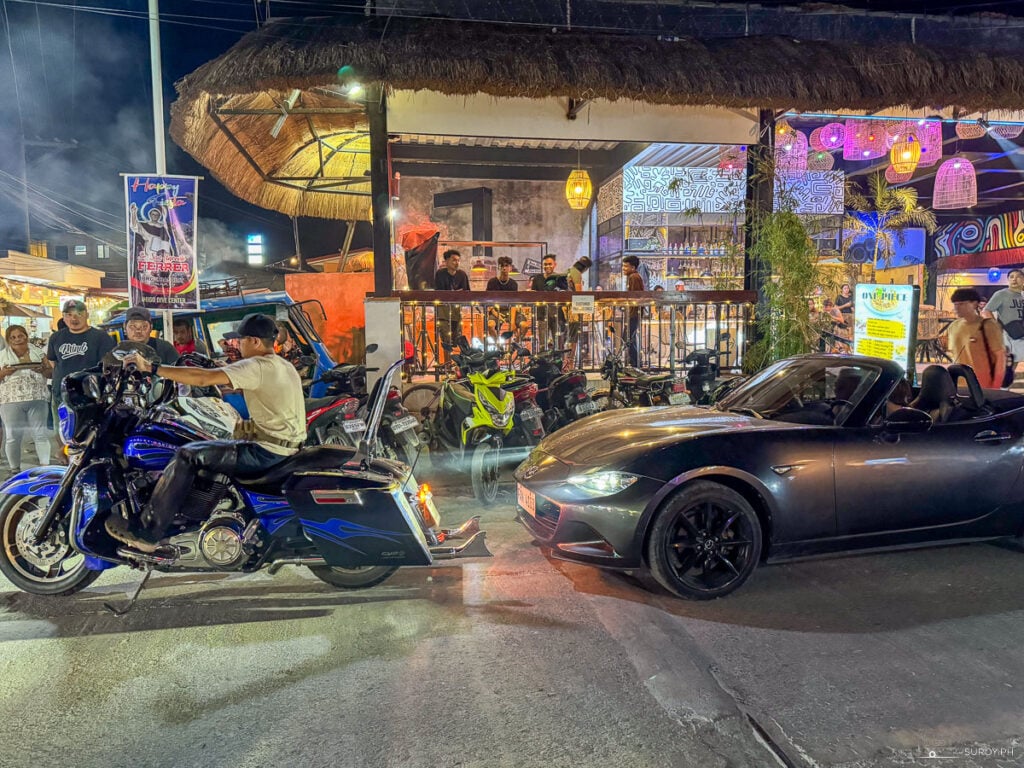
Basdaku if you want sand and quiet and do not mind riding to dive. It is the better call with kids.
Budget rooms run ₱400 to ₱800 a night on either side, mid-range ₱1,500 to ₱3,000. Meals are ₱100 to ₱150 at a carinderia, ₱300 to ₱500 a day if you eat cheap, ₱600 to ₱1,000 if you eat on the strip. (Checked August 2026.)
What three days actually costs
| Budget, guesthouse, scooter, local food | ₱1,200 to ₱1,800 a day |
| Comfortable, aircon, restaurants, one dive | ₱3,000 to ₱4,500 a day |
| Scooter | ₱300 to ₱500 a day |
| Water entry at Panagsama | ₱100, plus ₱25 in places |
| Fun dive, all in | ₱1,500 to ₱2,200 |
| Canyoneering, if you do it | ₱2,100 |
Best time to go
November to May is the Amihan, drier and clearer, and the visibility off the wall is at its best. June to October brings the habagat, which in southwest Cebu means rain in bursts, cheaper rooms and thinner crowds, and the occasional day when the boats stay in. The sardines are there either way.
Sea state decides more than rainfall does here. More in the August habagat guide and the best time to visit the Philippines.
Frequently asked questions
Is the Moalboal sardine run seasonal?
No. The school is resident at Panagsama and present most days year round. November to May gives you clearer water and calmer seas, which is what the “best season” advice is actually about. Worth knowing that the sardines have disappeared before, for about seventeen months from December 2011, and nobody has fully explained why they are there at all.
Do you need a boat to see the sardine run?
No. Swim out twenty to thirty meters from the Panagsama seawall to the drop-off. The fish sit one to ten meters down, so snorkelling is enough. A guide is optional at ₱300 to ₱500.
How much does it cost to swim at Panagsama?
₱100 environmental user fee, established under the municipal ordinance of 27 September 2021. A ₱25 beach fee is collected in some places. Carry ₱125.
Does Panagsama Beach have sand?
Barely. It is a seawall and rock shoreline with a couple of small sandy coves, and water entry is over rock. Basdaku in Barangay Saavedra, fifteen minutes north, is the actual sand beach.
Basdaku or Panagsama?
Panagsama for diving and the reef, Basdaku for sand and sunsets. Seven kilometers apart, so you can do both from either.
Is Kawasan Falls in Moalboal?
No. Kawasan is in Barangay Matutinao, Badian, eighteen to twenty one kilometers south, and the canyoneering route usually starts in Alegria. Thirty to forty five minutes each way.
How much is canyoneering at Kawasan?
₱2,000 per person, a regulated rate set by Badian and provincial ordinance since 26 October 2023, plus about ₱100 transport. Quotes below ₱2,000 are illegal and carry real penalties for the operator.
How do you get to Moalboal from Cebu City?
Ceres Liner from Cebu South Bus Terminal, ₱209 aircon or ₱170 ordinary, three to four hours. Take the Bato via Barili service, which runs every half hour, rather than waiting for a direct bus.
Can you touch the turtles?
No, and it is not just etiquette. Touching marine life is one of thirteen violations under the 2021 municipal ordinance and the fine is ₱2,500. It was enforced publicly in March 2024.
Can you fly a drone in Moalboal?
There is no local ordinance or marine park drone restriction on record. National rules apply: 400 feet, daylight, line of sight, thirty meters from uninvolved people, ten kilometers clear of airports. Registration thresholds are reported inconsistently, so check CAAP directly rather than a blog, and ask the tourism office or your resort, since local rules do not always reach the internet.
Where to next
- Kawasan Falls in Badian, the day trip everybody books from here
- Osmeña Peak in Dalaguete, the other genuine day trip and the highest point on the island
- Siquijor, since Moalboal down the south coast and across is a real route
- Oslob whale sharks and Oslob paragliding, the other side of the south loop
- Cebu lechon, for the Carcar stop on the way back
- The Cebu map, every place on the island worth the ride
Millions of them, moving as one.
Twenty meters off Panagsama, a wall of sardines that nobody can explain and nobody can promise will be there next year. Go and see it. Then wear it.
Island Series · Made in the Philippines
Wear the storyFees, fares and operating status on this page were checked in August 2026. Philippine transport fares move without notice and canyoneering suspends on weather. Confirm before traveling.