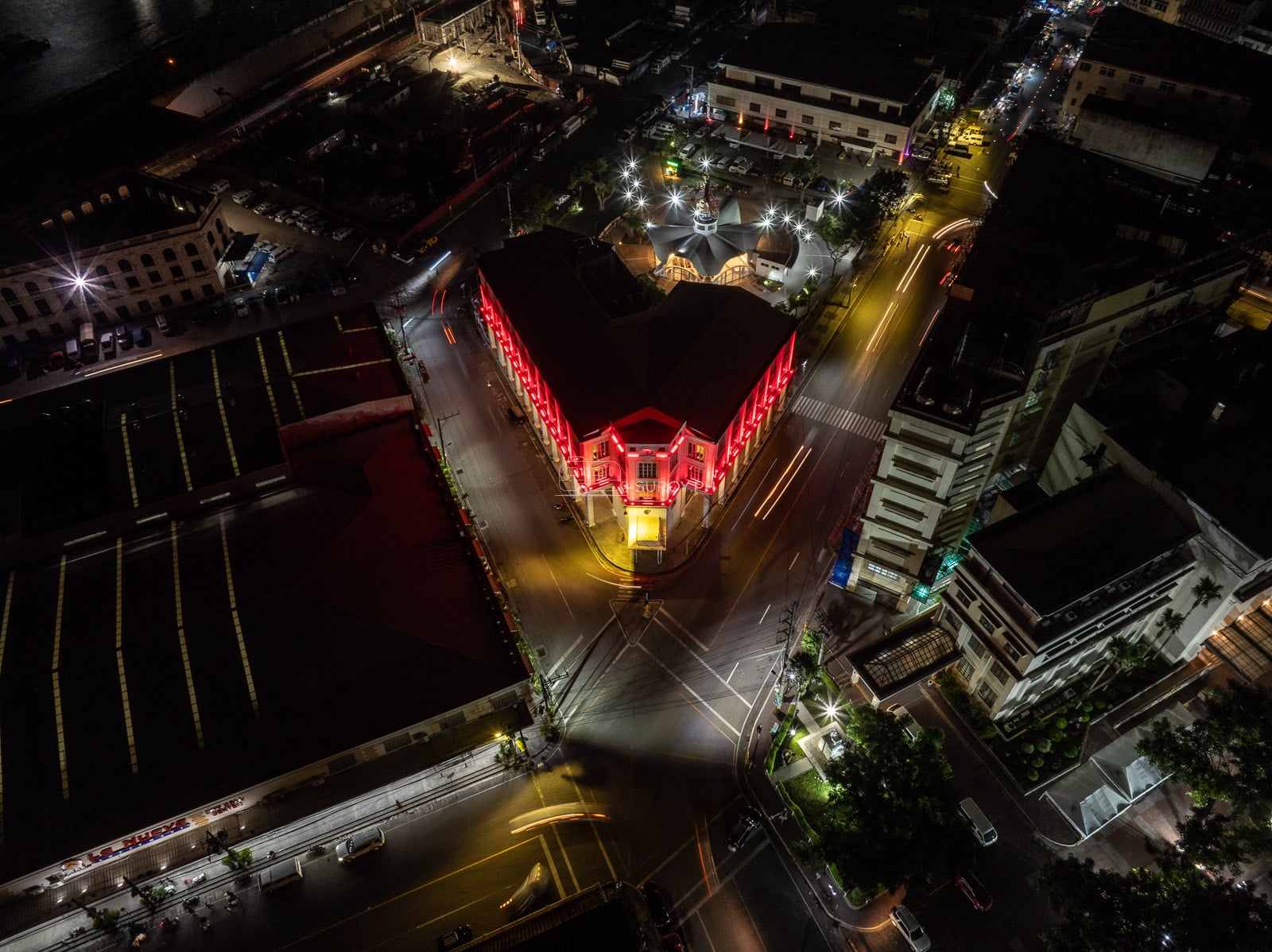

Two buildings went up here in the 1910s. Only one still has a roof.
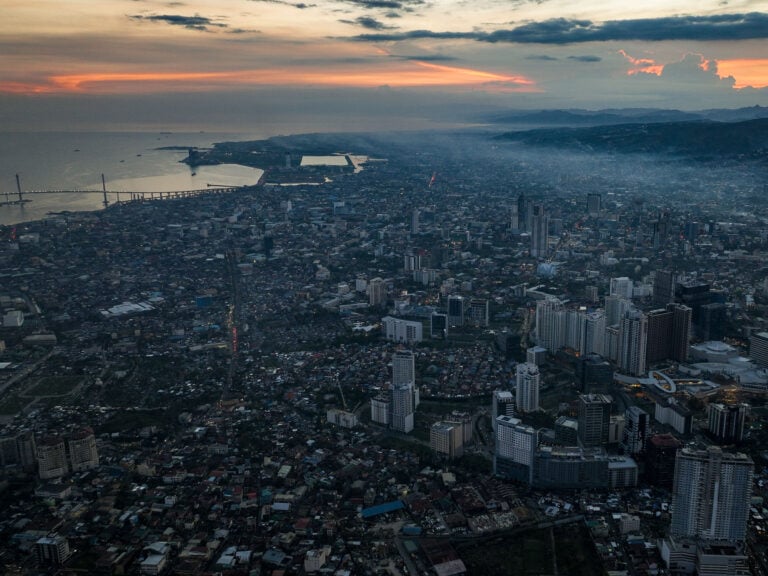
From directly overhead at nine on a January night, the corner of M.C. Briones and P. Burgos looks like a red arrowhead pointed at the sea. The Gotiaoco Building sits in the notch where the two streets fork, three storeys of 1914 masonry with LED strips run down every pilaster, and the traffic streaks past both flanks of it in long orange lines. Pan the drone forty seconds north and the next heritage building on the waterfront has no roof at all.
That is the whole story of Cebu’s port district in two frames. Two buildings, both put up in the 1910s, both survivors of the same war, standing a short walk apart. One of them takes a ticket at the door. The other one takes trucks.
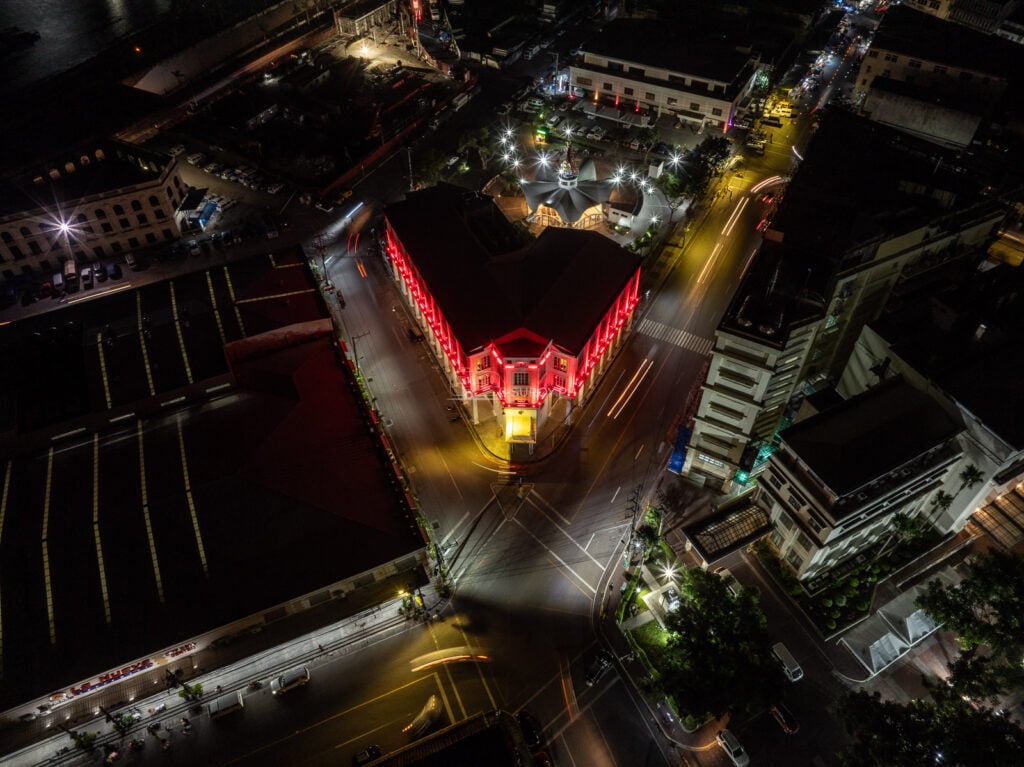
The one with the lights on it
The wedge is the Gotiaoco Building. Manuel Gotianuy had it built in 1914 and named it for his father, Don Pedro Gotiaoco, the Chinese trader whose business line runs forward to a good deal of what Cebu buys and sells today, and whose descendants turn up on any honest list of prominent people with Cebu roots. At four storeys it was the tallest thing in the city when it went up, and it carried the first elevator anybody here had ridden.
Look at the top-down frame again and you can see why the shape is what it is. The building was not designed around a plot. It was designed around a junction, the way flatirons everywhere are, and the sharp end has the entrance in it.
Since its restoration it has housed the Sugbu Chinese Heritage Museum. Ground floor carries the building’s own history and a replica trading junk loaded the way those boats were actually loaded, with tea and spices and ceramics. The mezzanine is built as a Chinese immigration office. The floors above it work through what Chinese families contributed to this city, period by period, with rotating shows of ceramics and clothing.
The name on the frieze is still there, cut into the stone above the third floor. In the red light it takes a second to resolve. GOTIAOCO BUILDING, in the raised capitals of a period when a family put its name on a wall and expected the wall to outlast the family.

The one without a roof
The Compañía Marítima Building went up in 1910 on land reclaimed for Cebu’s new port, and it was not called that at first. It was the Fernandez Building, put up by Fernandez Hermanos Inc. Three storeys of neoclassical along Quezon Boulevard between P. Burgos and Lapu-Lapu, arched windows in a long rhythm, pilasters, sculptured railings. An architect once described the facade as reading like a Renaissance palazzo, which sounds generous until you see the arcade in daylight.
The Manila Steamship Company took the ground floor. By the 1930s the whole building was the Shamrock Hotel, which is exactly the business you would run in a building this close to a pier full of arriving passengers. It took bomb damage in the war, was repaired, and became the head office of Compañía Marítima de Cebu, a shipping firm founded in 1886 and one of the biggest in the country before the war.
The company went bankrupt in 1980 and the building was left. Typhoon Ruping took the roofs in 1992. The 2013 earthquake did structural damage and the city declared it off limits. It has since been a parking lot, a store for fruit and vegetables, a place where seven truckloads of garbage accumulated before the city hauled them out, and, since 2016, temporary housing for Sinulog pilgrims under the name Devotee City.

Ownership was disputed between the Cebu City government and the Cebu Port Authority for years. A compromise agreement was signed on 28 May 2024. The Department of Transportation has approved converting the structure into a maritime museum. As of this writing that is an approval, not a building site.
Why it is sometimes wrapped in red
If you have seen the Maritima glowing at night and wondered when it was fixed, it was not. For Christmas 2022 the city cleaned the structure, painted it, and wrapped it in a red lighted ribbon so the whole shell read as a giant gift, with lit Christmas trees standing in the window openings. They did it again in November 2023.
It is a good-looking piece of work and it is worth being clear about what it is. Decoration on a ruin is not restoration of a ruin. The roof is still gone underneath the ribbon.

What the aerials actually show
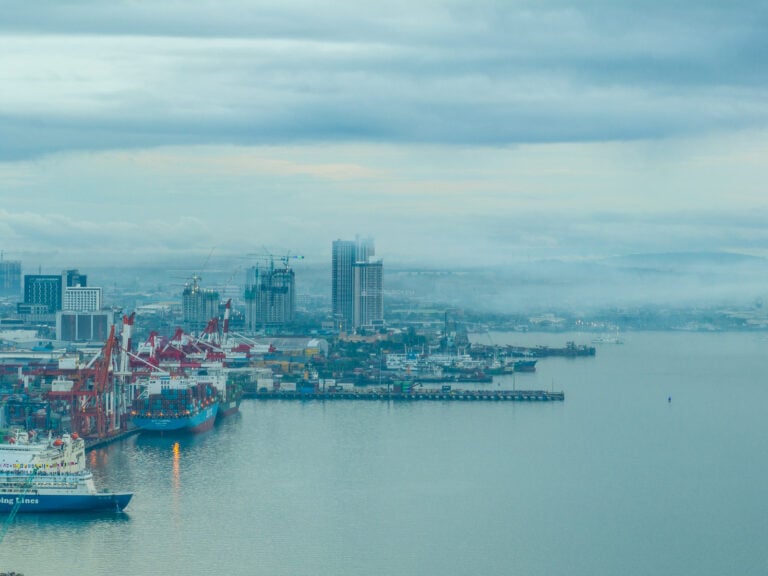
The daylight frame is the useful one. Two tiers of arched windows, no glass in any of them, no roof, and the parapet running the full length with nothing behind it. Vans and pickups parked hard against the walls on one side. Container trucks queued along the other. A crowd of people walking through the gap between the building and the warehouse next door as if it were an alley, because to them it is.
That is the honest picture of the place: not a romantic ruin behind a fence, but a very large shell that a working port has absorbed into its daily routine.
How to see both in one morning
Start at the museum. The Sugbu Chinese Heritage Museum is at the corner of M.C. Briones and P. Burgos Streets, opposite Cebu City Hall. It opens Tuesday to Sunday, 10:00 AM to 5:00 PM. Admission is ₱120 for foreign visitors, ₱75 for locals, and ₱60 for senior citizens, persons with disability and students. Checked August 2026, and worth a call before a special trip.
Then walk to the water. The Compañía Marítima is a few minutes north along Quezon Boulevard, on the port side. You cannot go in and you should not try. It is a declared off-limits structure inside an active port area with truck traffic that does not expect pedestrians. Photograph it from the road.
Fill the rest of the loop. Plaza Independencia, Fort San Pedro and Malacañang sa Sugbo all sit within the same few hundred metres, and Colon Street is a ten minute walk inland, which makes this the densest walkable heritage block in the city.

Drone rules. This is port airspace and it sits under the approach corridor for Mactan. Everything above was shot with the operator on the ground and eyes on the aircraft. Check current CAAP requirements before you launch anything here.

Frequently asked questions
Can you go inside the Compania Maritima building?
No. It has been declared off limits by the city since structural damage in the 2013 earthquake. It is roofless, missing interior walls, and sits inside a working port area. View it from Quezon Boulevard.
How old is the Compania Maritima building?
It was built in 1910 as the Fernandez Building. It became the Shamrock Hotel in the 1930s and later the head office of Compañía Marítima de Cebu, the shipping company founded in 1886 whose name stuck to it.
What is inside the Gotiaoco Building today?
The Sugbu Chinese Heritage Museum. Ground floor covers the building’s history and Chinese maritime trade, the mezzanine recreates an immigration office, and the upper floors carry Chinese contributions to Cebu plus rotating exhibits.
How much is the Sugbu Chinese Heritage Museum?
₱120 for foreign visitors, ₱75 for locals, and ₱60 for senior citizens, persons with disability and students. Open Tuesday to Sunday, 10:00 AM to 5:00 PM. Checked August 2026.
Who was Don Pedro Gotiaoco?
A Chinese trader whose business became one of the foundations of Cebu commerce. His son Manuel Gotianuy built the 1914 building on the waterfront and named it for him.
Why is the Compania Maritima lit up at Christmas?
The Cebu City government cleaned, painted and wrapped the shell in a red lighted ribbon for Christmas 2022, and repeated it in November 2023. It is seasonal decoration on a structure that has not been restored.
Photographed over Cebu City’s port district between March 2021 and January 2023. Museum hours, admission and the ownership timeline checked August 2026.