
Colon Street, Cebu: A Walking Guide to the Country’s Most Argued-Over Road
A 1.17 km strip of budget retail, ukay-ukay, phone repair stalls and jeepneys three abreast, with a derelict 1930 cinema still standing on it and a department store that reopened in July. Facts and fees checked August 2026.
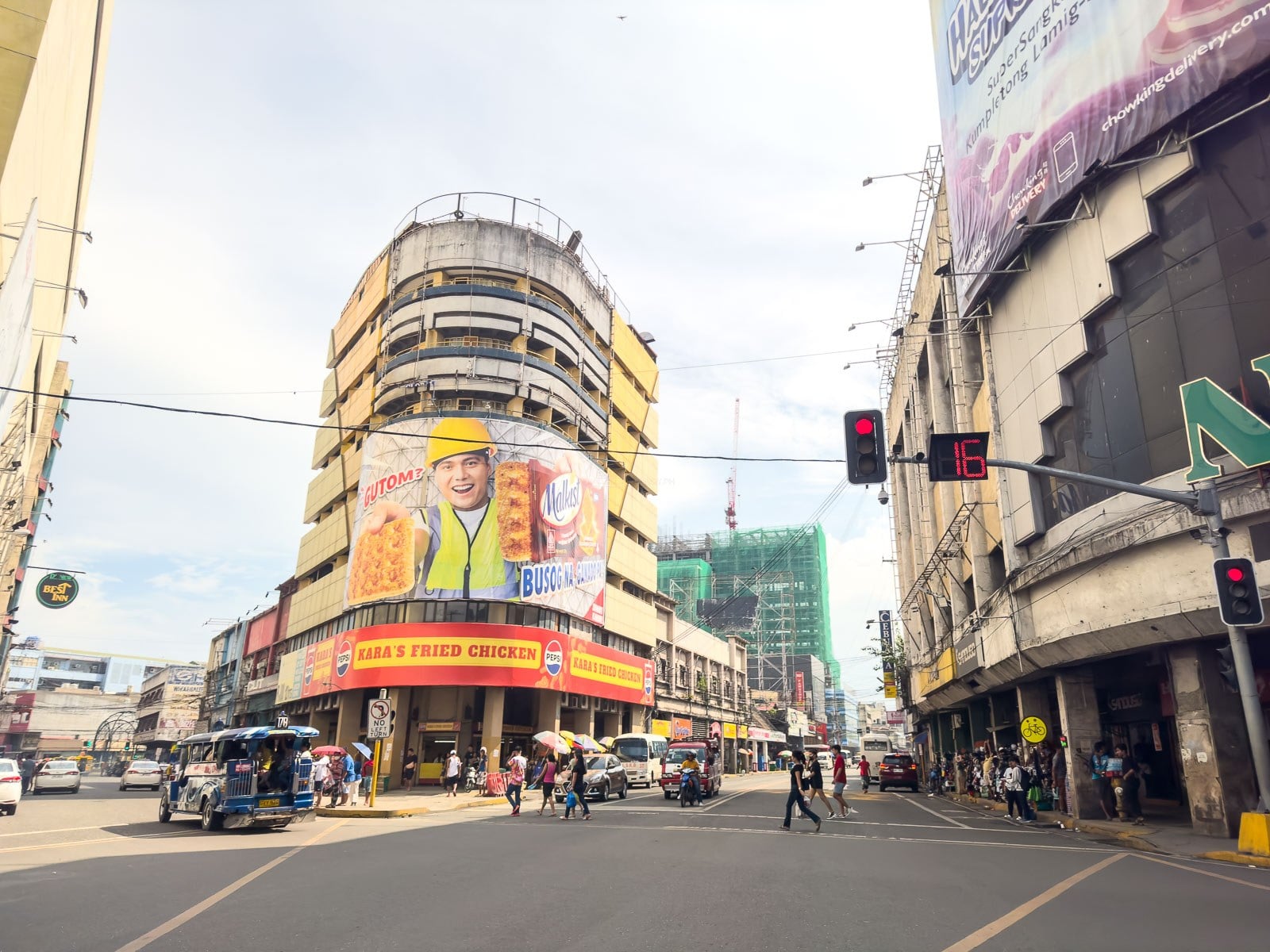
Colon Street is three lanes of jeepneys and a traffic light nobody is looking at.
The buildings on either side are doing four things at once. Ground floor: fried chicken, mobile phone accessories, a pharmacy, a bakery. First floor: a school, a dental clinic, a lending office with a hand-painted sign. Above that: shuttered windows, air conditioners, laundry. And above all of it, on the corner where Colon meets Osmeña Boulevard, a billboard for something entirely unrelated to any of it.
This is the oldest continuously commercial address in Cebu City, and it looks like it.
What Colon actually is now
A 1.17 kilometer street, classified as a national road, running roughly from Parian at one end toward the Basilica district at the other, crossing Osmeña Boulevard in the middle.
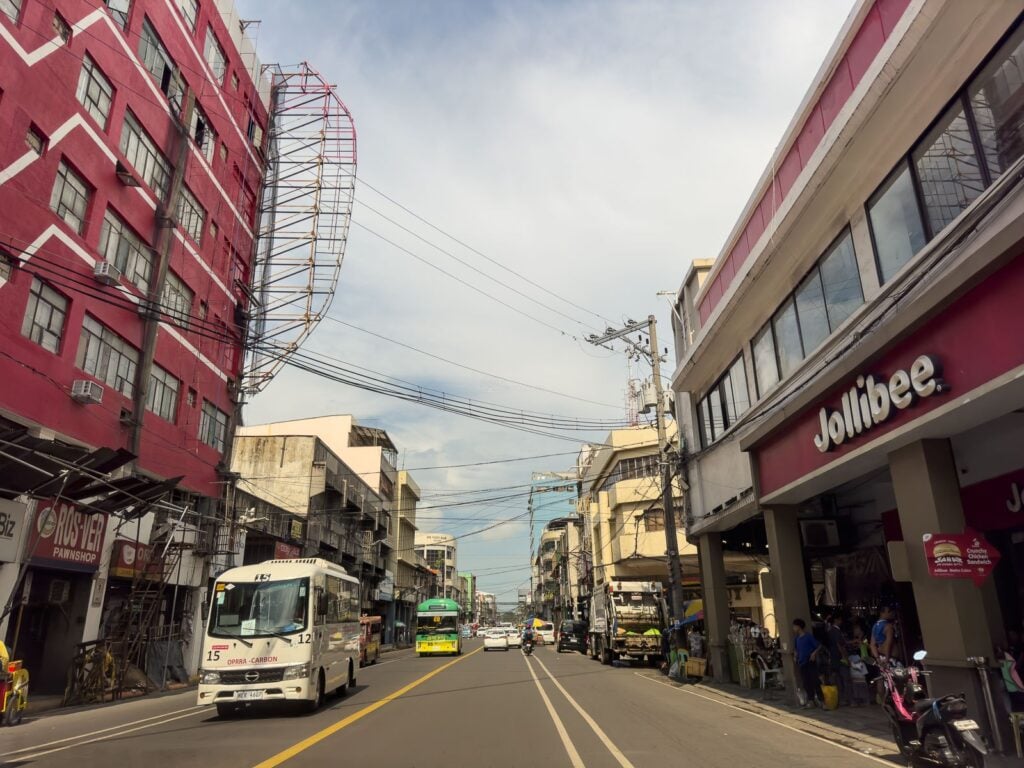
Commercially it is budget Cebu. Ukay-ukay by the rack, phone repair by the counter, fried chicken by the piece. Kara’s Fried Chicken is the institution here and has been for decades. Jollibee has a branch. Metro has a department store. Between them, several hundred small operators who have been on the same stretch for a generation.
What Colon is not, any more, is the fashionable end of Cebu. That moved uptown to Fuente and then out to Ayala and IT Park, and it is not coming back. Anyone arriving expecting a preserved heritage quarter is going to be disappointed within four minutes. Anyone arriving to see what a Philippine downtown actually looks like on a Tuesday will get exactly that.
The oldest street question
Colon is widely described as the oldest street in the Philippines, laid out in 1565 under Miguel López de Legazpi. Two government markers on this street say so, one installed in 1961 and one in 1999.
The documentary record does not support it.
What the record supports is the name. Colon is named for Cristóbal Colón, Columbus, and that has never been in dispute. Everything after that gets thinner the closer you look. No map or document places a street here in 1565. The earliest known map of Cebu City, from 1699, shows the Spanish city bounded by the Estero de Parian, which put the ground Colon sits on outside the city. The earliest surviving map that shows Colon Street itself is from 1873, more than three hundred years after Legazpi landed. And Spanish colonial town planning under the Laws of the Indies built the grid around a plaza, which in Cebu was Plaza Sugbu, not this street.
Dr. Jose Eleazar “Jobers” Reynes Bersales, the archaeologist and social historian, has made this case publicly and repeatedly, and proposes Calle Magallanes as the likelier candidate. He calls the claim the oldest fake news. The literary historian Resil Mojares documented the same origin story.
The origin of the claim is the good part. Around 1910 a Cebu shop was selling postcards to American servicemen labelled “Oldest Street in Cebu.” A photo studio later widened that to “Oldest Street in the Philippines.” In 1933 the American Express Company put the title in its Philippines guidebook, which is roughly the point at which a souvenir caption became a fact. In 1961 the government cast it in bronze.
The markers are still standing and still say 1565. No correction has been issued. Read them, then read this section again, and the street gets more interesting rather than less.
Metro, and a department store that came back
The largest building on Colon is Metro, and since July it is a different shop inside.
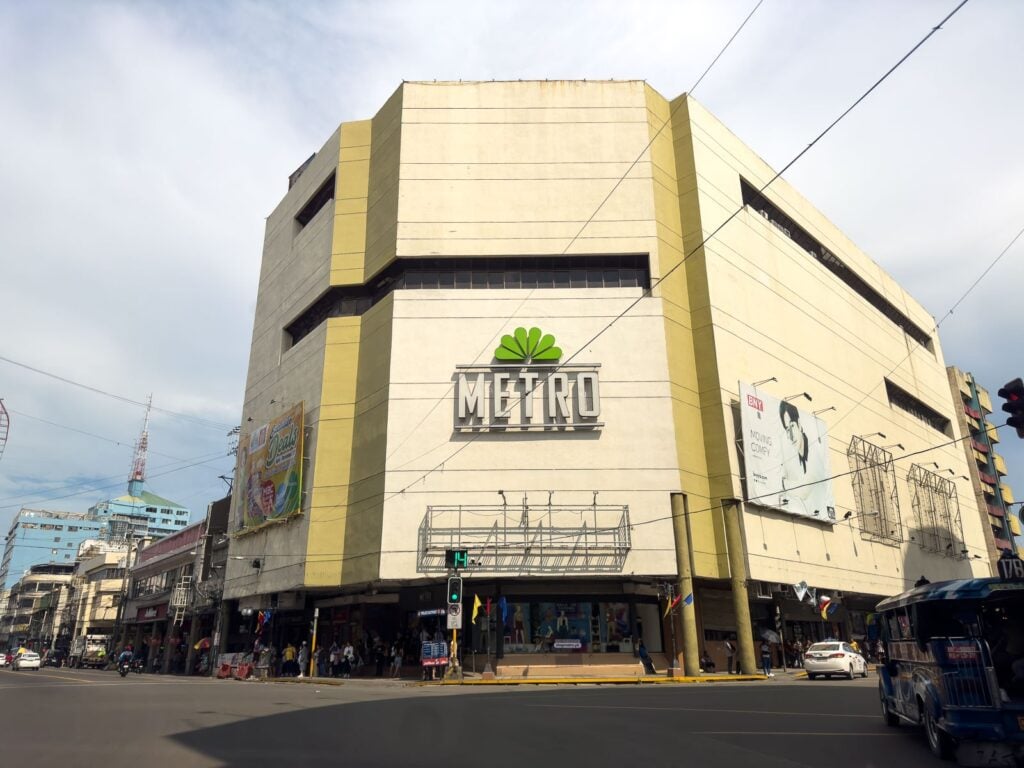
Metro Colon relaunched on 23 July 2026 after a renovation, under the line “Where It All Started, Better Than Ever.” It opened here in 1982 as Gaisano Metro across three floors. It now runs to six: refreshed supermarket, redesigned fashion floor, furniture and home moved up to the fifth, a new home improvement section and a rebuilt Food Avenue on the sixth. There is a new LED screen on the facade facing Osmeña Boulevard.
The detail worth keeping is that this is the flagship of the whole Metro Retail group, and the reason it is the flagship is that this is where the family started. At the relaunch, Margaret Gaisano-Ang spoke about keeping her parents’ dream alive and did not entirely hold it together.
A downtown that everybody agreed had been left behind has just taken a six-floor investment from the retailer that grew up on it.
Store hours are not published anywhere we could find. Call before you plan a trip around it.
Relaunch date confirmed. Hours unverified, August 2026.
The cinemas nobody watches films in
Colon was Cebu’s cinema street and most of the buildings are still standing. You will walk past them without noticing, which is the point of this section.
| Cinema | Built | Now |
|---|---|---|
| Teatro Junquera, later Cine Oriente | 1896 | Standing, converted to shops. Ornate rosettes still on the facade above the signage. |
| Teatro Empira, later Cine Ideal | 1902 | Standing. Ukay-ukay racks and phone stalls. |
| Vision Theatre | 1930, by Dante Guidetti | Standing, derelict. Survived the wartime bombing of Cebu. |
| Cinema Theater | 1950s | Converted. Now the Pedro O. Go Building, a wholesale mart. |
| Eden Theater | 1950s | Converted to a shopping arcade. |
| Cinema Royo | — | Demolished. |
We have not confirmed Vision Theatre’s state in 2026 and you should not assume it is still safe to approach. A heritage plaque program once marked many of these buildings. A 2017 survey found only twelve plaques still in place, several vandalised. Nobody has counted them since.
What is walkable from Colon
This is the practical reason to come, and it is a strong one. Colon sits in the middle of almost everything old in Cebu.
| Landmark | Walk | Fee | Hours |
|---|---|---|---|
| Yap-Sandiego Ancestral House | 3 to 5 min | ₱100, includes a family-guided tour | 8:00 AM to 5:00 PM daily |
| Heritage of Cebu Monument | 3 to 5 min | Free | Open, outdoor |
| Carbon Market | about 5 min | Free | Morning to late |
| Casa Gorordo Museum | about 7 min | ₱100 adult, ₱75 student | 9:00 AM to 6:00 PM, closed Mondays |
| Basilica Minore del Santo Niño | about 10 min | Free | Daily, masses from early morning |
| Magellan’s Cross | about 10 min | Free | Kiosk open through the day |
| Fort San Pedro | about 15 min | ₱30 adult, ₱15 student | 8:00 AM to 7:00 PM daily |
| National Museum of the Philippines, Cebu | about 15 min | Free | 9:00 AM to 5:00 PM, closed Mondays |
Every fee and every opening time in that table should be treated as indicative. Philippine museum pricing changes without announcement and the figures above come from published listings rather than from a till receipt. Two of them close on Mondays, Casa Gorordo and the National Museum, and that is the detail that will actually ruin a morning. Plan the walk for any other day.
The efficient version runs in one direction and does not double back. Start at the obelisk at the eastern end, do the Parian cluster first for the Heritage Monument, Yap-Sandiego and Casa Gorordo, then walk the length of Colon west, cut down to Carbon, and finish at the Basilica, Magellan’s Cross, then Fort San Pedro and the National Museum, which share the same corner of Plaza Independencia. Three hours at a slow pace, more if you eat, and you should.
Fees and hours checked against published sources, August 2026.
Getting there and getting around
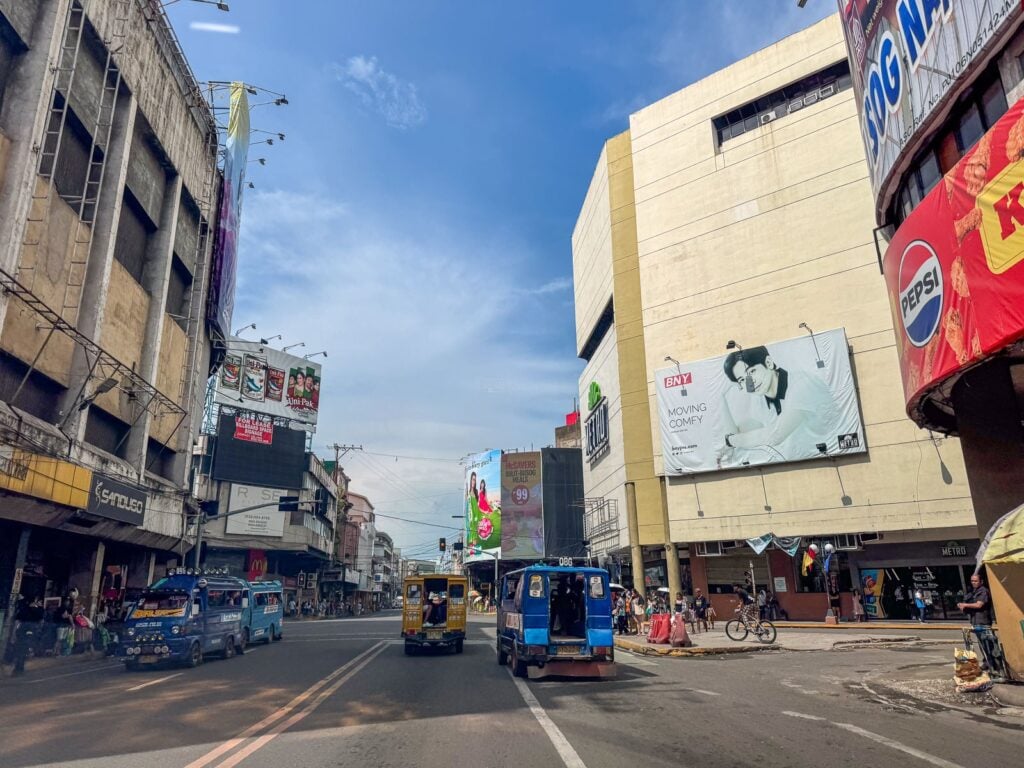
Colon Street runs 1.17 km east to west. 10.2967° N, 123.8990° E
It is one of the densest jeepney corridors in Cebu City. Something between thirty and forty route codes touch downtown, across the 01, 02, 03, 04, 06, 08, 09, 10, 11, 12, 13 and 14 series. Read the code on the windscreen rather than the destination painted on the side, and see the Cebu City jeepney guide for the full list.
Fares moved in March 2026. The national minimum went to ₱14 for traditional jeepneys and ₱17 for modern units, effective 19 March 2026. Whether Central Visayas applied that figure on the same terms is something we could not confirm from a published Cebu source. Carry coins and expect the higher figure.
The Cebu BRT began partial operations on 13 March 2026 and it does not run along Colon. Its alignment goes down Natalio Bacalso and Osmeña Boulevard toward IT Park, and the useful thing for a Colon visit is that Osmeña crosses Colon, so the nearest access is at that junction. It is free to ride under a first-year fare program. Downtown appears only in expansion plans, not in current operations.
Driving in is possible and parking is the problem. On a weekday morning, take a jeepney.
Fares and BRT status checked August 2026.
Safety, honestly
Colon has a reputation and it is worth separating what is documented from what is repeated.
What is documented: in September 2023 Police Lt. Col. Janette Rafter of the Cebu City Police Office named Colon Street specifically as a pickpocket-prone area, in the context of theft being the most common of the city’s eight focus crimes that year. That is the only official attribution to this street in the record.
What is also documented: Cebu City police reported a 24.1 per cent drop in overall crime incidents for January to September 2025 against the same period in 2024, from 4,843 cases to 3,678. No Colon-specific breakdown was published.
What is not documented: any current advisory naming Colon. Nothing from 2025 or 2026 singles out this street.
The honest read is that Colon is a crowded downtown commercial street in a large city, that theft here was a named police concern three years ago, and that citywide crime has measurably fallen since. Treat it the way you would treat any dense market district anywhere: phone in a front pocket or not out at all, bag in front on the crossings, and more attention on a December Saturday than a Tuesday morning. That is the whole of it. Anything sharper than that is describing an atmosphere rather than a number.
What is changing
Three things, at three different speeds.
Carbon is being rebuilt and it is five minutes away. A joint venture between Cebu City and Megawide is redeveloping seven to eight hectares in Barangay Ermita under a fifty-year concession, with an interim market building already housing over a thousand vendors, Freedom Park restored and reopened with its own obelisk, and a main public market building scheduled for 2026 to 2027. Completion is targeted for 2030. It is contested: vendors campaigned against the privatisation in April 2026, state auditors have questioned the terms, and a petition to halt the project was denied by the Cebu City RTC on 2 May 2026 with a wider hearing on the joint venture’s validity that followed. No source documents construction physically disrupting Colon itself.
Pedestrianisation is a proposal and nothing more. Cebu City’s planning office has published a Heritage Loop concept covering Colon and the surrounding blocks, roughly 700 by 400 meters, with perimeter parking and closures through the Sto. Niño and City Hall squares. There is no implementation date, and the council’s own transport committee head has said the city is not ready for it. Whether anything has advanced since is unverified. Do not plan a visit expecting a pedestrian street.
The night market comes and goes. Colon has hosted a seasonal night market, historically December to February, and its 2025 run became a legal and political fight over road closure permits, because Colon is a national road and closing it requires DPWH approval on top of city consent. We could not confirm its status for 2026. August is off-season regardless.
Wear the island.
The beach sits about four kilometres from the runway. One of these carries the island. The other carries the runway.
Cebu Coordinates
Island Series
₱999
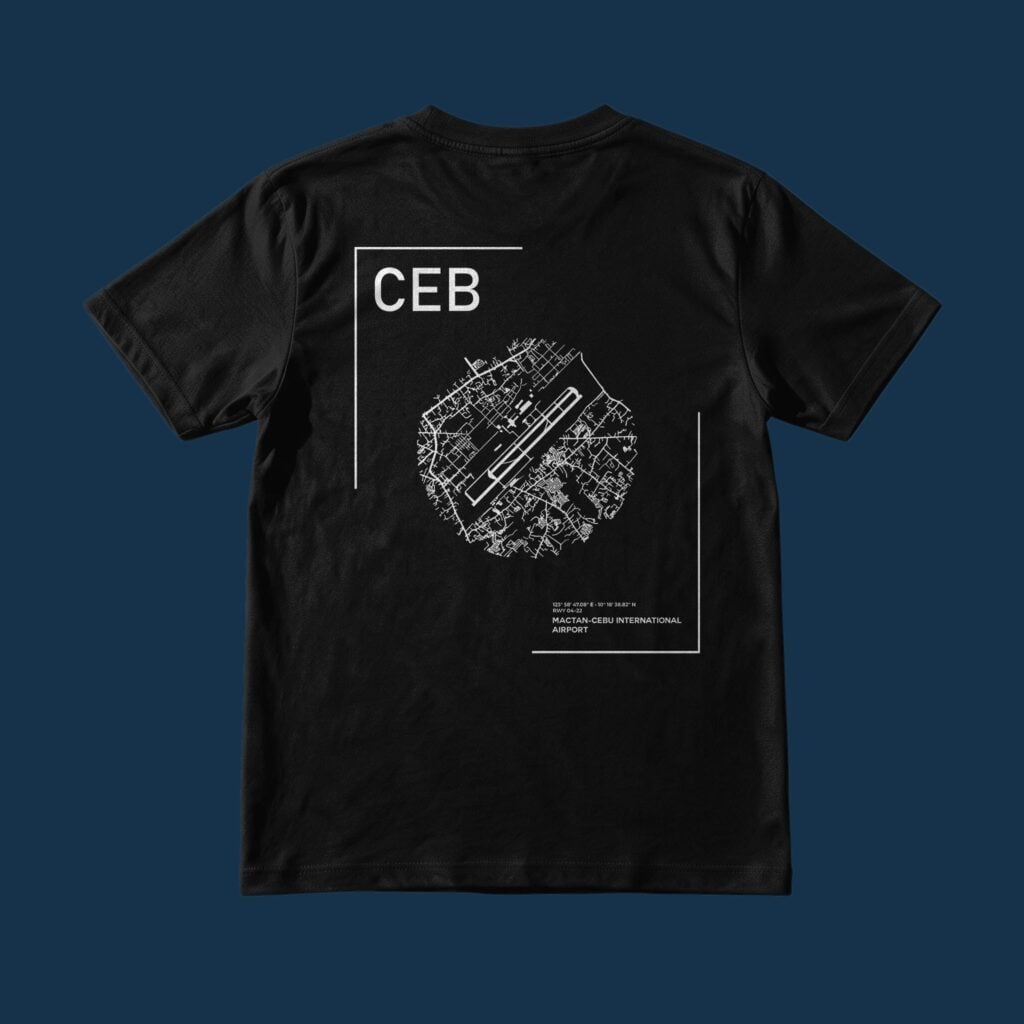
Airport Series CEB
Mactan-Cebu
₱1,299
Frequently asked questions
Is Colon Street the oldest street in the Philippines?
It is widely described that way, including on two government markers, but the documentary record does not support it. No map or document places a street here in 1565. The 1699 map of Cebu shows the Spanish city bounded short of this ground, and the earliest surviving map showing Colon dates to 1873. The archaeologist Jobers Bersales has publicly disputed the claim and proposed Calle Magallanes instead. The name honouring Cristóbal Colón is not in dispute.
Where does the “oldest street” claim come from?
A tourist postcard sold in Cebu around 1910 described it as the oldest street in Cebu. A photo studio later broadened that to the Philippines, and a 1933 American Express guidebook printed it as fact. The government installed markers repeating it in 1961 and 1999.
Is Colon Street safe for tourists?
It is a crowded downtown commercial street. A Cebu City police officer named it as a pickpocket-prone area in 2023, and citywide crime has fallen 24 per cent since. No current advisory names the street. Normal dense-market precautions are sufficient: phone away, bag in front, more care on busy weekends.
What is there to do on Colon Street?
The street itself is budget shopping and street food rather than sightseeing. Its value is position: Yap-Sandiego Ancestral House and the Heritage of Cebu Monument are three to five minutes away, Carbon Market five, Casa Gorordo seven, the Basilica and Magellan’s Cross ten, Fort San Pedro fifteen.
Is Metro Colon open?
Yes. It relaunched on 23 July 2026 after a renovation that expanded it from three floors to six. Store hours are not published in any source we could find, so call ahead.
Getting to Colon Street
By jeepney, from most parts of Cebu City. Something between thirty and forty route codes touch downtown. Read the code on the windscreen. The Cebu BRT does not run along Colon but crosses it at Osmeña Boulevard.
Jeepney fare to Colon
The national minimum rose to ₱14 for traditional jeepneys on 19 March 2026. We could not confirm a Cebu-specific published figure after that adjustment. Carry coins.
Are the old Colon cinemas still there?
Most of the buildings are, though none operate as cinemas. Teatro Junquera from 1896 and Teatro Empira from 1902 survive as shops. Vision Theatre from 1930 stands derelict. Cinema Royo was demolished.
How long a Colon Street walk takes
About three hours at a slow pace for Colon plus the Parian cluster, the Basilica, Magellan’s Cross and Fort San Pedro. Longer if you stop to eat, and you should.