

Philippine Travel Tax and Terminal Fees in 2026: Who Pays, Who Is Exempt, and How to Get It Back
Two separate charges leave the country with you, and only one of them is reliably inside your ticket. Economy travel tax is ₱1,620. The departure fee stacked on top runs from ₱150 to ₱950 depending on which airport you fly out of, and at five of them it still has to be handed over in cash before immigration. Rates checked August 2026.
Two different agencies want money from you on the way out of the Philippines, and they are not the same money.
The travel tax belongs to TIEZA, the tourism authority. It is a tax on the person, it is levied because of who you are rather than where you are standing, and it has existed in some form since 1977. The passenger service charge, which everybody still calls the terminal fee, belongs to whoever runs the airport. It is a charge for the building. One is national and identical at every departure point. The other changes the moment you switch airports, and in 2026 it changes a lot.
Confusing them is expensive in a specific way. A traveler who assumes both are already inside the fare walks up to a counter in Iloilo or General Santos owing ₱700 to ₱900 per head, in cash, thirty minutes before a flight they cannot miss.
The travel tax, and what it costs
Economy is ₱1,620. First class is ₱2,700. Those are the full rates, they apply to every departure from the Philippines to an international destination, and they have not moved in 2026.
Who owes it comes down to three categories. Philippine citizens. Permanent resident aliens. And non-immigrant foreigners who have stayed in the Philippines for more than one year.
That third line is why ordinary tourists never pay it and never think about it. A visitor on a two week trip, or a three month one, is simply outside the tax. The clock only matters once a stay crosses twelve months, at which point a long staying foreigner who has never given the travel tax a thought suddenly owes it on the way home.
Pay by card or e-wallet and a merchant discount rate of 1.266 percent is added on top. Small, but it is there, and it surprises people who have budgeted the round number.
The two discounts, and they are not the same size
There are two reduced tiers, and the gap between them is large enough to be worth checking properly.
The standard reduced rate is ₱810 economy, ₱1,350 first class. It is a flat halving, and it goes to three groups: children over two years old and up to their twelfth birthday, measured at the date of travel; accredited Filipino journalists traveling on assignment; and anyone the President authorises in the national interest.
The privileged reduced rate is ₱300 economy, ₱400 first class. This one is not a discount so much as a near waiver, and it is tied to somebody else’s status rather than your own. It goes to the dependents of an overseas Filipino worker traveling to that worker’s job site: the legitimate spouse, unmarried children under twenty one, and children with disability regardless of age.
The arithmetic is worth stating plainly. An OFW spouse who claims the privileged rate pays ₱300 instead of ₱1,620. That is ₱1,320 recovered on one ticket, and for a family of four flying out to join someone at a worksite it is more than five thousand pesos.
Who does not pay at all
The exempt list is longer than most travelers realize, and several of the entries catch people who have been paying for years without checking.
Overseas Filipino workers, land based and sea based, with a valid Overseas Employment Certificate. Airline crew joining an aircraft in international service. Filipino permanent residents abroad. Infants aged two and under. Bona fide scholarship students on a course of at least one year, approved by the relevant government agency. Foreign diplomats accredited to the Philippines and their households. United Nations officials. Philippine government personnel traveling on an official travel order. Personnel of multinational companies with regional headquarters here. Balik Scientist awardees and their dependents. Filipino Muslims traveling on the annual pilgrimage to Mecca. Philippine Sports Commission athletes and delegates.
The Filipino permanent resident abroad category deserves its own paragraph, because it has two alternative tests and people fail the wrong one. You qualify either by holding formally granted permanent resident status from a foreign government, or by having lived abroad uninterruptedly for five years with no single absence longer than six months in any one year. Meet either, and you are exempt. The exemption lapses when the residency status expires, or when you have stayed in the Philippines for more than one year, whichever arrives first.
The certificate itself costs nothing. TIEZA’s own service charter puts the fee at zero for both the exemption certificate and the reduced rate certificate. A ₱200 processing fee existed historically and is still printed on at least one government page, which is how the figure keeps resurfacing. It is not current.
You can now apply for both online, and that is new. Until late 2025 the travel tax portal took payments only, and an exemption certificate or a reduced rate had to be applied for in person at a TIEZA office or an airport counter. Since November 2025 the enhanced system handles all four things, full payment, the exemption certificate, the reduced rate and refunds, and it accepts up to ten passengers in a single transaction on different flight dates and destinations. Most published guidance still describes the in person process, so anyone told they must queue in Pasay for a certificate is working from an old instruction.
The timing rule that costs people money
This is the part that matters more than the rates.
An exemption or reduced rate certificate has to exist before the airline issues the ticket. Not before the flight. Before the ticket.
Tickets bought inside the Philippines have the travel tax collected by the carrier as a matter of law, folded into the fare at the point of sale. Once that has happened, a certificate obtained afterwards does not shrink the fare you already paid. It converts your situation from a discount into a refund claim, which means a form, a two year deadline, and a cheque in the post rather than money you never spent.
Some carriers put a hard window on it. One European airline selling in the Philippines requires a child’s reduced rate certificate within three days of booking, after which the full ₱1,620 stands and the passenger is on their own with the paperwork.
Tickets bought outside the Philippines run on the opposite rule. Under the collection regulations, carriers and agents abroad are not supposed to collect Philippine travel tax at all. The passenger pays TIEZA directly, online or at an airport counter, and shows the receipt at check in. This is regularly ignored. In 2018 the labour department had to order more than forty international airlines, including most of the Gulf carriers, to stop embedding travel tax and terminal fees in tickets sold to OFWs. Anyone buying a Philippine departure abroad should read the fare breakdown for a line reading travel tax or PH tax before assuming it is not in there.
Certificates can be obtained online through TIEZA’s travel tax portal, through the eGovPH app, at mall satellite offices, at provincial offices, and at airport counters. The counters at NAIA Terminals 1 and 3 and at Mactan Cebu run 24 hours. In person processing is quoted at six minutes for an exemption and ten for a reduced rate. Online is quoted at fifteen. Those are service standards rather than promises, but they are the published ones.
The terminal fee, and the split that actually matters
Here is the distinction that decides whether you need cash at the airport.
Domestic passenger service charge is inside your ticket, everywhere. It has been integrated at the point of sale since September 2017, across every airport the civil aviation authority runs. Book a domestic flight and the terminal fee is in the fare. There is nothing to pay at the terminal.
International passenger service charge splits by who owns the airport. At the privatised and authority run airports, meaning NAIA, Clark and Mactan Cebu, it is integrated into the ticket. At the airports the civil aviation authority operates directly, it is still collected in cash at a counter before immigration.

That second group is the one that catches people, and it includes real international gateways: Iloilo, Kalibo, Puerto Princesa, General Santos and Davao. A family of four flying Kalibo to Incheon can be looking at ₱2,800 in cash they had not planned for, at a counter, with a queue behind them.
Carry pesos. Not dollars, not a card, and not a hopeful expression.
What each airport charges
| Airport | International | Domestic | In your ticket? |
| NAIA (Manila) | ₱950 | ₱390 | Yes, both |
| Clark | ₱830 ex VAT | ₱370 inc VAT | Yes, both |
| Mactan Cebu | ₱850, see note | around ₱300 | Yes, both |
| Bohol Panglao | ₱900 as of mid 2025 | not published | Unconfirmed |
| Davao | ₱700 to ₱900, see note | ₱150 to ₱350 | Domestic only. Intl is cash |
| Iloilo | ₱700 to ₱900, see note | ₱150 to ₱350 | Domestic only. Intl is cash |
| Kalibo | ₱700 to ₱900, see note | ₱150 to ₱350 | Domestic only. Intl is cash |
| Puerto Princesa | ₱700 to ₱900, see note | ₱150 to ₱350 | Domestic only. Intl is cash |
| General Santos | ₱700 to ₱900, see note | ₱150 to ₱350 | Domestic only. Intl is cash |
NAIA. The ₱950 and ₱390 rates took effect 14 September 2025, the first increase in roughly two decades, under the private consortium now running the airport. One important detail that went almost unreported: the rate is set by the date you bought the ticket, not the date you fly. A ticket purchased before 14 September 2025 carries the old ₱550, and no top up is owed at the airport. If a counter asks for the difference on an old booking, it is wrong.
Clark. Rates effective 1 December 2025, integrated since January 2021. Clark’s own investment corporation still hosts a FAQ page quoting ₱600 and ₱150 and stating that fee integration has not been implemented there. That page has been wrong since January 2021.
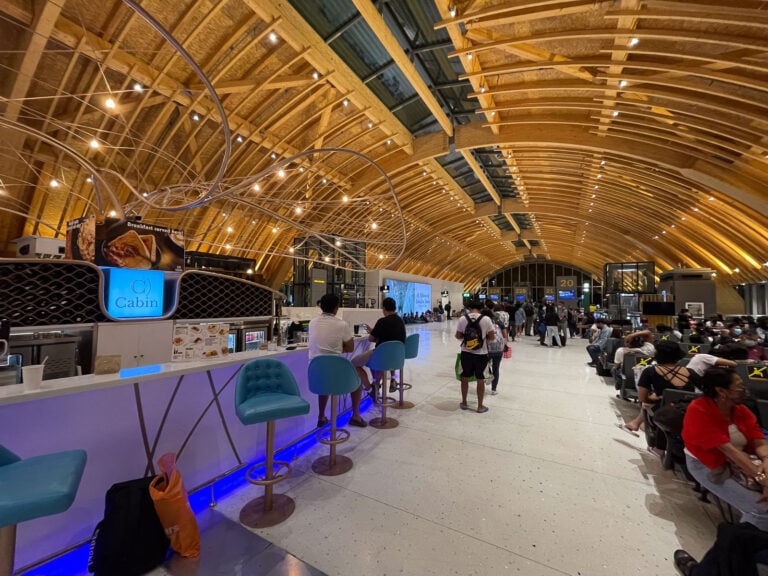
Mactan Cebu. 10.3075° N, 123.9793° E. Integrated into airfare since September 2019, after the airport signed agreements with twenty five carriers. We could not confirm the ₱850 from the airport operator directly. Mactan Cebu’s own site would not return the figure, and one aviation industry comparison published in July 2025 put the airport’s international charge at ₱1,030, which is higher than NAIA’s. Two possibilities sit behind that: either the rate rose and was not announced widely, or the table was wrong. Suroy.ph could not resolve it, and would rather say so than print the tidier number. If you are flying international out of Cebu, look for the terminal fee line in your fare breakdown when you book, and treat that as the answer.
Bohol Panglao is now under private operation and was explicitly excluded from the 2026 fee reduction described below, so it did not come down. The current figure is not published anywhere we could find.
The cut, and the figure that has not been published
On 1 April 2026, with jet fuel having climbed from around 89 dollars a barrel to roughly 200, the transport department directed the civil aviation authority to cut its fees. International departures dropped from ₱900 to ₱700. Domestic fell to somewhere between ₱100 and ₱200 depending on airport class. Landing and takeoff charges for the airlines were roughly halved.
The reduction was announced as running for three months, subject to review. That window closed on 30 June 2026.
Suroy.ph checked the civil aviation authority’s announcements page, its 2026 memorandum circular index, and the news record through the end of July 2026, and found nothing stating whether the cut lapsed, was extended, or was made permanent. As of August 2026 there is no published answer. If you are flying international out of Iloilo, Kalibo, Puerto Princesa, General Santos or Davao, budget for ₱900 in cash and be pleased if it is ₱700.
NAIA, Mactan Cebu, Clark, Bohol Panglao and Laguindingan were all excluded from the cut, because they are run under private concessions that sit outside the authority’s fee jurisdiction. That produced its own argument in March 2026, when a lawyers’ group pointed out that the airport handling roughly four fifths of the country’s air passengers is the one place a government fee reduction cannot reach.
Getting money back
The refund window is two years from the date of payment. Not the date of the flight. If you paid for a ticket in November and flew the following June, the clock started in November.
You can claim if you were exempt and paid anyway, if you qualified for a reduced rate and paid full, if you were charged twice, if you downgraded from first class to economy, if the collection was simply erroneous, if your ticket went unused and non refundable with no fare value left, or if you were a foreigner who never crossed the one year mark.
The instrument is TIEZA Refund Application Form No. 353. File in person, by email to the travel tax refund address, or through the online refund portal. You will need the form, your passport, the ticket or itinerary showing the tax line, the original official receipt or online acknowledgement, and whatever document proves your category. If somebody else is claiming on your behalf, that requires a notarised special power of attorney. Processing is quoted at three working days for a complete file.
Payment comes back as a cheque made out to the person named on the ticket. Not a card reversal. Plan for that if you are already abroad.
One reason airline counters push back on refunding travel tax themselves: under the regulations, a refund a carrier grants without proper documentation gets assessed straight back against the carrier. They are not being difficult. They are being careful.
The departure fee refund is a different animal
Overseas Filipino workers are exempt from the international passenger service charge, but the mechanism is nothing like the travel tax exemption. There is no certificate that stops the charge landing. The airline collects it at booking, and the worker claims it back afterwards.
At NAIA the whole claim moved online on 1 March 2026. There is no counter. The claim goes by email to the new airport operator’s refund address with the ticket showing the international charge line, a copy of the employment certificate, the boarding pass, a government ID and a completed declaration form. On the fare breakdown the charge usually appears as LI International.
The amounts involved are not small in aggregate. Between 2015 and 2017 workers paid more than half a billion pesos in terminal fees and travel taxes they were entitled to have back, mostly because nobody told them and the claim window closed.
At Clark, the operator has to process an exempt passenger’s refund within a year of the flight date, but the passenger still has to file. At the civil aviation authority’s airports the refund path is narrower again, and has been described as available to overseas workers specifically rather than to anyone wrongly charged.
What is not settled
Three things, stated plainly rather than guessed at.
The status of the April 2026 fee reduction past 30 June has not been published. Mactan Cebu’s current international charge could not be confirmed from the operator and two credible figures conflict by ₱180. Bohol Panglao’s rate under its new private operator is not public.
And the largest one. On 16 March 2026 the House of Representatives passed House Bill 8464, the Travel Tax Abolition Act of 2026, by 257 votes to one with one abstention, repealing the 1977 decree and the relevant section of the Tourism Act. It was among the priority measures approved that February and was certified urgent. The Senate referred it to the committees on ways and means, tourism, and finance, where two counterpart bills sit: one exempting economy class only and keeping the tax on business and first, the other abolishing it outright. No floor action has been recorded since that referral as of September 2026. TIEZA, which draws about nine tenths of its funding from the tax, has asked that any abolition be pushed to January 2027.
Until that becomes law, ₱1,620 leaves the country with you.
Rates and processes checked August 2026.
Wear the gate.
Two airports do most of the collecting on the way out of this country. Manila charges ₱950 and prints it on the ticket. Mactan Cebu folded its charge into the fare in 2019 and lets you walk through. The Airport Series draws both fields the way a chart does, runways to scale, the code and the numbers set underneath.

Airport Series MNL
Global Collection
₱1,299

Airport Series CEB
Global Collection
₱1,299
Frequently asked questions
Do tourists pay the Philippine travel tax?
No. Foreign visitors who have not stayed in the Philippines for more than one year are outside the tax entirely. It only starts to apply once a stay crosses twelve months.
How much is the Philippine travel tax in 2026?
₱1,620 economy and ₱2,700 first class. Reduced rates are ₱810 and ₱1,350 for children aged two to twelve, journalists on assignment, and presidential authorisations. The privileged reduced rate for OFW dependents is ₱300 economy and ₱400 first class.
Is the terminal fee included in my ticket?
Domestic, yes, everywhere, since 2017. International, only at NAIA, Clark and Mactan Cebu. At Iloilo, Kalibo, Puerto Princesa, General Santos and Davao it is still collected in cash at the terminal before immigration.
How long do I have to claim a travel tax refund?
Two years from the date you paid, not the date you flew. File TIEZA Form No. 353 with your passport, ticket and original receipt.
Does the travel tax exemption certificate cost anything?
No. It is free. The ₱200 processing fee still printed on some government pages is not current.
Is the travel tax being abolished?
House Bill 8464 passed the House of Representatives on 16 March 2026, 257 votes to one. It sits in Senate committee and no floor action has been recorded as of September 2026. The tax remains in force and is still collected.