
Molo, Iloilo: The Church of Sixteen Women, and the District Around It
A Chinese quarter founded in 1637, a church finished in 1888 out of coral stone and egg white, and a plaza with Greek goddesses on it. Ninety minutes, three kilometers from the city proper, and it costs nothing to walk into.
Molo is not a suburb of Iloilo City. It is an older town that the city grew around, and it still behaves like one.
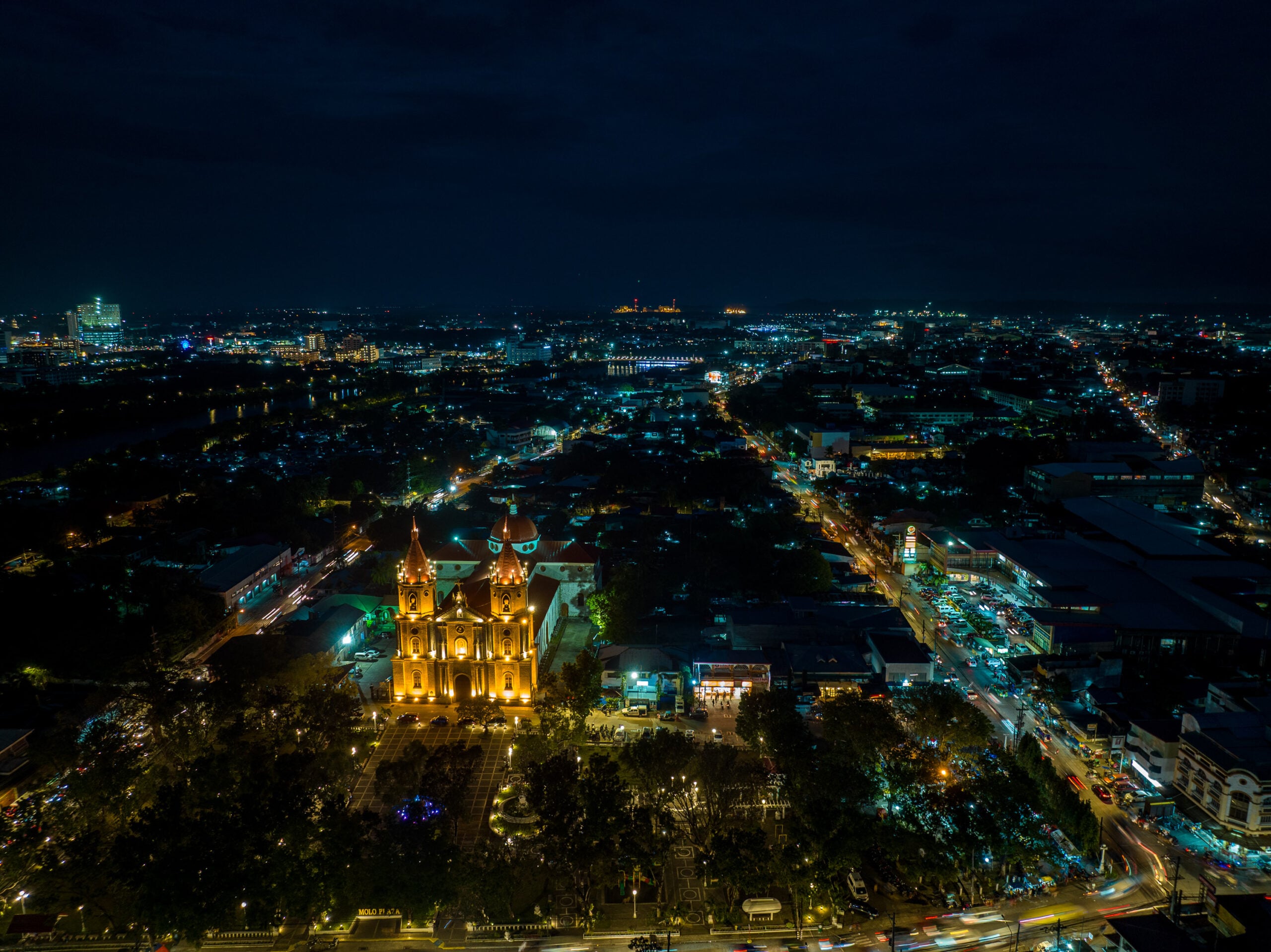
The give-away is the plan. Church on one end, plaza in the middle, the old family houses on the edges, the commercial street running past. Stand in the middle of it at six in the evening and the whole layout is legible in a way it never is in a district that grew up piecemeal. From 80 meters up it is even clearer: a straight axis from the church door, down the paved spine of the plaza, out to the mansion on the far corner.
That plan is the point. Everything worth seeing here sits on it, and you can walk the lot in an hour and a half.
The short version
Go for the church. Stay for the plaza. Eat the soup. Then leave, because Molo is a good ninety minutes and a poor full day, and any guide that stretches it into one is padding.
Best time is late afternoon into dusk. The facade is floodlit after dark, the plaza fills with families, and the light between about 5:30 and 6:30 PM is the only window where you get both the building and the sky.

Molo Church, and what it actually is
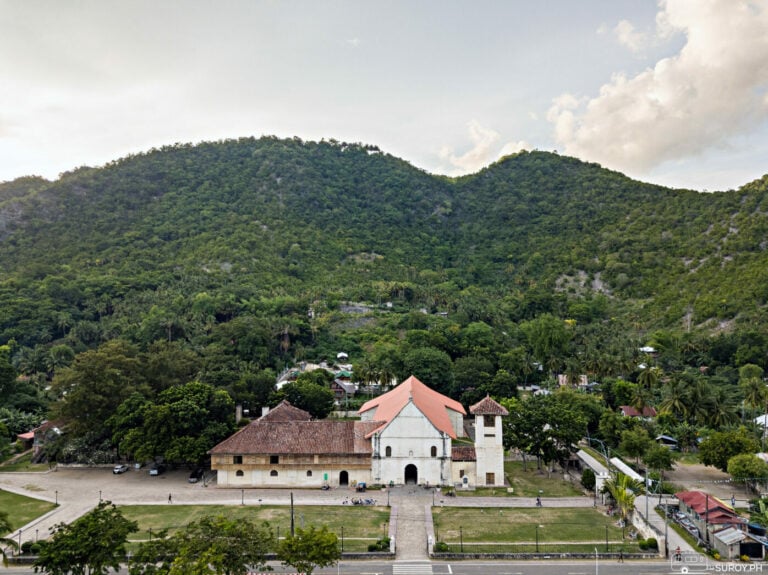
The building is Sta. Ana Parish, dedicated to Saint Anne, the mother of Mary. It is a parish church of the Archdiocese of Jaro. It is not a cathedral, whatever a dozen listings say, and the archdiocese’s cathedral is Jaro Cathedral, four kilometers north. It belongs to the same family of Panay churches that most visitors only see one of.
It went up in stages across most of a century. A first structure in 1831 under Fray Pablo Montaño, built of tabique pampango with a chalk roof, which is to say it was never going to last. Plans for a permanent church were drawn in 1866 and approved by Bishop Mariano Cuartero in 1869. It was finished in 1888 under Fray Agapito Buenaflor, with construction supervised by Don Jose Manuel Locsin.
The material is the part people miss. Coral stone, cut and hauled and set in a mortar of egg white and sand. That is why the facade reads warm cream rather than gray, and why the surface looks rough close up and smooth from the air.

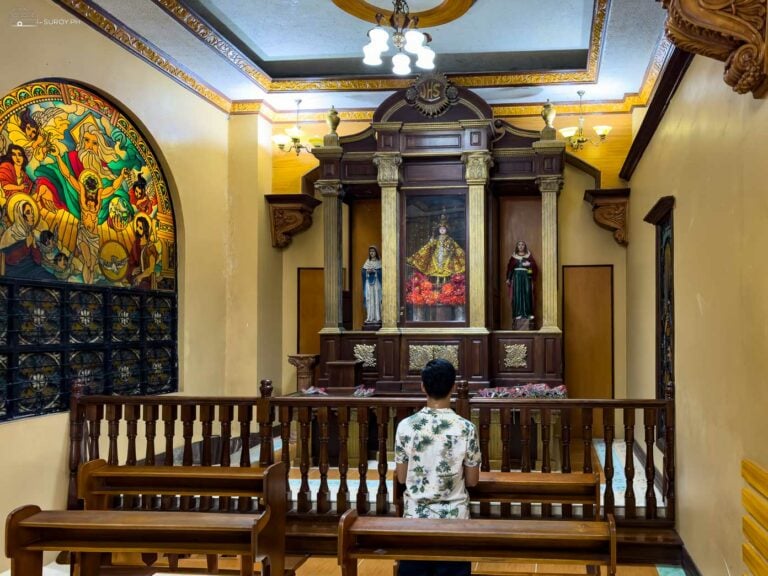
The style is Spanish neo-Gothic with Renaissance Revival elements: two towers with spires, pointed arches, three naves inside, four wooden side altars, a high altar, and two carved pulpits. The roof and the spires are painted a deep red, which is the thing you actually recognize it by, and from directly overhead the red dome over the crossing is the strongest shape in the district.
It has taken damage and been repaired. On 18 March 1945 one of the towers was destroyed in the fighting for Iloilo, and it was rebuilt afterwards under Rev. Manuel Alba. Gunfire damage on one of the bells is still there if you look.
Jose Rizal came here on 4 August 1886, on a stop in Iloilo, and by every account he came to see the biblical paintings. Those paintings are gone. The visit is still real and the plaque still says so, but do not go expecting to see what he saw.
Molo Church was declared a National Historical Landmark in 1992. That is the correct instrument. Several of the pages ranking for this church call it a National Cultural Treasure declared by the National Museum, which is a different declaration made by a different agency, and it did not happen here.


Why they call it the feminist church
Sixteen statues of female saints stand on the pillars down the nave. Not one male saint among them, which in a Philippine church is genuinely unusual, and it is the reason the nickname stuck.

They are, in the order most people list them: Juliana of Nicomedia, Marcella, Lucy, Apollonia, Genevieve, Rose of Lima, Elizabeth of Hungary, Teresa of Ávila, Clare of Assisi, Monica, Cecilia, Felicity of Rome, Agnes of Rome, Margaret of Antioch, Martha of Bethany, and Mary Magdalene. Sta. Ana herself holds the high altar.

Two things worth being straight about. The nickname is modern and journalistic, not liturgical, and nobody in 1888 was building a feminist statement. And the popular claim that this was the first church in the Philippines built specifically for women is repeated a lot and documented nowhere. What is checkable is the sixteen statues, and they are enough.
Look up when you are inside. The saints are set high on the pillars and most visitors photograph the altar and walk out without ever seeing them.
Visiting: hours, mass, fees
It is a working parish and it behaves like one. Somebody is praying in there at most hours, and a wedding or a funeral will close the nave to visitors without warning.
| Entrance fee | None. It is a church. There is a donation box and it is worth using. |
| Sunday mass | Seven masses, running from 5:30 AM through to 8:00 PM |
| Weekday mass | 5:30 AM and 5:30 PM |
| Saturday | Anticipated Sunday mass at 5:00 PM |
| Language | Hiligaynon and English, depending on the mass |
| Feast day | 26 July, Sta. Ana. The district is not a quiet stop that week. |
| Best time to photograph | 5:30 to 6:30 PM. Facade floodlighting comes on at dusk. |
| Dress | Shoulders covered. Nobody will stop you at the door, and you will still be the one who got it wrong. |
| Address | San Pedro Street, Molo, Iloilo City, facing Molo Plaza |
Mass times checked August 2026. Parish schedules move for feast days, Holy Week and the school calendar, so confirm at the parish office rather than trusting any page, this one included.
Molo Plaza
The plaza is the second half of the church and most guides treat it as a car park.
It runs as a long paved spine from the church door, with two circular garden features on the axis, lawns and mature acacias on both sides, and a perimeter road on all four edges. What makes it odd, and worth ten minutes, is the statuary: Greek goddesses around the plaza, and a monument to Maria Clara, the character out of Noli Me Tangere. A Catholic church at one end and a row of classical goddesses in front of it is the sort of thing that only makes sense once you know what Molo was.
At night the circular gardens are lit and the whole plaza is in use: kids on the paving, vendors on the perimeter, people sitting on the low walls. It is the most alive the district gets, and it is free.


Molo Mansion
Across the plaza from the church stands a big cream mansion with a red roof, a formal garden and a curving front stair. This is the Yusay-Consing Mansion, which everyone calls Molo Mansion.

It went up in the 1920s. The first family in it were Doña Petra Lacson and her husband Estanislao Yusay, a judge of the Court of First Instance in Manila. It later passed to Timoteo Consing Sr., who was governor of Iloilo from 1935 to 1937. Neoclassical balustrades, high ceilings, carved detail, the standard vocabulary of a Philippine sugar-era house built by people with money.
It was left to rot for years and came close to demolition. A private developer bought and restored it, and it reopened as a heritage house with a retail floor selling Ilonggo food products, crafts and delicacies, plus a cafe and a public garden at the front.

On the fee. The garden and the ground floor retail are walk-in. There is no admission gate in the way a museum has one, and expect the visit to cost you whatever you buy in the shop rather than a ticket. Opening hours are not reliably published anywhere and the mansion has been closed on days when listings said it was open, so treat late morning to early evening as the working assumption and do not build a schedule around it. Checked August 2026.
You will read that Presidents Quezon and Osmeña stayed here. It is repeated locally and it is not documented. Take it as a story the house tells about itself.


Pancit molo, and the thing everyone gets wrong
Pancit molo comes from this district. It is a soup. Pork dumplings wrapped in wonton skin in a clear chicken broth, with garlic and spring onion over the top. There are no noodles in it. The pancit in the name comes from the wrapper, not from anything you would recognize as pancit anywhere else in the country.
La Paz batchoy is not from Molo. It is from La Paz, another district of Iloilo City, on the other side of the river, and it is a completely different bowl: miki noodles, pork offal, crushed chicharrón, a beef and shrimp broth. Both are Iloilo. Only one of them is Molo, and the number of guides that put batchoy in Molo is remarkable.
The reason both exist is the same reason the district exists. Molo was founded in 1637 as a Parián, the quarter Chinese traders were required to live in, and pancit molo is what happens when a Fujianese dumpling soup gets made for two hundred years by Ilonggo cooks with Ilonggo ingredients.
Eat it in the district if you can. If you want it from a name you will recognize, most of the well known bowls are in the city proper rather than in Molo itself, which is worth knowing before you plan the walk around a meal. Where most people go to eat in Iloilo is a drive out of town in the other direction.
The part that explains all of it
Molo was a Chinese quarter before it was anything else, established in 1637. The name is a corruption: locals called the raiders from the south moro, the Chinese residents said it as molo, and the mispronunciation became the place.
Then it got rich, and then it got educated. By the 1800s Molo carried four colleges and enough chief justices, senators, governors and generals to earn it the nickname the Athens of the Philippines, which is the kind of thing a district only gets called if it was insufferable about it at the time. Franklin Drilon is from here. So was Rodolfo Ganzon. The list of Molo-born judges and revolutionary generals runs long.
It stopped being its own town on 16 July 1937, when it was incorporated into Iloilo City. Today it covers 5.54 square kilometers across 25 barangays with about 76,793 people in it, which makes it one of the densest parts of the city.
Knowing that is the difference between looking at a nice church and looking at what a very rich, very literate, half Chinese trading town built for itself when it had something to prove.
How to get to Molo
Molo sits about 3.2 kilometers southwest of the Iloilo City proper. It is close enough that the journey is not the problem.
By jeepney. Take anything signed Molo or Arevalo from the city proper and get off at the plaza. Every driver knows it. Fares were adjusted nationally in March 2026, so any peso figure printed on a blog older than that is wrong. Ask when you board.
By tricycle or Grab. Grab operates in Iloilo City and the run from the center is short. A tricycle will also do it and you should agree the number before you sit down.
From the airport. Iloilo International Airport is in Cabatuan, about 16 kilometers northwest of Molo as the crow flies and further by road. Allow 40 minutes to an hour depending on traffic on the Iloilo Airport Road.
On foot from the city proper. Possible, about 45 minutes, and not recommended in the middle of the day. The Iloilo River Esplanade covers part of the distance pleasantly and then you are on a main road.

Ninety minutes in Molo
The honest itinerary, in order, on the axis.
- Church, 30 minutes. Go in. Look up at the pillars and find the sixteen. Then walk around the outside and look at the coral stone from close range.
- Plaza, 20 minutes. Walk the spine from the church door out. Find the goddesses and the Maria Clara monument.
- Molo Mansion, 20 minutes. The garden, the stair, the shop.
- Soup, 20 minutes, if you have found a bowl in the district. Otherwise carry it into the evening in the city proper.
Stay for dusk if you can. The floodlighting is the best thing about the building and almost nobody stays for it. Everything in this guide was photographed in that hour.
If you have a second Iloilo half day, put it on Jaro Cathedral and the Jaro belfry, then Miagao if you are willing to drive 40 kilometers south for a UNESCO site that earns it.
What most guides get wrong
Three corrections, all checkable.
- Molo Church is not a cathedral. It is Sta. Ana Parish, a parish church of the Archdiocese of Jaro. The cathedral is Jaro Cathedral.
- The 1992 declaration made it a National Historical Landmark, not a National Cultural Treasure, and it came from the National Historical Institute, not the National Museum. Two different instruments, two different agencies.
- La Paz batchoy is not a Molo dish. Pancit molo is from Molo and it is a dumpling soup with no noodles in it. Batchoy is from La Paz.

Wear the arrival.
Iloilo International is the calmest arrival in the country. One terminal, one runway, nobody shouting at you on the way out. The print is the airfield drawn to plan, with the code under it.
Global Collection · ILO · ₱1,299
Frequently asked questions
Why is Molo Church called the feminist church?
Because sixteen statues of female saints stand on the pillars down the nave and there is not a single male saint among them, which is unusual in a Philippine church. Sta. Ana, the patron, holds the high altar.
Is there an entrance fee at Molo Church?
No. It is a working parish and entry is free. There is a donation box.
Is Molo Church a cathedral?
No. It is Sta. Ana Parish. The cathedral of the Archdiocese of Jaro is Jaro Cathedral, about four kilometers north.
What is Molo Church made of?
Coral stone, set in a mortar of egg white and sand, finished in 1888.
Did Jose Rizal visit Molo Church?
Yes, on 4 August 1886. He came to see the biblical paintings, which are no longer there.
How long do you need in Molo?
Ninety minutes covers the church, the plaza and the mansion at a comfortable pace.
What is the difference between pancit molo and La Paz batchoy?
Pancit molo is a clear broth with pork dumplings and no noodles, and it comes from Molo. La Paz batchoy is a rich noodle soup with pork offal and chicharrón, and it comes from La Paz. Different districts, different bowls.
Photographed over Molo Plaza on 15 February 2023 with a DJI Mavic 3, between 6:02 and 6:35 PM. The church, the plaza and the mansion are unchanged since. Mass times, fees and transport were re-checked in August 2026.
More from Iloilo: Pancit molo, Talaba, Diwal, the angel wing clam, Breakthrough Restaurant, Miagao Church and the Paraw Regatta.