

Six Spanish-Era Churches in One Day: The Southern Cebu Heritage Drive
Six coral stone churches, 116 kilometers, one tank of fuel and a start before six. The southern Cebu heritage run is the best day of driving on this island, and the version most people attempt is one church too long. Add Samboan and you are not doing a day trip any more, you are doing an overnight and pretending otherwise.
This is the drive as it actually works: what each church is, what it holds, and the visiting information that exists as against the visiting information people assume exists.

The route
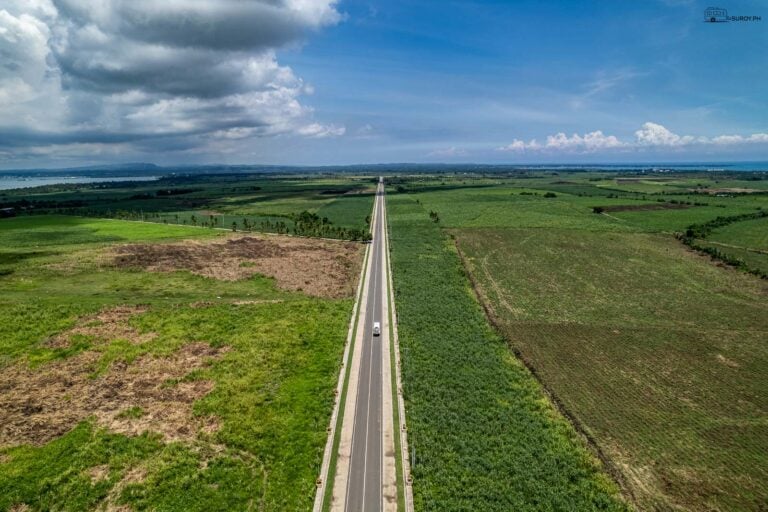
Everything sits on the Cebu South Road, Natalio Bacalso Avenue, National Route 8, which runs down the east coast from Cebu City. The towns come in order, which makes the navigation trivial and the timing everything.
Distances from Cebu City: Carcar 40 km, Sibonga 50, Argao 67, Dalaguete 84, Boljoon 103, Oslob 116, Samboan 150.
Leg to leg that is about ten kilometers from Carcar to Sibonga, seventeen to Argao, seventeen more to Dalaguete, nineteen to Boljoon, thirteen to Oslob, and then thirty four more to Samboan around the southern tip. That last leg is the one that breaks the day. Nobody publishes road times between these towns, so budget from the distances and the fact that the Cebu South Road is a busy two-lane national road with towns strung along it.
The honest verdict: Carcar through Oslob is six churches and a comfortable long day. Samboan wants its own morning, and it is worth one.
Heritage drive
One road, six churches
Pick a church.
40 km
Carcar
St. Catherine of Alexandria, 1860s to 1870s, a National Cultural Treasure from the 27 June 2019 batch. Sibonga, 10 km on, has the Raymundo Francia ceiling. Fill up by Carcar.
67 km, an hour
Argao
San Miguel Arcangel, 1734 to 1788, with the most complete compound on the drive: tower, convent, watchtowers, walls and four gateways. Half the ceiling is Raymundo Francia’s.
84 km
Dalaguete
San Guillermo de Aquitania, 1802 to 1825. The best documented treasure marker in the set, unveiled 9 February 2024.
103 km
Boljoon
Patrocinio de Maria, the oldest and most significant. The pulpit panels are back on the pulpit since March 2025. Museum door locked; ask for the curator.
116 km
Oslob
Immaculate Conception and the unfinished Cuartel barracks. The interior was rebuilt after the 2008 fire. Late afternoon is the light for the Cuartel.
National Museum and NHCP declarations; parish schedules; checked 1 November 2026.
Carcar, St. Catherine of Alexandria
Completed in the 1860s or 1870s and now an archdiocesan shrine. Declared a National Cultural Treasure by the National Museum on 27 June 2019, though the marker was not unveiled until 25 November 2023, during the fiesta, the delay put down to the pandemic.
Carcar is also where the food stop belongs. The town is the lechon capital of the island and you are passing through it at breakfast time, which is either excellent planning or a problem for your afternoon, depending on temperament. The lechon question is covered elsewhere on this site.
Sunday masses run 6:00, 8:00 and 10:00 in the morning and 3:00, 5:00 and 7:00 in the afternoon. Weekday times are not published.
Sibonga, Our Lady of the Pillar
The one most itineraries skip, and the one with the ceiling.
Stone and coral, built between 1866 and 1898, Neo-Gothic, and reinaugurated on 17 November 1907 after a renovation under Fr. Francisco Latorre. The reason to stop is overhead: trompe-l’oeil ceiling murals painted by the Cebuano artist Raymundo Francia between 1927 and 1931. Francia painted half the ceiling at Argao too, so seeing both in one morning is a genuine art-history sequence rather than two churches that happen to be near each other.
Also a National Cultural Treasure from the 27 June 2019 batch, and carrying a separate National Historical Commission Level II recognition from 2010. As of late 2023 the treasure marker had still not been turned over, and whether it has since been installed is not published.
If the name Sibonga rings a bell it is usually for Simala, the Marian shrine up in the hills, which is a different building from a different century. The Pillar is the one down in the poblacion, and almost nobody stops for it.
Argao, San Miguel Arcangel
The most complete complex on the drive, and the one that needs the most time.
The parish dates to 1703 under the Augustinians. The stone church was begun in 1734 and finished in 1788, coral stone, Baroque, with a two-level ornate pediment and double-pilaster columns on a cruciform plan. Inside there are five retablos, the main one carrying three life-size archangels. Half the ceiling is Francia; the rest is by an unknown Boholano hand.
What makes Argao worth an hour rather than twenty minutes is everything around the church: a three-level bell tower, the convent, two watchtowers, a baptistry, fortified walls with four gateways, a structure that served as leprosarium and autopsy room, a Gethsemane garden on a former cemetery, and a plaza carrying Via Crucis reliefs.
A National Historical Landmark under a 2004 NHCP resolution, marker installed 11 July 2016, and raised to archdiocesan shrine in September 2007. Its National Cultural Treasure date is reported inconsistently, as 2019 in one account and 2023 in another; the 27 June 2019 batch is the likelier declaration with a later marker.
Masses: Monday to Friday 6:00am, 12:15pm and 5:15pm. Saturday 6:00am and 6:00pm. Sunday, eight masses between 4:30am and 7:30pm. Parish line (032) 346 6720. Those times were last published in 2023, so treat them as a guide and call.
There is a parish museum in the rectory on the epistle side, Museo dela Parroquia de San Miguel. Its fees and opening hours are not published anywhere.
Argao is also where a day trip quietly turns into a stay. The Ka Treasure water terraces sit inland from the church, and the coast here has places to sleep, which makes it the natural break point if six churches in one day starts sounding ambitious around lunch.
Dalaguete, San Guillermo de Aquitania
Built 1802 to 1825 in coral stone, Baroque-Rococo, a three-level carved facade, a three-bodied bell tower, pointed-arch side windows and Rococo retablos. The ceiling paintings came later, in 1935.
A National Historical Landmark since 2004. The entire compound was declared a National Cultural Treasure on 27 June 2019, and the marker was unveiled on 9 February 2024 by the Cebu Archbishop with the National Museum’s Cebu head. That is the best documented declaration date in this whole set, which is worth knowing if you care about getting the dates right.
Dalaguete is also the turn-off for Mantalongon and Osmeña Peak, if the drive is turning into something longer.
That same turn-off climbs to Enchanted Mountain, which is worth knowing if the church stop was always partly an excuse to get up the mountain.
Boljoon, Patrocinio de Maria Santisima

The oldest and, by a distance, the most significant.
Pirates destroyed the earlier building in 1782. Fr. Ambrosio Otero began the replacement in 1783, Fr. Manuel Cordero continued it in 1794, and Fr. Julian Bermejo finished it. The result is Filipino Baroque at 65 meters long, 12 wide, 12 high, on mortar and lime walls two meters thick, carried by 28 pillars. The complex holds the remains of fortified walls, a cemetery, a blockhouse, a two-story convent and an eighteenth century watchtower that became the belfry.
Declared a National Cultural Treasure in 2001 by the National Museum, one of 26 Spanish colonial churches named that year, and a National Historical Landmark in 1999. It is a candidate for UNESCO listing as an extension of the Baroque Churches of the Philippines. The National Museum’s own account gives the treasure year as 2001.


The pulpit panels, and where that stands

Carved pulpit panels depicting saints disappeared from the church in the 1980s. Four resurfaced in a private collection and were donated to the National Museum in February 2024. The museum’s board approved their return in May 2024.
The formal turnover happened on 13 March 2025, National Museum to the Archdiocese of Cebu, at the Cebu Metropolitan Cathedral Museum. Four panels traveled to Boljoon by motorcade the next day; a fifth was already at the parish. They were shown publicly from 14 to 18 March, reinstalled on the pulpit on 19 and 20 March, and blessed at a thanksgiving mass on 21 March 2025.
They are on the pulpit now. That is the answer to the question everyone asks at the door. The panels were also slated for carbon dating to establish their precise age, and no result of that has been published as of November 2026.
The parish museum charges ₱30 per person, though that figure comes from visitor reports last updated in 2020 and wants confirming. The door is kept locked and you ask for the curator nearby; one visitor was told to come back after one. Photography is not permitted inside the museum, cited as a security restriction. Given what went missing from this parish in the 1980s, that is not an unreasonable position.
Masses: Sunday 6:00am and 10:00am in Cebuano, 1:00pm for funerals, 4:00pm in English for children. Monday 6:00am. Tuesday to Friday 5:00pm. Saturday 6:00am and an anticipated mass at 5:30pm. Published 2023.
Our full guide to Boljoon Church goes deeper on the building itself.

The full account of the panels coming home is written up separately.
Oslob, Immaculate Conception and the Cuartel
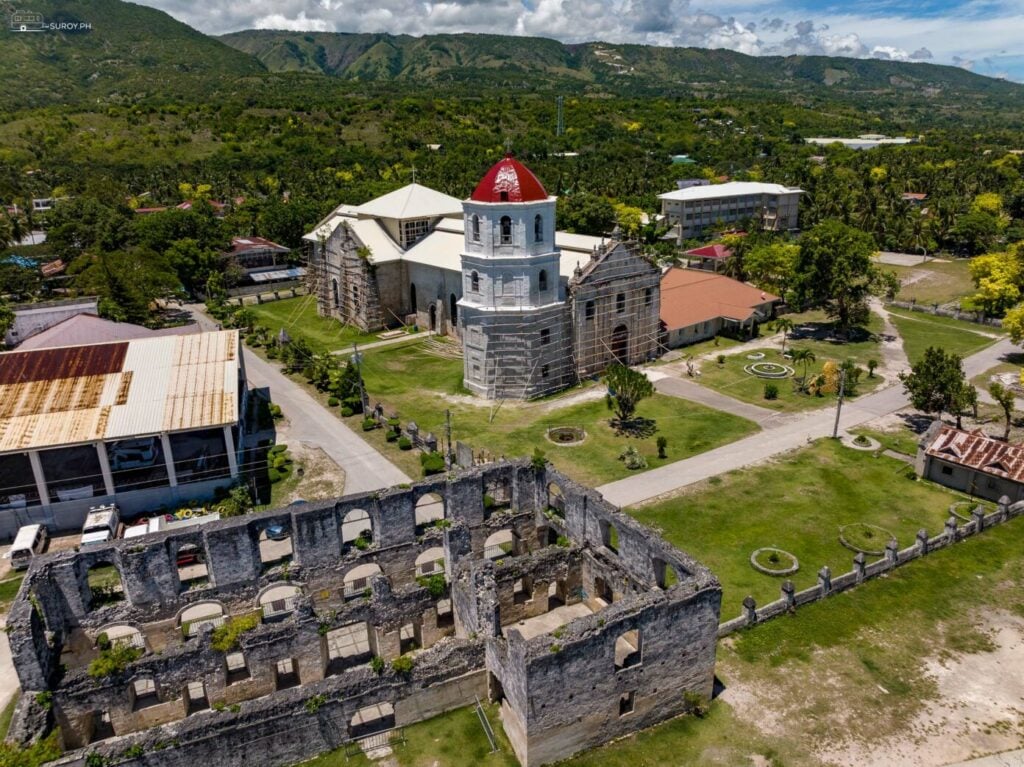
Construction began in 1830 under a design commissioned by Bishop Santos Gomez Marañón and built by Fr. Julian Bermejo, the same priest who finished Boljoon. Completion is given as either 1847 or 1848; the parish was erected on 8 January 1848. Cut coral stone, buttresses added between 1848 and 1850, and an octagonal bell tower with a red dome cap raised in 1858.
This church has burned twice. A fire on 7 November 1955 was followed by a 1980 renovation. A second fire on 26 March 2008 gutted the nineteenth century interior, altar and rectory included, reportedly electrical. Restoration was completed on 10 December 2010. So what you are looking at inside is nearly sixteen years old on top of two hundred year old walls, and knowing that changes how you read the room.
Declared a heritage church by the NHCP in September 2022 with a National Cultural Treasure marker unveiled in May 2023, on the same 2019 declaration.
The Cuartel sits just outside the perimeter wall to the front right of the church, near the sea. Unfinished Spanish barracks in coral block, started around 1860 and still unfinished when Spanish rule ended in 1898. It has no separate heritage designation that is published. It is also the most photographed thing on this drive and the one that photographs best in late afternoon, which is convenient given where it falls in the day. See our Oslob church and Cuartel guide.


Oslob is also the busiest town on this drive for reasons that have nothing to do with the church. The whale shark watching runs from Barangay Tan-awan, and Tumalog Falls is minutes away in Barangay Luka. Both pull crowds the churches never see.
Samboan, if you give it a morning

St. Michael the Archangel. The parish became independent on 3 November 1784, having previously been administered from Tanjay across in Negros, and the church was completed in 1842 under Fr. Romualdo Avila. Coral stone and wood, four pilasters, a rose window, a cross acroterium, and an arched entry carrying relief work and the Spanish royal seal, which indicates the crown funded it directly. The bell tower is octagonal, on the epistle side, and the ceiling paintings are by Bohol artists.
Samboan carries an NHCP Level II marker installed in 2016. It is not in the June 2019 National Cultural Treasure batch, and no treasure status for it is published.
The reason to come is next door. The Campanario de Antigua, built in 1878, coral stone slabs under terracotta tiles, raised to watch the Tañon Strait for pirates. It is described as the tallest and best preserved watchtower on Cebu island. From it the Escala de Jacob drops 157 steps to the coastal barangays below.
The Museo de Samboan opened in 2010 and was under renovation as of May 2023, aiming to reopen for the Dagayday Festival in September. Its current status, fees and hours are not published.

Samboan is also waterfall country. Aguinid Falls is the one people drive down for, and it is what stops an overnight here feeling like an indulgence.
What is not published, and it is most of it
Here is what is published, and what is not.
No parish, the Archdiocese of Cebu, the National Museum or any LGU publishes opening hours, photography policy, dress code, entrance or donation fees, or parking arrangements for any of these seven churches. Not one.
What that means in practice:
- Hours. These are working parishes, not museums. They are generally open around mass times and often through the day. The mass schedules above are the only published anchor and the most recent of them dates to 2023.
- Photography. Fine in the nave at every one of these in ordinary practice. Not during mass. Not in the Boljoon museum, where it is expressly forbidden.
- Dress. Covered shoulders and knees. Nobody will stop you at the door and somebody will notice.
- Money. No entrance fees are published. Donation boxes exist. The Boljoon museum’s ₱30 is the only figure anyone has reported and it is six years old.
- Parking. Plaza parking at all of them, which is easy on a weekday morning and a scrum on a Sunday. Time your run to avoid arriving as a mass lets out.
On the earthquake
Worth stating plainly because it stopped a lot of trips that did not need stopping. The magnitude 6.9 Cebu earthquake of 30 September 2025 was centered offshore about 19 kilometers northeast of Bogo City, by the PHIVOLCS account, in the north of the island. The five heritage churches the Department of Tourism named as damaged are all northern: Daanbantayan, Bantayan, Tabogon, San Remigio and Bogo.
No church on this southern itinerary is listed as damaged in any government source. The drive is unaffected.
How to run the day
- Leave Cebu City by 5:30am. You are trying to be past Carcar before the traffic thickens and to reach Boljoon in good light.
- Weekdays over Sundays. Sunday gives you eight masses in Argao alone and a full plaza at every stop.
- Call Argao and Boljoon ahead if the museums matter to you. Both need a person to open a door.
- Cash, small notes. Donation boxes and a ₱30 museum do not take cards.
- Fill up by Carcar. Stations thin out further south.
- Six is the number. Carcar, Sibonga, Argao, Dalaguete, Boljoon, Oslob. Save Samboan.
Can you see the southern Cebu heritage churches in one day?
Six of them, yes: Carcar, Sibonga, Argao, Dalaguete, Boljoon and Oslob, spanning 116 km of the Cebu South Road. Samboan sits 34 km further around the southern tip and turns the trip into an overnight. Leave Cebu City by 5:30am and go on a weekday.
Are the Boljoon pulpit panels back in the church?
Yes. Four panels were formally turned over by the National Museum to the Archdiocese of Cebu on 13 March 2025, joined a fifth already at the parish, and were reinstalled on the pulpit on 19 and 20 March 2025, then blessed on 21 March. Carbon dating was planned and no result has been published as of November 2026.
Is there an entrance fee for the southern Cebu churches?
No entrance fee is published for any of the seven churches. The Boljoon parish museum has been reported at ₱30 per person, though that figure dates to 2020. Donation boxes are the norm. Photography is not permitted inside the Boljoon museum.
Were the southern Cebu churches damaged by the 2025 earthquake?
No. The magnitude 6.9 earthquake of 30 September 2025 was centered offshore northeast of Bogo City in northern Cebu, and the five heritage churches the Department of Tourism named as damaged are all in the north. No southern Cebu church on this route appears in any government damage list.
Without a car, the southern towns run off the South Bus Terminal in Cebu City, though going by bus will cost you churches.
Suroy Wear

Coral stone, and everything after it.
The Cebu Icons Tee stacks the island’s landmarks, the Basilica among them. Two hundred years of building, on one back. ₱999.
Wear the story