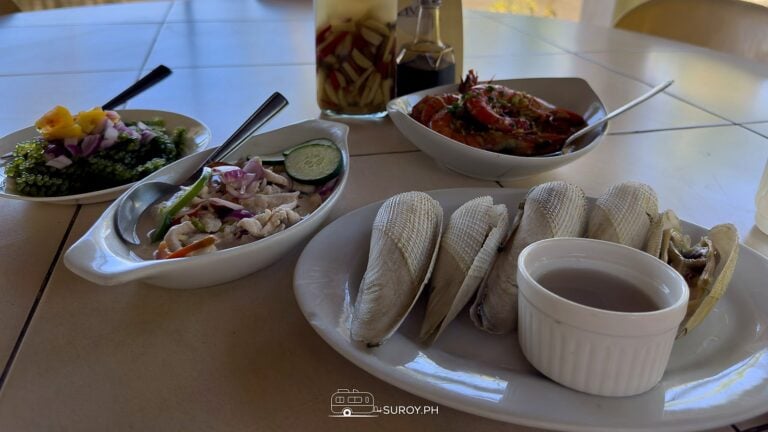


Talaba in Iloilo: From Thirty-Five Pesos a Basket to the Gold Tray
Western Visayas grows more oysters than anywhere else in the Philippines. How talaba is farmed, when it is safe to eat, what it costs, and where to eat it in Iloilo City.
For most of its history in Iloilo, talaba was sold by the basket. Steamed, piled up, set on a table with a saucer of vinegar and a pile of crushed siling labuyo, and eaten with both hands until somebody lost count. In 2012 a basket ran about thirty-five pesos. Nobody plated it. Nobody garnished it. It was an abundance food in the region that produces more oysters than anywhere else in the Philippines, and it was priced accordingly.
Which is what makes the current version worth writing about. There are rooms in Iloilo now where talaba arrives on brushed gold trays, laid on beds of rock salt, one baked under cheese, one under a green chili and garlic salsa, one raw with a lemon wedge angled beside it. It is the same animal. It grew on the same ropes in the same bays. The distance between the basket and the gold tray is roughly fifteen years, and that distance is the story.

Check the shellfish bulletin first
Start here, because almost no food article does, and because the answer changes.
The Bureau of Fisheries and Aquatic Resources publishes a numbered Shellfish Bulletin roughly every one to two weeks on bfar.da.gov.ph. Each one supersedes the last and lists which bays are closed for paralytic shellfish poison. As of Shellfish Bulletin No. 19, dated 5 August 2026, no area in Western Visayas is listed as positive. Iloilo waters named as free of toxic red tide include the coastal waters of Dumangas, Estancia, Carles, Concepcion and San Dionisio.
All types of shellfish and Acetes sp. or alamang gathered from the areas shown above are NOT SAFE for human consumption.
BFAR Shellfish Bulletin, standard advisory wording for a closed area
Two things follow. The first is that paralytic shellfish toxin is heat stable. Baking an oyster under cheese does nothing to it, which is exactly why BFAR bans every preparation from a positive area rather than only the raw ones. The second is that “red tide in the Visayas” in a news headline usually means Eastern Visayas, several hundred kilometers away, and has no bearing on an Iloilo dinner. Check the bulletin number and its date, not the headline.
Iloilo is not exempt from this. In August 2023, seven Western Visayas sites tested positive, including waters around the Gigantes Islands in Iloilo and off Panay and Roxas City in Capiz. August is the risk window. The southwest monsoon, roughly June through September, is when blooms are expected.
What Iloilo talaba actually is
The species is Magallana bilineata, still listed in most Philippine references under its older name Crassostrea iredalei. In English it is the slipper oyster or Philippine cupped oyster. In Filipino it is talaba, or talabang tsinelas when somebody needs to distinguish it from the other local species.
Western Visayas is the country’s leading oyster region and has been for a decade. Across the ten years to 2020 the region averaged over 21,000 metric tons a year, ahead of Central Luzon and well ahead of everywhere else. Oysters are abundant in Banate Bay. Dumangas, Estancia, Carles, Concepcion and San Dionisio are all active enough to sit on BFAR’s shellfish monitoring list.
None of which is in Iloilo City. The city eats oysters it does not grow, and the two districts where most of the good oyster rooms sit, Jaro and Mandurriao, are the two with no coastline at all. Every oyster served in them arrived by road.
How they are grown
Four traditional methods, and the local names are the useful ones. Sabog is broadcast, shells scattered on the bottom, the cheapest and least productive. Tulos is the stake method, bamboo driven into the mud. Sampayan is hanging or longline, the most productive per square meter. Paringit is the stone method.
The cultch, the thing the spat settles on, is empty oyster shells. Twelve to sixteen of them threaded on polyethylene rope, hung from bamboo platforms about half a meter below the zero tide line, posts four meters apart, cultches twenty to twenty-five centimeters apart. Oysters are farmed on the bones of previous oysters, which is a fact worth sitting with for a second.
Larvae settle in two to three weeks. Market size takes six to ten months. Capiz farmers in Panay town collect spat in May and harvest in October and November for the Christmas market, which tells you when supply is heaviest and cheapest.
The newest chapter is local. In January 2026 SEAFDEC’s Aquaculture Department, headquartered an hour down the coast at Tigbauan, started a pilot with BFAR Region 6 and the Bayuyan Small Fisherfolk Association in Estancia, growing hatchery-reared single spat in floating bags rather than on strung shells. Researcher Marinelle Espino described the aim as “more uniform growth” and the ability to reuse culture materials. A small fisherfolk project running forty minutes from a world-class aquaculture institute is the sort of coincidence that only happens in Iloilo.
Season and price
The best eating months are the cool dry ones, roughly November through May. That window is both peak harvest and lowest bloom risk, which is not a coincidence.
On price, BFAR’s own monitoring is the only defensible source. Its January 2026 report put Western Visayas oysters at ₱140 to ₱330 per kilo, against ₱30 to ₱140 the previous August. Do not read that as a straight price spike. January is peak holiday demand and BFAR’s ranges span different markets and probably different forms, since shucked meat prices per kilo run far above oysters in the shell. What the two numbers show honestly is that talaba has a wide floor and a high ceiling depending on when you buy.
How Iloilo eats it

Raw on the half shell. The dip is the diner’s job and everyone has an opinion about the ratio. Suka, crushed siling labuyo, garlic, salt, sometimes soy, sometimes calamansi squeezed straight onto the shell. Nobody hands over a mignonette. It gets built at the table, per person, and arguing about it is part of the meal.
Kinilaw nga talaba. Vinegar, onion, ginger, chili. The best-documented Filipino oyster preparation and the one that most rewards a very fresh oyster.
Baked. Butter, garlic, cheese, under a broiler until the edges catch. It is the crowd-pleaser and it is also the preparation that hides a mediocre oyster, which is worth knowing when ordering a mixed tray.
Steamed and grilled. The plainest service and the one the old talabahan were built on. Grilled over coals until the shell cracks open on its own.
The green chili and garlic salsa turning up on modern trays is worth noticing. It is the suka-and-labuyo dip taken apart and put back together as a spooned condiment. A chef restating a table ritual. Whether that is an improvement depends entirely on whether you liked building your own.
Where to eat talaba in Iloilo
The organizing word is talabahan, a place defined by one shellfish. Iloilo has enough of them to constitute a category and several carry it in the name.
Villa Arevalo is the classic answer. Breakthrough Restaurant on the beachfront at Sto. Niño, founded in 1986 by a marine biologist and on the sand since 1992, runs live tanks and serves oysters alongside imbao and seasonal diwal. Stanley Talabahan sits on stilts over the water nearby. Tatoy’s Manokan and Seafoods, on the Villa road, does oysters alongside the native lechon manok it is actually famous for. The unnamed seaside oyster shacks along the same strip are cheaper and no less fresh.
Mandurriao and Iloilo Business Park is where the newer money eats. Griller’s Oyster House has branches at the Vertex Building in Smallville and at Mandurriao Plaza. Ponsyon by Breakthrough is at Plazuela de Iloilo on Diversion Road, run by the same family as the beachfront original.

Jaro has Bulljack Talabahan on Monfort Boulevard, open daily, unpretentious, and rated well by a lot of people who eat oysters often.

Aggregator listings for Iloilo restaurants are unreliable and frequently show good places as closed when they are simply outside opening hours. Call.
What is true about oysters and what is marketing
Per 100 grams, oysters carry about 79 calories and 9 grams of complete protein, and the micronutrient numbers are genuinely unusual: zinc at roughly 555 percent of the daily value, vitamin B12 at 538 percent, copper at 493 percent, plus meaningful selenium and iron. That part is real.
The aphrodisiac claim is not. There is no scientific support for it. The zinc-and-testosterone version of the story is a supplement-marketing construct that got repeated until it sounded like a finding. Oysters are worth eating because they are delicious and nutritionally dense, which is enough.
Two real cautions. Oysters are filter feeders and accumulate what is in the water, including heavy metals, which is why the source bay matters. And red tide is not the only raw-oyster risk: Vibrio and norovirus are separate hazards, and pregnant people, young children and anyone immunocompromised are generally advised to skip raw oysters and stay with the baked tray.
Frequently asked questions
What is talaba in English?
Oyster. The species farmed across the Philippines is the slipper oyster, Magallana bilineata, widely still listed as Crassostrea iredalei.
Is it safe to eat raw talaba in Iloilo?
Check the current BFAR Shellfish Bulletin before eating. As of Bulletin No. 19 dated 5 August 2026, no Western Visayas area is listed as positive for paralytic shellfish poison. Separately, raw oysters carry Vibrio and norovirus risk regardless of red tide status, so pregnant people, young children and the immunocompromised should choose cooked preparations.
How much does talaba cost per kilo?
BFAR’s January 2026 price monitoring put Western Visayas oysters at ₱140 to ₱330 per kilo, up from ₱30 to ₱140 the previous August. Restaurant pricing is separate and runs higher.
Where does Iloilo talaba come from?
Mostly from oyster grounds elsewhere in the province and region, including Banate Bay, Dumangas, Estancia, Carles, Concepcion and San Dionisio, with additional supply historically coming from Capiz. Iloilo City itself does not farm oysters.
When is the best time to eat talaba?
The cool dry months, roughly November to May. That period is both peak harvest and the lowest risk window for algal blooms. June to September is the southwest monsoon and the season when blooms are expected.
More from Iloilo: Pancit molo, the Molo district guide, Diwal, the angel wing clam, Breakthrough Restaurant, Theo’s Restaurant and Bakery, the Paraw Regatta, Miagao Church and the Guimaras Island guide.
Shellfish bulletin status, prices and restaurant details checked in August 2026. Red tide advisories change every one to two weeks. Verify before eating.