
Newsletter Subscribe
Enter your email address below and subscribe to our newsletter


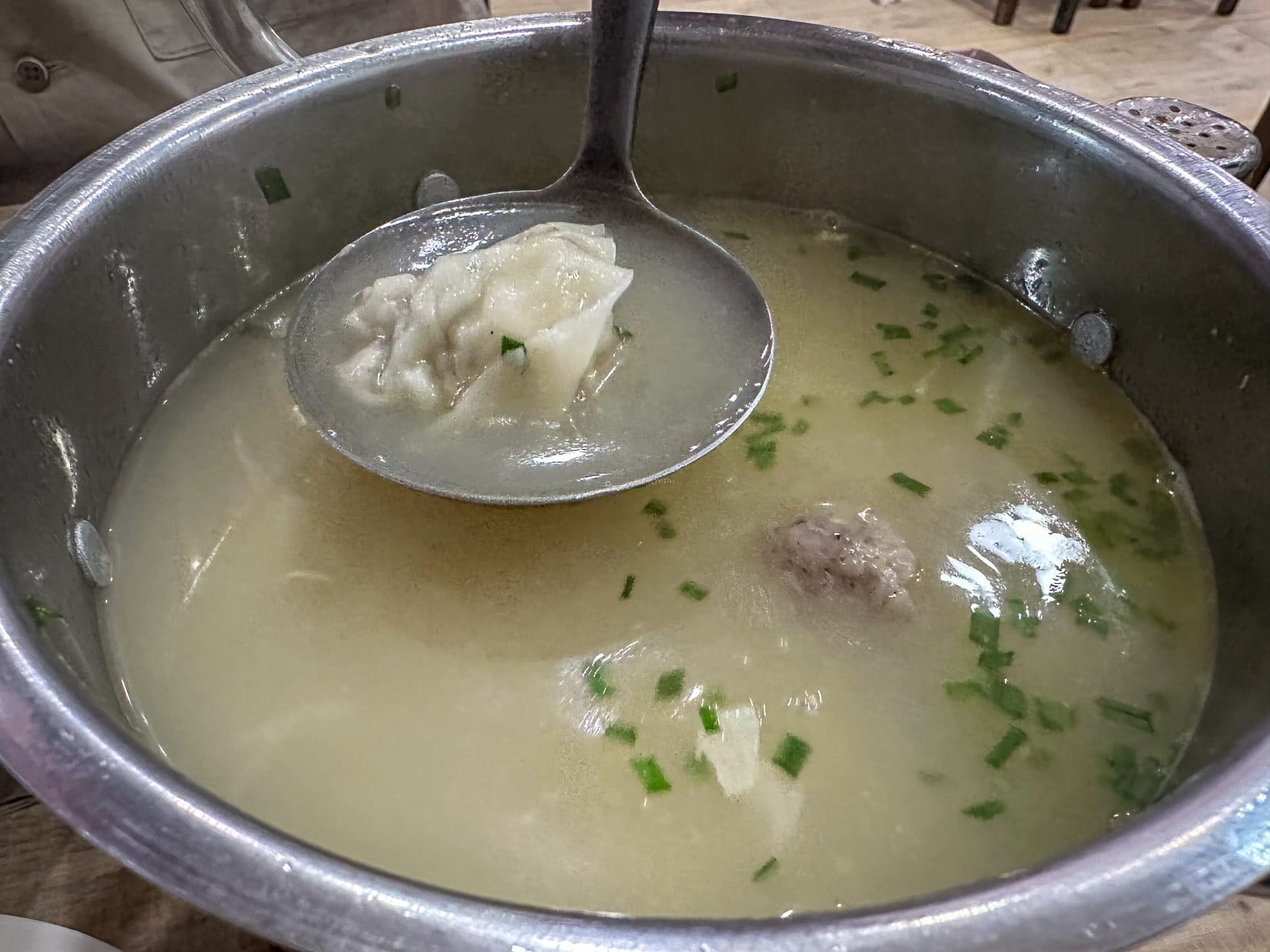
A dumpling soup from a district of Iloilo City that was a Chinese quarter before it was anything else. It arrives in an aluminium pot, it is eaten at Christmas and at funerals, and the word pancit in its name is doing something other than what you think.
10.6965° N, 122.5436° E
Order pancit molo expecting noodles and you will spend the first thirty seconds looking for them.
There are none. There never were. What arrives is a pot of pale, faintly starchy broth with pork dumplings loose in it, spring onion over the top, and a ladle stuck in the side so the table can serve itself. It is soup, it is a staple, and it is one of the two dishes Iloilo is known for nationally.
The other one is batchoy, and half the internet has the districts the wrong way round.
This is the thing to get straight first, because everything else about the dish makes more sense once you have.
Pancit is the Filipino word for a noodle dish, borrowed from Hokkien. In pancit molo, the wrapper does the job the noodle usually does. It is the same alkaline wheat dough, rolled thin and cut into squares instead of strands, then folded around ground pork. So the flour is there, the wheat is there, the chew is there. The strand is not.
Call it a wonton soup and you are not wrong about the lineage, and you are wrong about the dish. A Cantonese wonton soup is a clear broth with tight, small dumplings and usually noodles alongside. Pancit molo has no noodles, the dumplings are looser and larger, the wrappers are often torn and thrown in as well as wrapped, and the broth is chicken rather than pork bone. Two hundred years in Ilonggo kitchens will do that.
Molo is a place, not a style. It is a district of Iloilo City, three kilometres southwest of the city proper, and it was founded in 1637 as a Parián, the quarter Chinese traders were required to live in.
That is the whole origin in one sentence. Fujianese traders arrive with a dumpling soup. They are confined to one district. The district gets rich on sugar and shipping, gets educated enough to be nicknamed the Athens of the Philippines, and marries into Ilonggo families for two centuries. The soup changes with the kitchen it is cooked in. What comes out the far end is pancit molo.
The full story of the district, the church with sixteen female saints in it and the mansion across the plaza is in the Molo guide.
The bones of it are simple and the execution is where houses differ.
The dumplings. Ground pork, seasoned, sometimes with shrimp worked through it, wrapped in a wonton square. The fold is loose and gathered rather than crimped, which is why they open slightly in the pot and why the broth thickens as they cook.
The broth. Chicken, usually built from a whole bird so the shredded meat goes back into the soup. It is not a clear consommé. It goes cloudy from the wrapper starch, and that cloudiness is correct rather than a fault.
On top. Spring onion, fried garlic, a heavy hand with white pepper. Some houses float a pork ball in as well.
The pot. In Iloilo it comes to the table in an aluminium caldero with a ladle in it, and everybody serves themselves. Getting it in a single portioned bowl usually means you are eating it somewhere that has adapted for tourists.
One note on the broth, and it depends where you eat. Some houses thicken it well past the point a Cantonese cook would allow, closer to a light chowder. That is a regional preference, not a mistake, but if you have only ever had the thin version the thick one is a surprise.

Order pancit molo in Iloilo and there is a fair chance a plate of pinsec frito lands next to it.
Same wrapper, same pork filling, no broth. Deep fried until the corners blister and the loose flaps of wrapper go to glass, piled on a plate, served with a sweet chilli dip. The fragments of blistered wrapper that come off in the fryer are the best part and nobody removes them.
It is a different dish with its own name, and it belongs to the same Chinese-Ilonggo lineage as the soup. Ordering both is the normal move, not a greedy one, because between them they give you the wrapper in its two states.
Not, mostly, as lunch.
Pancit molo is occasion food. It turns up at Christmas, at Noche Buena, at Easter, at fiestas, at baptisms and at wakes. It is what a household cooks when there are more people in the house than usual, which is exactly what a big pot of dumplings in broth is good for.
That is also why the aluminium caldero matters. The dish is built to be put in the middle of a table and shared, and the restaurants that still serve it that way are preserving something more than a plating choice.
Day to day, an Ilonggo is more likely to have batchoy.
The two get confused constantly, including by guides that should know better, and they are not close.
| Pancit molo | La Paz batchoy | |
|---|---|---|
| District | Molo | La Paz, on the other side of the river |
| Noodles | None | Miki, fresh egg noodles |
| Broth | Chicken, cloudy, mild | Pork and beef bones with shrimp, dark, heavy |
| The meat | Pork dumplings, shredded chicken | Pork offal, liver, sometimes beef |
| On top | Spring onion, fried garlic, white pepper | Crushed chicharrón, fried garlic, spring onion |
| Occasion | Fiestas, Christmas, wakes | Any day, often breakfast |
Same city. Different districts, different centuries, different bowls. If a guide puts batchoy in Molo, that is a reliable signal that nobody involved has been to Iloilo.

This section names one meal, because that is how many Suroy.ph has eaten recently enough to stand behind. A list of ten places lifted from other people’s blogs is not a recommendation, it is a search result with a byline on it.
The pot in these photographs was eaten at Atria Park District in Mandurriao on 6 March 2023, at 10.7065° N, 122.5486° E. It came in the aluminium caldero with a plate of pinsec frito beside it, which is the correct order. The restaurant name did not get written down at the time and it is not going to be invented here.
What to look for instead, which travels better than a name:
If you are eating your way through Iloilo more broadly, the seafood is the other half of the argument: talaba if you are there in the right months, and Breakthrough or Tatoy’s out on the coast at Villa.
Suroy is Cebuano for to roam. One of these prints the dictionary entry. The other puts it on the side of a van.

Suroy Definition
Statement Series
₱999

Retro Van
Statement Series
₱999
No. Despite the name there are no noodles in it. The wonton wrapper is made from the same wheat dough as noodles and does the same job, which is where the word pancit comes from.
In the Molo district of Iloilo City, which was founded in 1637 as a Parián, the quarter Chinese traders were required to live in. The dish descends from a Fujianese dumpling soup adapted over roughly two centuries by Ilonggo cooks.
Shared ancestry, different dish. Pancit molo uses a chicken broth that goes cloudy from wrapper starch, larger and looser dumplings, shredded chicken through the soup, and no noodles at all.
Different districts of the same city. Pancit molo is a mild, cloudy chicken broth with pork dumplings and no noodles, from Molo. La Paz batchoy is a dark pork and beef broth with miki noodles, offal and crushed chicharrón, from La Paz.
The same molo dumpling, deep fried instead of simmered, served with a sweet chilli dip. Commonly ordered alongside the soup.
It is occasion food: Christmas, Noche Buena, Easter, fiestas, baptisms and wakes. It is built to be shared out of one pot.
No. It is served across Iloilo City and beyond. Eating it in the district it came from is a better afternoon, because the church, the plaza and the mansion are all on one axis and take about ninety minutes.
Photographed at Atria Park District, Mandurriao, Iloilo City, on 6 March 2023. Ordered: one pot of pancit molo and a plate of pinsec frito. Origin, district history and the batchoy comparison were re-checked in August 2026.
More from Iloilo: the Molo district guide, Talaba, Diwal, the angel wing clam, Breakthrough Restaurant, Tatoy’s and Theo’s Restaurant and Bakery.


