Newsletter Subscribe
Enter your email address below and subscribe to our newsletter


 ByPat
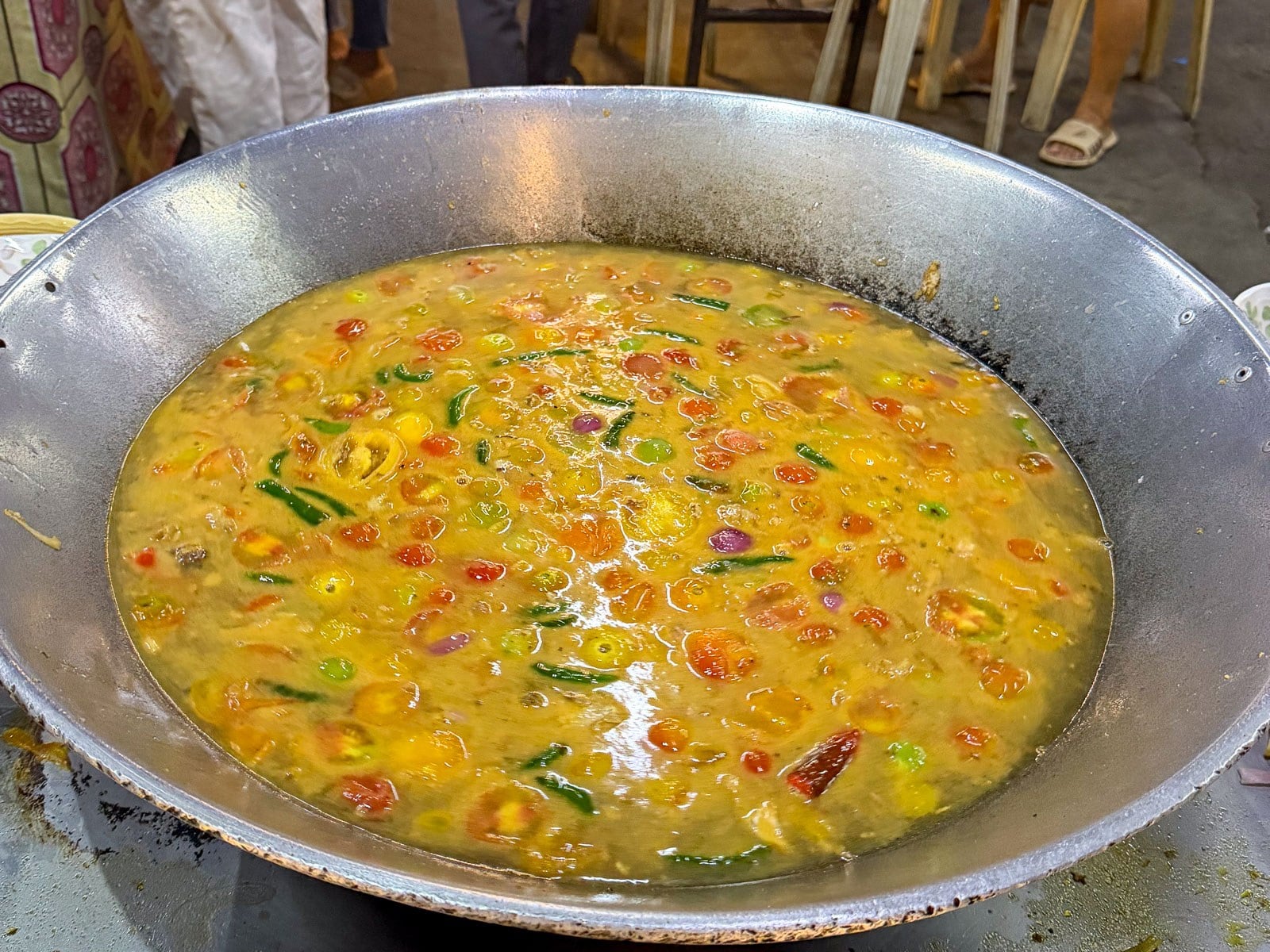
ByPatSour, spicy, built on ginger and tomatoes, and cooked in a kawa wide enough to feed a street. Cebu has an entire category of eatery named after this one dish, and the version most Cebuanos actually eat contradicts the word’s own definition.
The tomatoes go in first, halved, and they are yellow and orange rather than red.
Then ginger, cut coarse. Garlic. Long green chillies left whole so they release heat slowly instead of all at once. The whole lot goes into a kawa about the width of a bicycle wheel and cooks down until the tomatoes collapse and the oil turns the colour of the fruit. Only then does the fish go in.

That is larang, and if you have eaten in Cebu without ordering it you have walked past a hundred pots of it.
A fish stew, sour and spicy, and the two adjectives are doing more work than they usually do.
The base is garlic, red onion, ginger and tomatoes. The sour comes from iba or kamias, the bilimbi fruit, or from unripe tamarind, or from green mango. The heat comes from chillies that go in whole. Fermented black beans, tausi, add the salt and the depth. Fish sauce seasons it. Then the fish, and the pot is left to work.
It is not sinigang. Sinigang is sour and clean. Larang is sour and heavy, with a fat slick on the surface from the fish and a mineral edge underneath from the beans. It is a soup you eat with rice and a spoon and about forty minutes of your afternoon.
There is a whole class of Cebu eatery called a larangan, which is a place that exists to serve this. That is a fair indication of where the dish sits locally.
Same dish. Three forms of one word.
Larang is a Cebuano verb meaning to stew with coconut milk and spices. Linarang and nilarang are affixed forms of that verb: nilarang translates roughly as “done as larang”. The word was originally close in meaning to ginataan, the general act of stewing in coconut milk, and it has narrowed over time until it now means this specific dish and nothing else.
All three spellings circulate in Cebu and none is more correct than the others. The place that sells it is a larangan.
There is a competing story online that “larang” comes from a Malay word meaning forbidden, offered as a nod to the unusual fish the dish uses. It is a nice idea. It is also somebody’s aside rather than linguistics, and it contradicts a well attested Cebuano verb. Skip it.
The word larang means to stew with coconut milk. Coconut milk is in the etymology. It is in the standard dictionary definition. It is in most published recipes, and versions made with coconut milk and coconut cream are widespread across Cebu and well documented.
And then there are the larangans clustered around the Pasil fish market in downtown Cebu City, which serve a clear, sour, spicy broth with no coconut milk in it at all. Onions, tomatoes, garlic, ginger, water, kamias, unripe tamarind, fish sauce, chillies, black beans, fish. That is it. A recipe published in a Cebu cookbook runs the same way: no coconut milk. Accounts of Cebu City larangans published as recently as March 2026 describe the same clear, sour broth.

Both are called larang. Both are correct in the places that cook them. The word says coconut milk and the city that owns the dish frequently ignores it, which is what happens when a word for a technique gets attached to one specific pot and then that pot changes.
Practical upshot: ask before you sit down. If you have driven across Cebu for a coconut milk larang and the kitchen serves the clear version, that is not a mistake, and it is also not what you came for.
Porcupinefish. Parrotfish. Pufferfish. Stingray, triggerfish, moray eel.
Look at that list for a second. There is barely a fillet in it. These are reef fish and rough fish, spiny and awkward and full of bone, the ones that do not go on a grill and do not sell at a premium in the market. Tagotongan, the porcupinefish, is the most common version in Cebu City. Molmol, parrotfish, is the other standard.
Bigger fish turn up in larangans too, barracuda and Spanish mackerel and cobia and marlin, but the dish was built around the first group and it is still what defines it. A long sour stew is what those fish are for. Cook a parrotfish over coals and you get dry white meat and a lot of bone. Cook it in an acidic broth for forty minutes and the collagen goes, the flesh loosens off the frame, and the broth picks up everything the fish had to give.
Larang is a technique that turns the market’s least wanted fish into the thing people queue for. Grouper works fine if you want an easy version, and it misses the point.
The single most famous larang in Cebu is made from eel, in Cordova, on Mactan Island.
Bakasi are small moray eels, Gymnothorax richardsonii, often described as baby eels though they are adults at that size. They live in the muddy, grassy tidal flats around Cordova and are caught in a bantak, a woven bamboo trap shaped like a small vase, which works because the eels go looking for exactly that kind of crevice.
Linarang na bakasi is the eel sautéed and then stewed with soy sauce, black beans and sambag, tamarind. It comes out sour and hot and closer to a tom yum than to anything else in Filipino cooking. Locally it has a reputation as an aphrodisiac, which locally is not a joke.
The eatery everybody names is Entoy’s Bakasihan at Kampay Beach in Barangay Buagsong, Cordova, which appeared in the Cebu episode of Netflix’s Street Food. Its founder, Florencio “Entoy” Escabas, has died. The year is consistently given as 2020, though we could not confirm it from a primary record. The family has continued the business. It is roughly forty-five minutes from Mactan-Cebu airport, and about ten minutes off the CCLEX landing.
Cordova also runs an annual festival in August built around the eel and its preparations, tied to the feast of Señor San Roque. The naming is inconsistent across sources, appearing as both the Dinagat Festival and the Bakasi Festival, and the 2026 date is worth confirming with the Cordova LGU rather than trusting a listing.
Entoy’s hours are published inconsistently across sources, ranging from a 5 AM to an 8 AM opening, both closing at 7 PM. Prices circulating online are from 2019 and should not be relied on. Call before you drive out.

Pasil, Cebu City. Larangans cluster around the fish market, which is the sensible arrangement: the pot is next to the boat. Expect roughly ₱120 to ₱180 a serving.
Labangon, Cebu City. Neighbourhood larangans, roughly ₱130 to ₱200 a serving.
Cordova, Mactan. For bakasi specifically, and worth the drive if the eel is what you came for.
Lahug and Mandaue. At least one long-running karenderia on Salinas Drive has specialised in linarang and tinola for years, with the option of larang made from endong, bakasi or barracuda. That listing is old and needs confirming before anyone plans around it.
Across Cebu, ₱120 to ₱350 a serving covers most of it as of August 2026, with the top of the range reflecting premium fish and a restaurant table rather than a plastic stool.
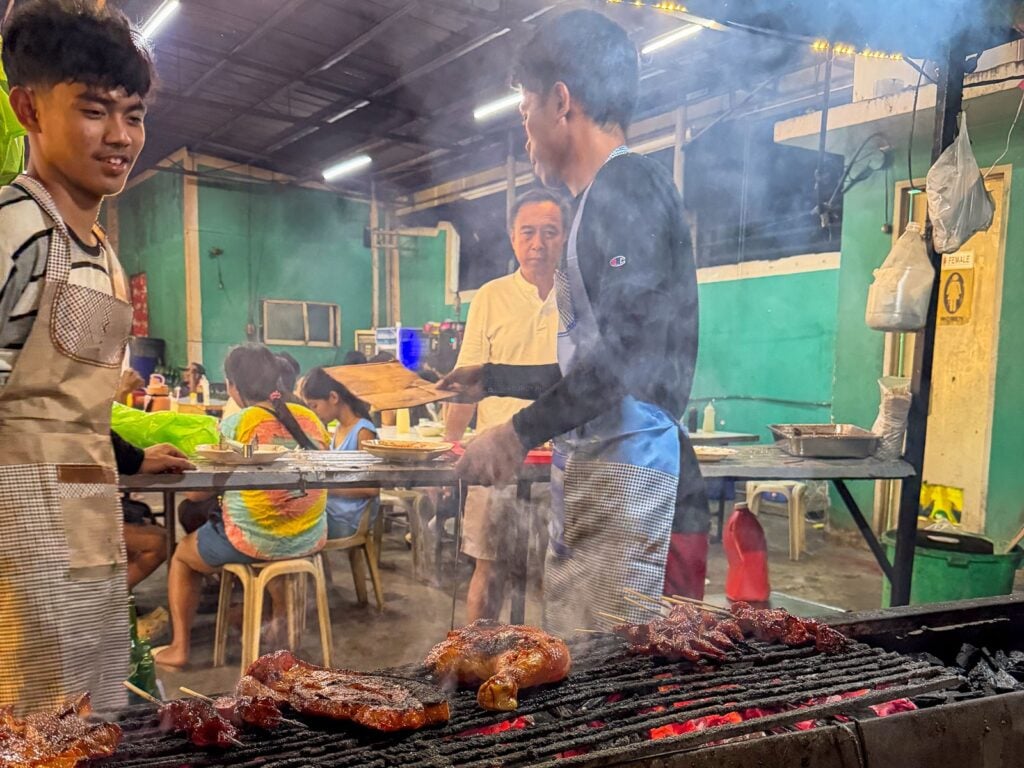
Prices drawn from listings published between 2019 and March 2026. Verify at the door.
The Pasil larangans serve in the early hours of the morning, and the reason is that larang in Cebu City has a long-standing local job as recovery food after a night of drinking.
That is documented rather than folklore, and once you know it the dish makes more sense than it did. Hot, sour, salty, fatty, with chilli in it and a broth you can drink. Every culture with a serious drinking tradition has built something like this. Cebu built it out of porcupinefish.
If you want the version tourists eat, go to a larangan at lunch. If you want the version the dish was actually shaped by, go at 4 AM in Pasil, which is a different proposition and a better story.
More from the same barangay: tuslob buwa, and Carbon Market at night.
Pasil Fish Market, Cebu City, where the dish comes from. 10.2894° N, 123.8858° E
The beach sits about four kilometres from the runway. One of these carries the island. The other carries the runway.
Cebu Coordinates
Island Series
₱999

Airport Series CEB
Mactan-Cebu
₱1,299
A Cebuano fish stew, sour and spicy, built on garlic, red onion, ginger and tomatoes, soured with kamias, tamarind or green mango, seasoned with fermented black beans and fish sauce, and cooked with fresh fish.
Yes. Larang is a Cebuano verb meaning to stew with coconut milk and spices, and linarang and nilarang are affixed forms of the same word. All three refer to the same dish. The eatery that serves it is a larangan.
It depends entirely on where you eat it. The word itself means to stew in coconut milk and many versions use it, but the larangans around Pasil in Cebu City commonly serve a clear, sour broth without any. Both are called larang. Ask before ordering if it matters to you.
Fresh reef and rough fish: porcupinefish (tagotongan), parrotfish (molmol), pufferfish (butete), stingray, triggerfish and moray eel, which is the Cordova version. Barracuda, Spanish mackerel, cobia and marlin also appear. Not dried fish. Grouper is a common accessible substitute.
Larang made with bakasi, the small moray eels caught in the tidal flats of Cordova on Mactan Island, stewed with soy sauce, black beans and tamarind. It is Cordova’s signature dish and the reason the town runs a festival around the eel every August.
Roughly ₱120 to ₱350 a serving as of August 2026, depending on the fish and the setting. Pasil larangans sit at the lower end, restaurants at the upper.
No. SUTUKIL stands for sugba, tuwa and kilaw, grilled, stewed and raw. The stewed slot is a general soup category rather than larang specifically.
A Cebu eatery that specialises in larang. The dish is common enough to have its own category of restaurant, which tells you something about how central it is.