

Panay Church, Capiz: The 10.4-Ton Bell Cast From 70 Sacks of Coins
Dakong Lingganay weighs 10.4 tons and was cast in 1878 from 70 sacks of coins the town donated. It is the largest church bell in Asia, and the church under it went up in 1774.
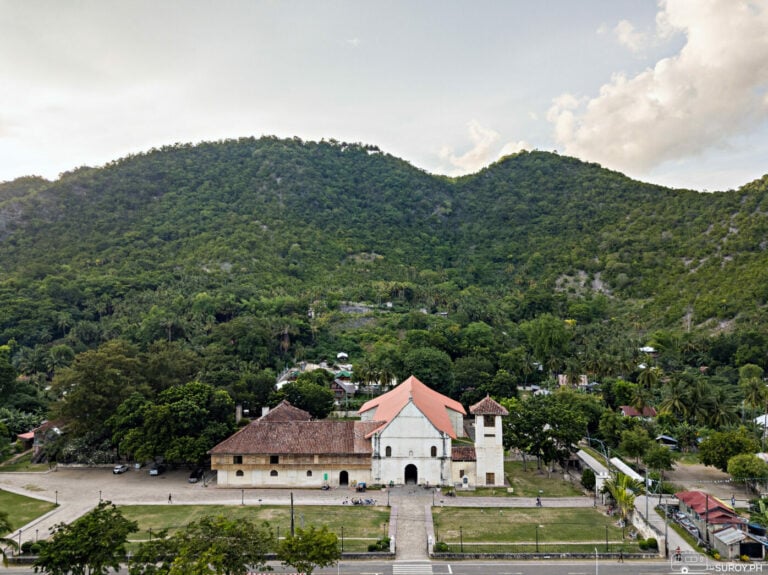
The bell is the reason to come. Dakong Lingganay, the big bell of Santa Monica Parish in Panay, Capiz, weighs about 10,400 kg and measures seven feet across and five feet tall. It hangs at the top of the church’s five-story belfry; the one beside the church at ground level is a full-size replica. The coral-stone church around it was completed in 1884, has been a National Historical Landmark since 1997, and costs nothing to enter.
Panay is its own town, about 20 minutes from Roxas City, not part of it. Give the visit an hour, more if the parish lets you up the tower.
Panay, Capiz · 11.5556° N, 122.7939° E · Checked October 26, 2026

Dakong Lingganay, the Panay bell
The bell was cast by Juan Reina for the rebuilt church, from what the parish says were seventy sacks of coins given by the townspeople. Published casting dates run from 1878 to 1884, and none of them is shown on the bell in our frames. It is rung on special occasions, and its sound is said to carry about eight kilometers.
Its Spanish inscription reads: Soy la voz de Dios que llevaré y ensalzaré desde el principio hasta el fin de este pueblo de Panay para que los fieles de Jesucristo vengan a esta casa de Dios a recibir las gracias celestiales. The plaque on the grounds gives it in English: “I am God’s voice which I shall echo and praise from one end to the other of the town of Panay so that the faithful followers of Christ may come to this house of God to receive the heavenly graces.”
About the rankings. Panay calls it the largest church bell in Asia, and it is very likely the largest in the Philippines, but no published measurement backs the Asia title. The line that it is the third largest bell in the world is simply wrong: Moscow’s Tsar Bell alone weighs about 200 metric tons.
Santa Monica Parish, Panay · Dakong Lingganay
The bell, to scale
Three ways to see the big bell. Tap a view.
Wider than you are tallSeven feet across at the lip, five feet tall, and about 10,400 kg. Stood on the ground, it would reach the shoulders of a 1.65 m adult and be wider than that adult is tall.
Five stories up, one of nineThe real bell hangs at the top of the belfry, ringed by eight smaller ones, and is still rung on special occasions. The climb is a narrow winding stair; ask at the parish office first. The bell at ground level is a full-size replica.
Seventy sacks of coinsThe parish story is that townspeople gave seventy sacks of coins for the casting, which Juan Reina carried out for the rebuilt church. Published casting dates run from 1878 to 1884.
Bell and person drawn to scale from the published dimensions; person shown at 1.65 m. The tower is a diagram.


Panay Church history
Panay was where the Christian story on the island began. The Augustinian Fray Martín de Rada preached here in 1566, the Augustinians established a church by 1572, and Panay became a parish in 1581. Fr. Miguel Murguía built a stone church in 1774. A typhoon on January 17, 1875, wrecked it, and the present church went up on the same footprint, completed in 1884 under Fr. José Beloso.
It is built of coral stone, with walls about three meters thick. The church is about 70 meters long, 25 meters wide and 18 meters high, laid out as a Latin cross. The National Historical Institute declared it a National Historical Landmark in 1997; the marker beside the main doors went up on December 6 that year.


What to see at Panay Church
- The replica bell. Beside the church, at ground level, for everyone who will not make the climb.
- The belfry. Five stories, a narrow winding stair, nine bells at the top. Climbing needs the parish’s permission: ask at the parish office.
- The facade. Plainer than the interior, with niches for Saints Thomas of Villanueva and Monica, the patron.
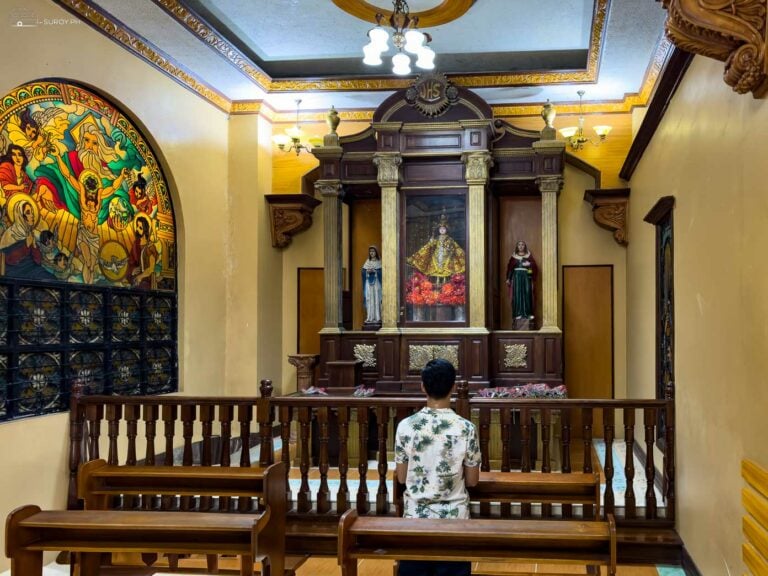
- Inside. A main altar and four side altars with gilded panels, a long nave under chandeliers, and a Lourdes grotto at the foot of the tower.
- Fuente de Vida. The old parish well, roofed and fenced, on the church grounds.
- The museum. A signpost by the church points to the Museo de Sta. Monica. Its opening hours could not be confirmed; early visitors have found it closed.


How to get to Panay Church
- Roxas City first. Roxas is the gateway, with an airport served from Manila and Ceres buses from Iloilo City, roughly three to four hours by road.
- Roxas to Panay. About 20 minutes. Regular tricycles and jeepneys run to Panay town; a regular tricycle costs far less than the fixed-rate round trips some drivers quote.
- Entry. Free. Donations are welcome.
- Mass times. We could not confirm a current schedule. Check the board at the church or with the parish office, and save the interior for between Masses.
The drawbacks: there is not much signage, the museum hours are a gamble, and the tower climb depends on who is in the parish office that day. Go in the morning or late afternoon; the plaza in front has little shade at midday.
Near Panay Church
Two stops in Roxas City pair well with it: the Sacred Heart of Jesus Shrine by the sea, and the Ruins of Alcatraz. Heading south to Iloilo afterward, the Jaro Cathedral guide and the Iloilo City travel guide pick up the trip.
A town that lost its church to a typhoon and built it again, then gave seventy sacks of coins for a bell. The Padayon tee is one word for that: keep going.
Suroy Wear · Statement Series

Padayon.
The Bisaya word for keep going, for every town that rebuilt after the storm. Made in Cebu. ₱999.
Wear the story
Frequently asked questions
How heavy is the Panay Church bell?
Dakong Lingganay weighs about 10,400 kg, roughly 10.4 metric tons. It is seven feet across and five feet tall.
Is the Panay bell the largest in Asia?
It is called the largest church bell in Asia and is very likely the largest in the Philippines, but no published measurement backs the Asia title. It is not the third largest in the world.
Is the bell on the ground the real one?
No. The bell at ground level beside the church is a full-size replica. The original hangs at the top of the five-story belfry.
Can you climb the Panay Church belfry?
Only with the parish’s permission. Ask at the parish office, which arranges a guide when one is available.
Is Panay Church in Roxas City?
No. It is in the town of Panay, Capiz, about 20 minutes from Roxas City.
When was Panay Church built?
The present church was completed in 1884, on the footprint of a 1774 stone church wrecked by a typhoon in 1875.