

Cebu IT Park: The Runway Underneath the Skyline
Cebu IT Park was an airport until 1966, and from the air the runway is still legible in the street grid. A guide to the 24-hour district: the night market, the food, the new BRT line and how to get there.
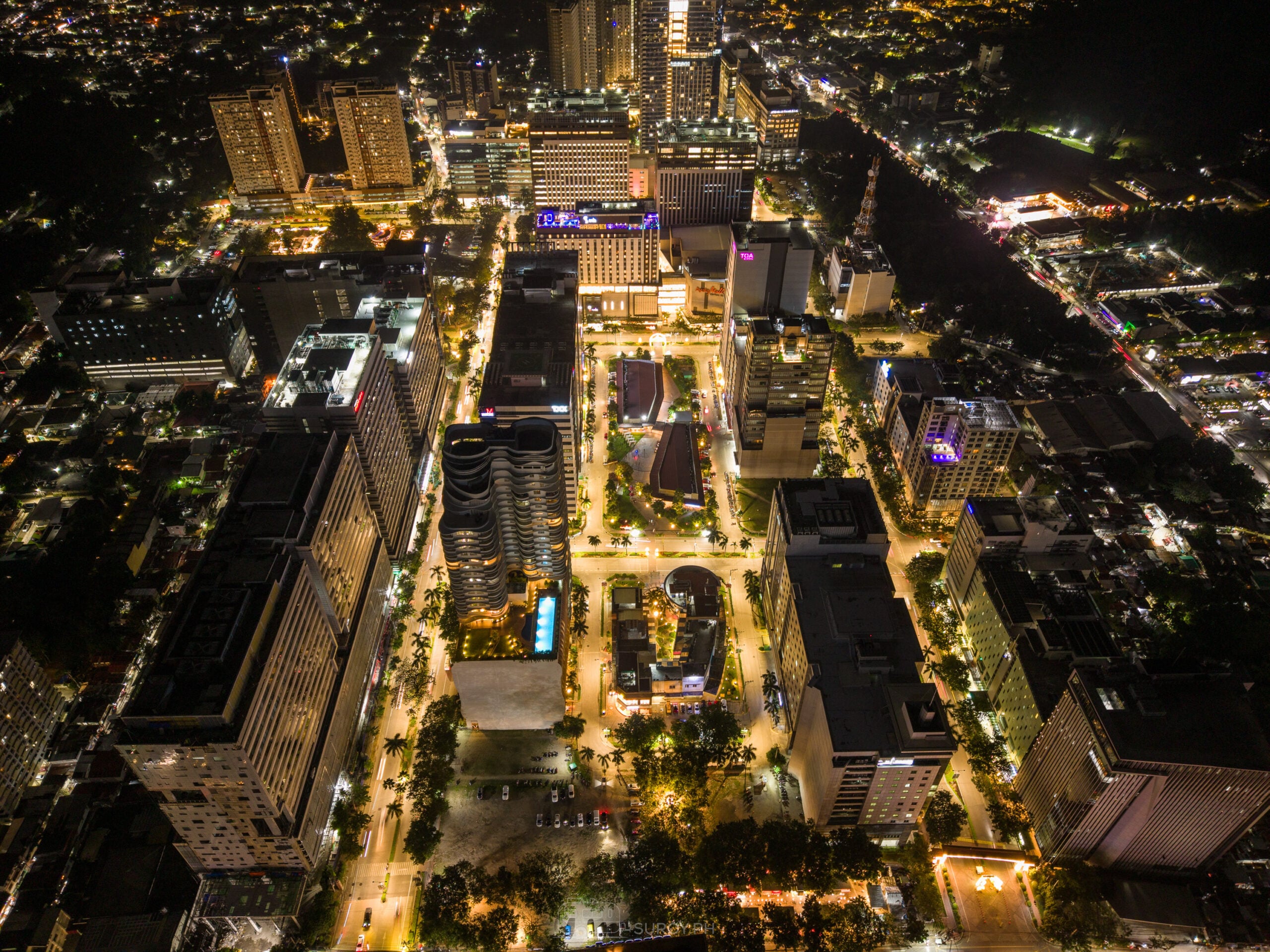
From directly overhead at night, Cebu IT Park does not read as an office district. It reads as a runway.
The long axis running through the middle of the block, the way the loop road bends at the ends rather than turning square, the low structures sitting lengthwise on the open lots where a taxiway would have run: the geometry of an airfield is still legible in the street plan, sixty years after the last commercial flight left. Nobody standing on Inez Villa Street with a milk tea can see it. It only shows from above.
Twenty-seven hectares. Around thirty towers. Tens of thousands of people working through the night. And underneath all of it, the Cebu Landing Field.
There was an airport here

The dates matter, because most accounts compress them into one and get it wrong.
On 24 June 1938, President Manuel L. Quezon designated the landing field at Lahug a military airport by Executive Order No. 154. On 12 August 1947, President Manuel Roxas reclassified it as a national airport under civil aviation by Executive Order No. 75. For nineteen years it was how Cebu connected to the rest of the country.
Commercial operations ceased on 27 April 1966, when everything moved to Mactan. The strip did not disappear. It sat there through the seventies, and on 19 February 1981 more than a million people stood on the old tarmac for an open-air Mass celebrated by Pope John Paul II. Ayala’s Cebu Property Ventures later bought the land, and the airfield closed for good in 1989.
Then it sat empty again. PEZA approved it as an economic zone on 6 April 2000. Presidential Proclamation No. 12, signed 27 February 2001, made it an Information Technology Special Economic Zone. Ground broke on the first office modules that year and they opened in 2002.
Three separate reasons, across sixty years, for a very large number of people to gather on the same rectangle of Apas: to board a plane, to hear a Pope, and now to answer a phone at three in the morning for someone in Ohio.
What Cebu IT Park is now
Twenty-seven hectares in Barangay Apas, developed by Cebu Property Ventures and Development Corporation, a subsidiary of Ayala Land. It holds the eBloc towers, the Skyrise buildings, TGU Tower, Calyx Centre, Park Centrale, the Filinvest Cyberzone towers, Globe Telecom IT Plaza, Avida’s residential towers and the Central Bloc complex, among others. Cebu Exchange, at 164 meters the tallest office building in Metro Cebu, sits on the edge along Salinas Drive.
The business numbers are healthier than they were. Office vacancy fell to about 14 percent in the third quarter of 2025, down from 28 percent in 2022, with more than 96,000 square meters of leasing transacted in the first nine months of that year. Around 10,500 flexible workspace seats sit here, roughly three quarters of Metro Cebu’s entire flex inventory. Filinvest Cyberzone Towers 3 and 4 completed and filled in early 2025.
None of which is why anyone visits. What draws people is that the district never closes.
The night shift is the day shift
The outsourcing floors here run on North American hours, which means Cebu’s small hours are somebody else’s mid-afternoon. The consequence is a genuine 24-hour street economy, rare in the Philippines outside Metro Manila and rarer still at this density.
At two in the morning the cafes are not closing, they are turning over. Convenience stores are busy. Motorbikes queue at the tower lobbies. Shift change is a visible event, a few hundred people crossing between buildings at once, lanyards out, some going home and some starting. The samgyupsal places run unlimited sets at roughly ₱399 to ₱599 and stay open long past the hour a restaurant in a normal business district would have stacked its chairs.
This is the actual attraction, and it is why IT Park earns an evening even from someone with no reason to be in an office park. It is one of the few places in Cebu where a visitor on a broken sleep schedule is not an inconvenience.
Sugbo Mercado is moving
The night market has run for years on the open lot in front of Avida Towers, beside the IT Park transport terminal. It is moving to the lot beside the JPMorgan Chase building, off Inez Villa Street, a short walk across the district. As of 9 August 2026 the new lot had tents up but was not yet trading, and no opening date has been published. Confirm before traveling for it.

The format does not change. Entry is free, most stalls accept G-Cash, and a reasonable budget is ₱150 to ₱350 a head, or ₱500 to ₱700 with drinks and barbecue. Arrive between 18:00 and 19:00. Grilled items start selling out around 21:00.
Full detail, stalls and the current location are in the dedicated Sugbo Mercado guide, and the move itself is covered here.
Eating in IT Park
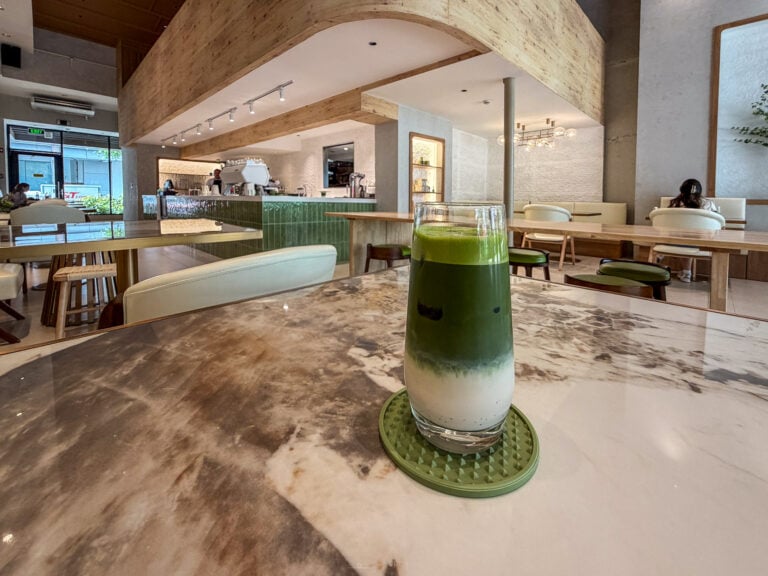
Beyond the market, the district’s food splits into three layers. Ayala Malls Central Bloc covers the air-conditioned end. The loop road carries the mid-range restaurants and the Korean grills. The 24-hour cafes, roughly ₱120 to ₱220 a drink, carry everyone else.
Two places already covered in detail: Sugbo Wings and Coffee Bear.
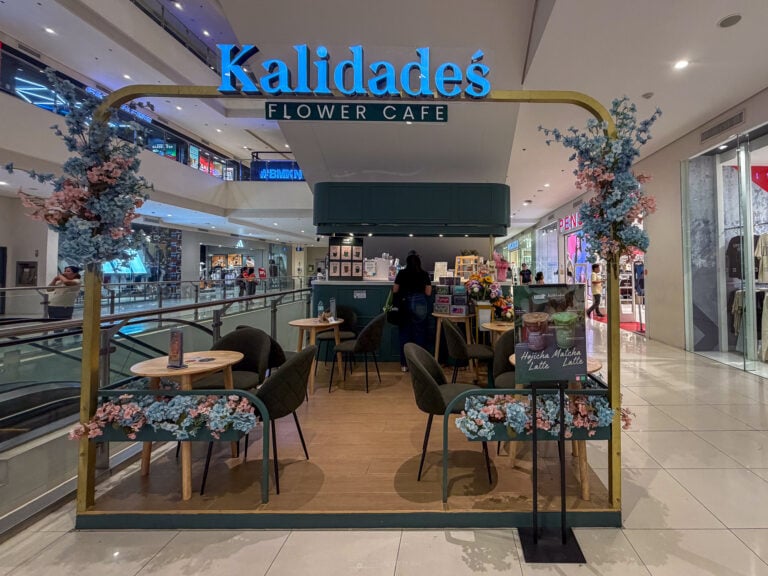
Ayala Malls Central Bloc: the practical indoor stop
Opened on 6 December 2019, Ayala Malls Central Bloc anchors a two-hectare mixed-use block at the heart of IT Park. The development pairs the five-story mall with two office towers and the 214-room Seda Central Bloc. Inside are shops, restaurants, four cinemas and a basement supermarket.

For travelers, it is the district’s easiest indoor reset: a place to cool down, wait out rain, pick up basics or meet before dinner. The IT Park transport terminal is across from the mall, and the official mall directory lists entrances on Inez Villa Street, Padriga Street and W. Geonzon Street. When booking a taxi or ride-hailing car, pin the mall and choose the entrance closest to your next stop.
Mall and tenant hours vary, so check the official Central Bloc listing before a late visit or holiday.
Getting there
The Cebu Bus Rapid Transit now terminates here, and almost no guide has caught up with it. Partial operations began on 13 March 2026 running Il Corso at the South Road Properties to Cebu IT Park, with dedicated lanes along N. Bacalso Avenue and Osmeña Boulevard. Northbound the sequence runs IT Park, Luz, Negros Road, Samar Loop, Pag-IBIG at Ayala, Sacred Heart, Capitol, Fuente, CNU, CSBT, V. Rama, SIT, Mambaling, SM Arena, SM Seaside, Nustar, Il Corso.
Fares from 19 March 2026 start at ₱18.00 for the first five kilometers, then ₱2.97 per additional kilometer, with a ₱14.40 minimum for students, seniors and persons with disability. Rides are free daily from 6:00 to 9:00 in the morning and 5:00 to 8:00 in the evening.
- From Mactan-Cebu International Airport: roughly 13 to 15 kilometers, 25 to 75 minutes depending on traffic. MyBus runs a direct route to the IT Park transport terminal across from Ayala Malls Central Bloc at a flat ₱50, hourly, though that fare dates from its 2025 launch and is worth confirming. Ride-hailing quotes vary widely between sources, from about ₱180 to ₱450, so check the app rather than trusting a number in a guide.
- Jeepney: codes 17B, 17C and 17D run Apas to Carbon. Routes 04L and 04M pass through Lahug and IT Park on the way to Ayala.
- From Ayala Center Cebu: 10 to 12 minutes by car, or the BRT from the Pag-IBIG station.
- Parking: expect roughly ₱30 to ₱50 an hour on the estate. It fills before about 6:30 in the evening on Fridays and Saturdays.
Peak traffic runs 7:00 to 9:00 in the morning and 5:00 to 8:00 in the evening. The district is privately managed, well lit, has visible security and real foot traffic at every hour, which makes it one of the more comfortable places to walk at night in Cebu City.
Up the hill from here
The IT Park transport terminal on Geonzon Street is also the departure point for the TOPS shuttle bus, at ₱200 including the entrance fee and the round trip. That is the cheapest straightforward way from the district to the Busay ridge, and it is published on the operator’s own site while going unmentioned in nearly every guide to the area.
Tops Lookout is open 24 hours at ₱100 regular admission. Temple of Leah sits 2.7 kilometers away, 20 to 35 minutes from IT Park by car depending on the climb. Further along the ridge: Lakeview Le Jardin, La Parisienne Sky and Top of Cebu.
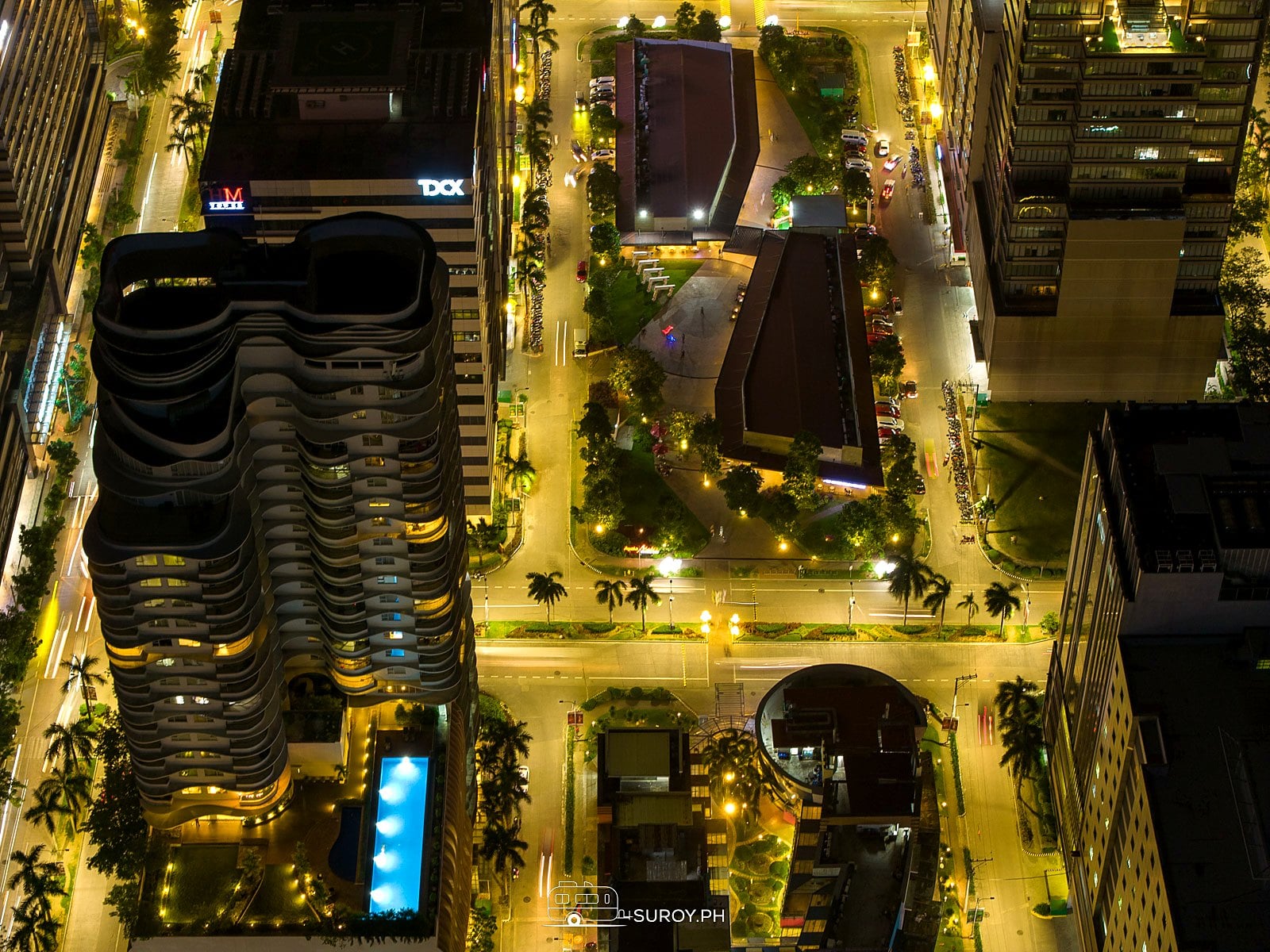
The district from the air


Frequently asked questions
Is there an entrance fee to Cebu IT Park?
No. It is an open, privately managed business district. Entry is free at all hours, including the night market.
What was Cebu IT Park before?
Lahug Airport, Cebu’s civil airport from 1947 until commercial flights moved to Mactan on 27 April 1966. The airfield hosted a Papal Mass for over a million people in February 1981 and closed permanently in 1989 after Cebu Property Ventures acquired the land.
Is Cebu IT Park safe at night?
It is consistently described as one of the safer areas to walk at night in Cebu City. It is privately managed, well lit, patrolled by private security, and carries genuine foot traffic around the clock because of the night-shift workforce. Normal urban precautions still apply.
How do you get from Mactan airport to IT Park?
MyBus runs a direct hourly service to the IT Park transport terminal for a flat ₱50 as of its 2025 launch. Ride-hailing takes 25 to 75 minutes depending on traffic, with quoted fares varying widely. The distance is roughly 13 to 15 kilometers.
Is Cebu IT Park worth visiting?
For the night market, the 24-hour food scene and as a base with easy transport links, yes. As a sightseeing destination in daylight, not particularly. It is a working business district that becomes interesting after dark.
Nearby on Suroy.ph: Sugbo Mercado, Sugbo Wings, Coffee Bear, Tops Lookout, Temple of Leah and Ayala Malls Cebu Business Park.
Fares, transport details and the Sugbo Mercado situation were checked in August 2026. Central Bloc details were checked in September 2026. The night market is moving to the lot beside JP Morgan.