ByPat
Coron Palawan Travel Guide: Itinerary, Costs and the Month Everyone Skips
A complete Coron guide: four-day itinerary, current 2026 prices, Kayangan Lake, Twin Lagoon, Mount Tapyas and the Tagbanwa ancestral domain the whole island runs on.
Coron is the best three days in the Philippines. August, the month every guide tells travelers to avoid, is a gamble worth taking.
Both of those things are true at once, and the second one needs the honest version. August is peak habagat, the southwest monsoon. Coron averages around 487mm of rain across roughly 27 rain days that month. Tourism sites rate it as a period when boat trips, diving and snorkelling are not recommended. When a storm warning goes up, the coast guard cancels every island hopping tour in the bay, and no amount of money changes that.
What the warnings leave out is that August is also Kasadyaan, Coron’s month-long town fiesta, with a perya running beside the plaza and the church on Roxas Street dressed in yellow banderitas. Not one guide on the first page of Google mentions it.
This is the complete guide: the logistics, the current prices, the tours, the part about whose island it actually is, and the case for the month everyone skips.
Where Coron actually is, and why that matters

First correction, and almost every first-timer gets it wrong. Coron town is not on Coron Island.
Coron town sits on Busuanga Island, at 11.9986° N, 120.2052° E. That is where the airport is, where the hotels are, where people eat. Coron Island is the karst wall visible across the water, roughly 30 to 45 minutes south by outrigger banca. Kayangan Lake, Barracuda Lake and Twin Lagoon are all there. Visitors sleep on one island and spend their days on another.
The whole group is the Calamianes, at the northern tip of Palawan province: Busuanga, Coron Island, Culion, Calauit and a scatter of smaller ones. Getting this straight resolves half the confusion in Coron trip planning, including why the question of how far Kayangan Lake is from a hotel has no useful answer until it is understood as a boat ride.
How to get to Coron

By air
Flights land at Francisco B. Reyes Airport (USU) on Busuanga. It has a single 1,200m runway and no instrument landing system, which is why it operates daylight hours only, roughly 06:00 to 17:00. There is no such thing as a late flight into Coron. A delayed Manila leg means not landing at all.
Cebu Pacific, Philippine Airlines and Sunlight Air fly from Manila, Clark and Cebu. Flight time from Manila is just under an hour. Return fares run ₱1,500 to ₱4,000 depending on how early the booking goes in and whether a seat sale is running.
Airport to town is ₱150 to ₱250 per seat in a shared van, or ₱800 to ₱1,500 for a private one. Budget 25 to 45 minutes depending on the road and how many hotels the driver is dropping at.
By sea
- Manila to Coron: Atienza Interisland Ferries RORO, around 13 hours, economy from ₱1,700. Sailings midweek and Saturday.
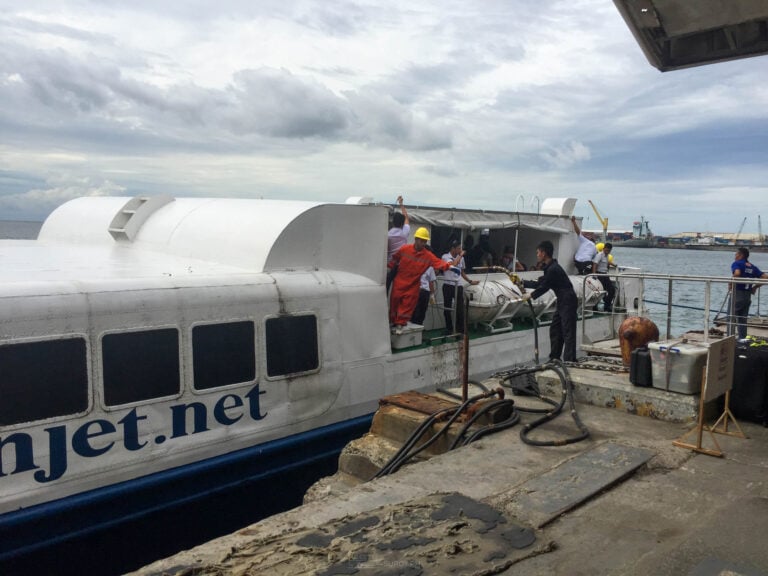
- El Nido to Coron: the popular one. Montenegro, Jomalia, Atienza and Calamianes Fast Ferry run it daily, 3 to 5 hours, roughly ₱1,600 to ₱3,000 depending on operator and speed. Most depart late morning to midday.
- Puerto Princesa to Coron: 8 to 10 hours and not worth it. Fly, or route through El Nido.
- Coron to Culion: Montenegro RORO, 1 hour 30, ₱325, twice daily each way.
Anyone combining Coron with El Nido should do El Nido first and ferry north. The boat ride works better in that direction and it lands in Coron with the tours still ahead.
How many days to spend in Coron
Three full days is the honest minimum. Four is right. Five allows Calauit or Culion.
| Days | What fits |
|---|---|
| 2 | One island hopping tour and Mount Tapyas. Rushed, and a lot gets missed. |
| 3 | Two tours, Mount Tapyas, Maquinit Hot Spring, the town. The sensible floor. |
| 4 | All of the above plus a weather buffer day. The recommended length. |
| 5+ | Add Calauit Safari Park, Culion, or wreck diving. |
That buffer day is not padding. In rainy season it is the difference between seeing Coron Island and not seeing it.
A four-day Coron itinerary
Day 1. Land in the morning, van to town, drop bags, eat. Walk to San Agustin Parish Church on Roxas Street. Climb Mount Tapyas at about 16:30 to reach the cross for sunset. Dinner in town.
Day 2. The Coron Island Ultimate Tour. Kayangan Lake, Barracuda Lake, Twin Lagoon, a coral garden, Banol Beach, Skeleton Wreck, CYC Beach. Out at 08:00, back around 17:00.
Day 3. Island Escapade or Reefs and Wrecks, then Maquinit Hot Spring after dark.
Day 4. Buffer. If the weather held, use it for Calauit Safari Park or a Culion day trip. If it did not, this is the day to go back out.
Coron Island: the lakes and lagoons
Everything below sits inside the Tagbanwa ancestral domain, and that shapes the entire visit. The section further down explains why, and it is worth reading before booking a tour.
Kayangan Lake
11.9534° N, 120.2235° E. Entrance ₱300.

The most photographed lake in the Philippines, and the one most people misunderstand.
The famous photo is not the lake. The viewpoint with the wooden deck, the karst spires and the bancas moored below sits on the stairway between the boat landing and the lake, and it looks backwards, down over Kayangan Bay. The lake itself is over the ridge, another few minutes up and then down. Almost everyone who posts that shot has photographed the wrong body of water.
The lake earns the climb regardless. Brackish, clear enough to lose track of depth, walled in by limestone, and connected to Awuyuk Cave, a near pitch-black cavern at one end.

The rules are not negotiable. Life jackets are mandatory, and that rule exists because two tourists drowned here in 2017. Freediving and scuba are restricted. Reef-safe sunscreen only, applied before leaving town. Operating hours roughly 07:00 to 16:00, no overnight stays. And no drones, which matters more than it first appears.
The Kayangan crowd problem, in numbers
In 2022 the Asian Development Bank published a carrying-capacity study for Coron and El Nido. It put Kayangan Lake’s real environmental carrying capacity at roughly 70 snorkelers per day.
In 2018, Kayangan took around 100,000 visitors.
That is roughly four times over, every day, for years. The study recommended upper and lower limits rather than a hard cap, and as of August 2026 no enforced daily cap appears to have been published.
The practical response is to get there first. Joiner tours leave town from about 08:00 and reach Kayangan between 09:00 and 10:00. A private boat leaving at 07:00 buys a nearly empty lake. It costs more, and it is the single best money spent in Coron.
Twin Lagoon
11.9478° N, 120.2096° E. Entrance ₱200.


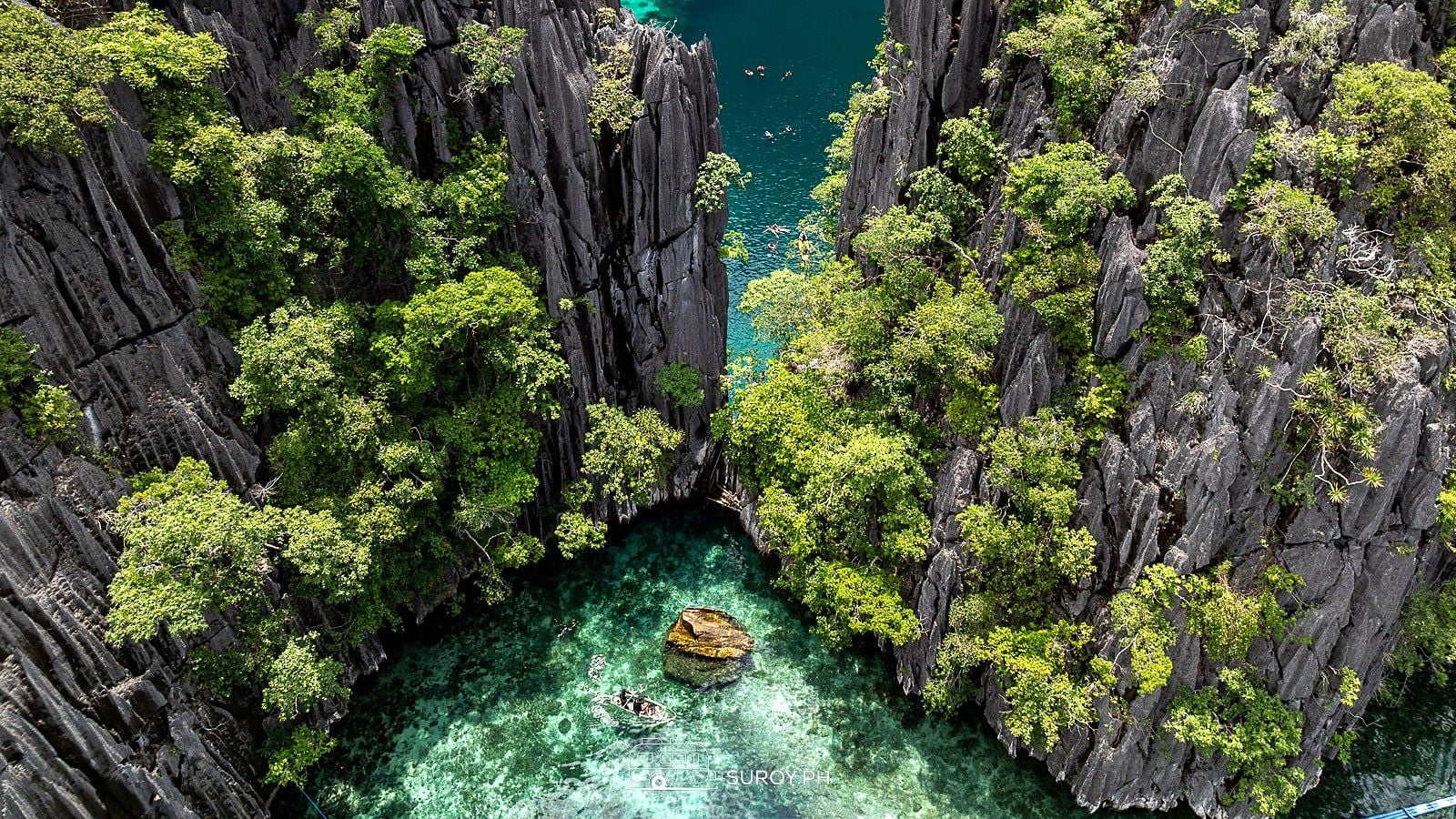
Two lagoons split by a thin limestone wall. The outer one takes the boats and the kayaks. The inner one is the swim. There are two ways through: a wooden staircase over the wall, or, at low tide, ducking under the wall through a submerged gap. Which option a visitor gets is decided by the tide, not by preference.
Most guides claim a sharp temperature and salinity difference between the two lagoons where fresh water meets salt. No source measuring it could be found, so no number appears here.
The blue hole nobody names

Fly out of Twin Lagoon, climb, and turn back toward the reef flat outside the entrance. There is a large, almost perfectly circular deep-blue hole set into pale shallow coral, like something punched clean through the reef.
It has no published name. Twin Lagoon has a name. Barracuda has a name. Malwawey has two. This, visually the most dramatic feature in the neighborhood, has none. The only other account of it comes from a couple who flew a drone over the same reef, compared it to the blue hole in Belize, and wrote that no tour group, website or boat crew had mentioned it to them. Their captain’s explanation was that locals do not go because visitors never ask.
It cannot be seen from a boat. It only exists from a couple of hundred meters up. That is the whole story of drone photography in the Philippines in one reef.

Barracuda Lake
11.9551° N, 120.2167° E. Entrance ₱200.
The strangest water in Coron and the reason divers fly in. Reaching it means scrambling up and over jagged limestone. The surface sits around 28°C. Then at roughly 14 meters down the temperature spikes to about 38°C, hot enough that a wetsuit becomes a nuisance. There is a halocline as well as a thermocline, fresh water sitting on salt, refusing to mix, the boundary shimmering like heat off asphalt.
Almost no coral, almost no fish. That is not the point. The point is bare white limestone falling away in 30m visibility and a visible seam where the lake changes state. It is named for the barracuda the Tagbanwa found sheltering in it. Deaths here have been depth related. Respect the briefing.
Coral gardens, and a naming trap
Coron has several stops called “Coral Garden” and they are not the same place.
- Twin Peaks Coral Garden, 11.9540° N, 120.2120° E, ₱150. Between Twin Lagoon and Barracuda.
- Malwawey Coral Garden, also called Atwayan, 11.9397° N, 120.1909° E, ₱150. Southwest coast, about 1.9km from Twin Lagoon.
- Coral Garden Reef, a separate feature again, 11.9504° N, 120.1970° E.
If a boatman says coral garden, ask which one.
The beaches
- Banol Beach, 11.9503° N, 120.1931° E, ₱150 to ₱200. About 400m of beige sand under steep cliffs, boat access only, has toilets. The classic lunch stop.
- Smith Beach, 11.9467° N, 120.1936° E, ₱150. Much smaller, a cove of around 30m.
- CYC Beach, 11.9637° N, 120.1807° E, free. Not on Coron Island at all but its own small island in the bay. Usually the last stop before home.
Siete Pecados Marine Park
Entrance ₱100. Less than 3km from town, so it lands first or last in the day.
Seven rocky islets over 180 hectares, protected since 2005, managed jointly by the Coron municipal agriculturist’s office and Barangay Tagumpay. It won a Blue Park Award at silver level in 2024. The reef tops out around 2m and drops past 8m, and it holds hawksbill turtles, dugong, humphead wrasse and Pectinia maxima, an endangered endemic coral. It has the highest fish species richness and biomass in the entire Calamianes protected-area network, which is remarkable given how many boats cross it daily. For one snorkel in Coron, this beats most of the beaches.
The part most guides leave out: whose island this is
Coron Island is not a tourist site with locals nearby. It is the ancestral domain of the Calamian Tagbanwa, who call the island Calis, and the tourism happens by their permission.
The sequence matters. The Tagbanwa Foundation of Coron Island formed in 1985. In 1990 it secured a stewardship agreement over land. In 1998 it was awarded a Certificate of Ancestral Domain Claim covering roughly 22,000 hectares, and in 2001 a full Certificate of Ancestral Domain Title.
It was the first ancestral domain claim in the Philippines to include ancestral waters. They called it teeb surublien, inherited seas. When a provincial task force tried to shrink the claim to around 8,000 hectares by stripping the water out of it, they refused and kept the whole thing, sea included. That decision is the reason Coron looks the way it does today.
Ten of the island’s twelve freshwater lakes are sacred and closed to outsiders. Only Kayangan and Barracuda are open, at set hours, with no overnight stays. Only seven of the island’s thirty-three beaches are open. The Tagbanwa performed a ritual called uliwansag, asking the spirits of the lakes for permission, before opening any of them to visitors at all.
So when the sign at Kayangan says no drones, that is not a bureaucrat being difficult about airspace. It is a request not to fly a camera over somebody’s sacred ground. Suroy.ph is built largely on aerial photography and the position here is plain: put the drone away at Kayangan. Every aerial frame in this guide was shot at Twin Lagoon or over Busuanga. There is more than enough sky everywhere else.
The entrance fees at each site go to the roughly 2,000 tribal members living in villages on the island. That ₱300 at Kayangan is not a gate charge. It is the arrangement that lets anyone in at all.
Coron town: Mount Tapyas, the church, and the fiesta nobody writes about
Mount Tapyas
Free. Summit 210m. Climb 20 to 30 minutes.

The steps are painted with numbers and the internet has settled on 721. Some guides say 724, some say around 700, and at least one writer who counted argues it is nearer 300 to 400, on the grounds that the painted numbers arrive far too quickly to be honest. What is not in dispute is that it is a hot, steep, unshaded staircase with benches at intervals, and there is no road, so walking is the only option.
At the top there is a steel cross, a viewing platform, and the giant white CORON letters that light up after dark. The reward is the entire bay, the karst islands stacked to the horizon, and the town laid out below.


Go at 16:30. Earlier and the climb cooks. Later and it happens in the dark.
The cross is one of the eight in Sacred Heights: Religious Structures on Philippine Hills and Mountains.
San Agustin Parish Church
Roxas Street, Coron Town Proper. The patron is Saint Augustine, feast day 28 August. Masses run daily, Sunday from 06:00.

Kasadyaan Festival, and why August is not the disaster it looks like
Kasadyaan is Coron’s town fiesta. The word is Cuyunon for happiness. It is a thanksgiving festival honouring San Agustin and it runs through August, typically opening in the first half of the month and building toward the feast day on the 28th.

Parades, street dancing descended from the traditional ati-ati, sports, nightly variety shows, an agri-trade fair, and a perya at the plaza. None of it appears in the guides that tell travelers to skip August.
Two traps for anyone researching it. There is a different Coron Festival in early August honouring Our Lady of Salvation, and that one is in Tiwi, Albay, nothing to do with Palawan. And one Palawan festival calendar files Kasadyaan under July, contradicting every other source. Confirm current-year dates with the Coron LGU tourism office.
Maquinit Hot Spring
₱200 adult, ₱100 under 10, ₱143 senior and PWD. Open 08:00 to 20:00, last entry 19:00.
38 to 40°C, and it is saltwater, geothermally heated groundwater mixing with the sea. It is widely described as the only saltwater hot spring in the country. Barangay Tagumpay, 20 to 30 minutes from town on a rough road, tricycle round trip ₱300 to ₱400. Go at night after a full day on a boat.

Beyond Coron Island
The WWII Japanese shipwrecks
On 24 September 1944, more than 100 aircraft from US Task Force 38 hit the Japanese fleet sheltering in Coron Bay. What went down that day is now one of the best wreck-diving sites on earth, ranked by Forbes Traveler in the global top ten.
| Wreck | Type | Length | Depth | Level |
|---|---|---|---|---|
| Okikawa Maru | Oil tanker | 170m | 10 to 26m | Open Water + |
| Morazán / Olympia Maru | Freighter | 93m | 12 to 25m | Open Water + |
| Tangat Wreck | Freighter | 127m | 21 to 30m | Advanced / Wreck |
| Kogyo Maru | Auxiliary supply | 129m | 22 to 36m | Advanced / Wreck |
| Akitsushima | Flying-boat tender | 118m | 22 to 36m | Technical |
| Irako | Provision ship | 147m | 34 to 45m | Technical |
| Kyokuzan Maru | Auxiliary freighter | 135m | 22 to 39m | Deep / technical |
Non-divers get three shallow enough to snorkel: Skeleton Wreck (about 25m of hull, 5m at the top down to 22m at the stern), East Tangat Wreck and Lusong Gunboat. The Reefs and Wrecks tour is built around them. Wreck dives run roughly ₱2,500 to ₱4,000.
Calauit Safari Park
₱400 entrance plus ₱100 environmental fee. Tours ₱2,300 to ₱2,700. About 2 hours 15 by road and boat from Coron town.
There are giraffes and zebras on an island in Palawan, and the reason is not a happy one.
Marcos declared Calauit a game preserve by presidential proclamation on 31 August 1976, saying it answered a Kenyan request routed through the IUCN for help conserving endangered species. The IUCN has no record of any such request. On 4 March 1977, 104 animals across eight species arrived: giraffes, zebras, impalas, waterbucks, elands, bushbucks, gazelles and topis.
Roughly 254 Tagbanwa families were evicted to make room and moved 40km to Halsey Island, a former leper colony. A UN report described the move as under duress. The provincial government took over administration in 2008, and in 2010 the Tagbanwa were finally granted ancestral land title.
Most of the African species have died out. Giraffes and zebras remain. The park now leans on what belongs here: 1,200 to 1,300 Calamian deer, Philippine crocodile, Palawan bearded pig. Worth going, worth knowing what it is.
Culion
The old leper colony, 1 hour 30 by RORO from Coron, ₱325 each way, twice daily. Day tours around ₱1,200.
Founded in 1906, opening with 370 patients shipped in from Cebu. Roughly 5,303 people were relocated there between 1906 and 1910, making it the largest colony of its kind anywhere. The WHO declared Culion leprosy-free on 18 June 2006, a century to the day after it began. The Culion Museum and Archives entered UNESCO’s Memory of the World Register for Asia-Pacific in 2018. It is the most affecting half-day in the Calamianes and hardly anybody makes the trip.
Malcapuya, Banana, Bulog Dos and Black Island
The Island Escapade tour, roughly 90 minutes out, and a completely different landscape from Coron Island. No karst walls, just long white beaches and sandbars.
Malcapuya ₱250 to ₱300, Banana ₱300, Bulog Dos ₱200, Ditaytayan ₱200. Black Island (Malajon) is ₱200 to ₱250 and a serious commitment, about 3 hours from town by van and boat, realistically only worth it bolted onto the Calauit trip. Black limestone cliffs, white sand, a cave with a pool inside it, and a wrecked hull sitting in a few feet of water.

Coron tour prices
Joiner rates, including entrance fees, environmental fees, hotel transfers, lunch, water, life vest and guide. Roughly 08:00 to 17:30.
| Tour | Price | What it covers |
|---|---|---|
| Coron Island Tour A | ₱1,200 | Kayangan, Twin Lagoon, coral garden, beach |
| Coron Island Tour B | ₱1,400 | Barracuda, Twin Lagoon, Skeleton Wreck, CYC |
| Ultimate Tour | ₱1,700 | Kayangan, Barracuda, Twin Lagoon, coral garden, Banol, Skeleton Wreck, CYC |
| Island Escapade | ₱1,700 | Bulog Dos, Malcapuya, Ditaytayan |
| Reefs and Wrecks | ₱1,700 | East Tangat, Lusong Gunboat, coral garden, Pass Island |
| Calauit Safari | ₱2,700 | Plus ₱100 environmental fee |
| Town Tour + Hot Spring | ₱800 | Mount Tapyas, church, Maquinit |
| Black Island or Pamalican add-on | +₱600 | Each |
Private boats run ₱3,500 to ₱9,500 depending on destination and group size. Guide fee is typically ₱500 per tour, charged separately on DIY trips.
For one tour only: the Ultimate Tour at ₱1,700. It is ₱500 more than Tour A and covers nearly everything. Splitting Tour A and Tour B across two days costs ₱2,600 and duplicates stops.
For one upgrade only: a private boat for the Kayangan morning, leaving at 07:00.
What Coron costs: a real four-day budget
Those figures are one four-day trip. If yours is longer, cheaper, or shared differently, the Palawan trip cost calculator runs the same price model for Coron, El Nido and Puerto Princesa against your own dates.
| Item | Budget | Mid |
|---|---|---|
| Accommodation, 3 nights | ₱2,100 | ₱5,400 |
| Airport transfers, both ways | ₱400 | ₱500 |
| Ultimate Tour | ₱1,700 | ₱1,700 |
| Second tour | ₱1,700 | ₱1,700 |
| Maquinit Hot Spring plus trike | ₱400 | ₱400 |
| Food, 4 days | ₱2,000 | ₱4,000 |
| Tricycles around town | ₱200 | ₱200 |
| Total | ₱8,500 | ₱13,900 |
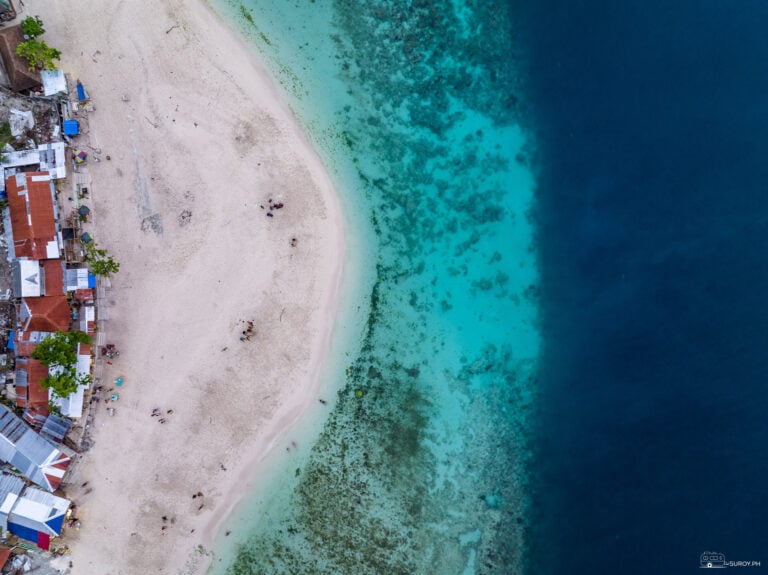
Accommodation bands in Coron town: dorm ₱350 to ₱600, fan private ₱700 to ₱1,200, aircon private ₱1,000 to ₱1,800, mid-range ₱1,800 to ₱3,500, resort ₱4,000 and up. Almost nothing in town proper is beachfront, which surprises people. Coron town is a working port. The beautiful part is a boat ride away.
When to go

Best: December to April. Dry, calm seas, tours run. Best diving visibility: March to May. Rainy: June to October.
August in numbers: around 487mm of rain, roughly 27 rain days, air 28 to 29°C, sea about 28.5°C, humidity around 80 percent. Ten of those days bring heavy rain.
The real risk is not rain. Warm rain on a boat is fine. The real risk is cancellation. When a warning goes up the coast guard grounds every island hopping boat in the bay. That is exactly why a rainy-season trip needs a buffer day, and why August works with four days rather than three.
Practical notes
- Cash. ATMs in Coron town run dry, especially at weekends and during fiesta. Bring more than expected from Manila or Cebu.
- Reef-safe sunscreen. Buy it before flying. Apply before leaving town.
- Water shoes. The Barracuda Lake approach is jagged limestone and the Kayangan steps get slick.
- Dry bag. Bancas take spray, and in August they take rain.
- Drones. Not permitted at Kayangan Lake. National rules keep flights under 400ft and away from the airport zone. Busuanga airport sits at 12.1215° N, 120.1000° E.
- Book tours the day before from a hotel or a town agency. There is no need to prepay online at inflated rates.
- Phone signal is decent in town and gone on Coron Island. Expect to be offline 08:00 to 17:00.
Frequently asked questions
Is Coron better than El Nido?
Different, not better. Coron is karst walls, lakes and wrecks. El Nido is beaches and lagoons. Coron is the stronger diving destination and El Nido has the better beaches. Do both, El Nido first, then ferry north.
Do you need to book Coron tours in advance?
No. Book the day before from a hotel or a town agency. The only thing worth arranging early is a private boat in high season.
Can you fly a drone in Coron?
In most places yes, at Kayangan Lake no. That prohibition exists because Coron Island is Tagbanwa ancestral domain and the lakes are sacred. National rules also apply: stay under 400ft and out of the airport zone.
How many steps is Mount Tapyas?
The steps are numbered to 721 and most guides repeat it. At least one writer who counted puts it closer to 300 to 400. It takes 20 to 30 minutes either way.
Is Kayangan Lake worth it with the crowds?
Yes, with an early start. The ADB put its environmental carrying capacity at around 70 snorkelers a day and it has taken close to 100,000 in a year. Leaving at 07:00 on a private boat makes it a different lake.
What is the environmental fee in Coron?
There is no single blanket fee. In practice each site charges ₱100 to ₱300, and joiner tours bundle it into the price. Calauit charges a separate ₱100.
Is August a bad time to visit Coron?
It is the riskiest month, with roughly 27 rain days, and tours do get cancelled when warnings go up. It is also Kasadyaan festival month with far fewer tourists. Go with four days and a flexible attitude.
Should you stay in Coron town or at a resort?
Town, for a first trip. Everything leaves from town, it is cheaper, and the food is there. Coron town is not a beach town, so do not book expecting sand outside the door.
Wear the story
Coron from a few hundred meters up and Coron from the waterline are two different islands. The Palawan Above & Below Tee is about exactly that. Shop the Island Series at suroywear.com.
Where to next: Siquijor, Guimaras, Sacred Heights.
Fares, fees and tour prices checked in August 2026. Photography by Suroy.ph, shot on Busuanga and at Twin Lagoon in August 2024. No aerial images were taken over Kayangan Lake.