Newsletter Subscribe
Enter your email address below and subscribe to our newsletter


Registration is the wrong first question. The rule that stops most drone flights in the Philippines is the ten kilometre circle around every aerodrome, and it covers most of the coastline.
Most people arriving in the Philippines with a drone in the carry on ask the wrong question first. They ask whether they need to register it. The answer is usually no, and it is the least useful answer available, because the rule that actually stops them flying has nothing to do with registration.
It is the ten kilometre circle around every aerodrome. Draw it on a map of the places people bring drones to photograph and very little of the coastline survives.
Fly a consumer drone recreationally, under seven kilograms, and under the civil aviation authority’s published guidance you need no registration and no controller certificate. What you do need is to stay inside the operating limits, and to get a special permit for anything that breaches them.
The limits are not generous, and one of them is the whole story.
These come from Part 11 of the Philippine Civil Aviation Regulations, in the consolidated January 2026 edition. They are the operating rules for the open category, and they apply whether or not your aircraft is registered.
| Limit | Rule |
| Maximum altitude | 120 metres above ground level. Not 400 feet. |
| Line of sight | Visual line of sight at all times. Beyond it needs a special permit. |
| Time of day | Daylight only. Night flying prohibited unless indoors or shielded. |
| Distance from people | 30 metres horizontally from anyone not involved in the operation. |
| Distance from aerodromes | 10 kilometres. Inside that, and inside controlled airspace, a special permit is required. |
The regulation says 120 metres above ground level. That converts to 393.7 feet.
Four hundred feet is the United States figure, and it is repeated on almost every English language page about Philippine drone law, including one of the civil aviation authority’s own web pages. The regulation itself does not contain the string. Nor does it contain 122 metres, which is the metric conversion of the American limit and which turns up in guides that have converted the wrong number twice.
Six feet is not going to be the difference between a legal flight and a seizure. It matters because of what it reveals: a great deal of what circulates about flying here has been assembled from American rules with the place names changed.
This is the rule to plan around.
The Philippines has an unusual geography of aerodromes. Islands that exist as destinations tend to have an airstrip on them, and that airstrip tends to be near the part of the island people photograph. A ten kilometre radius from a runway is not a technicality on a map like this. It is most of the map.
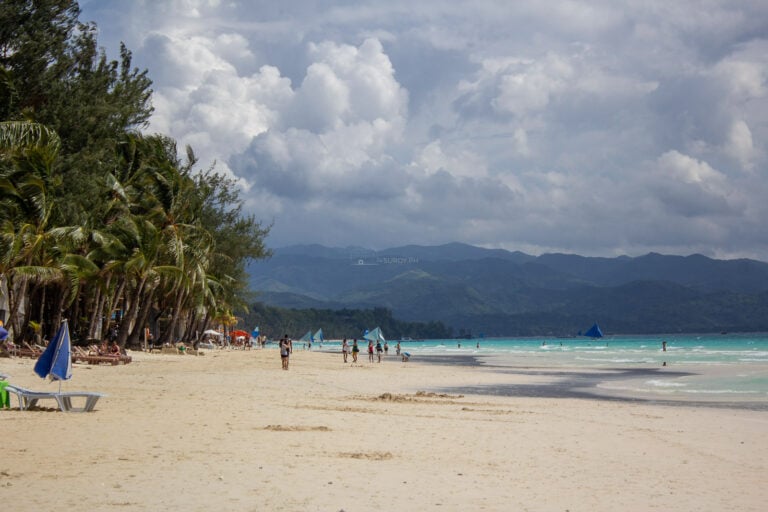
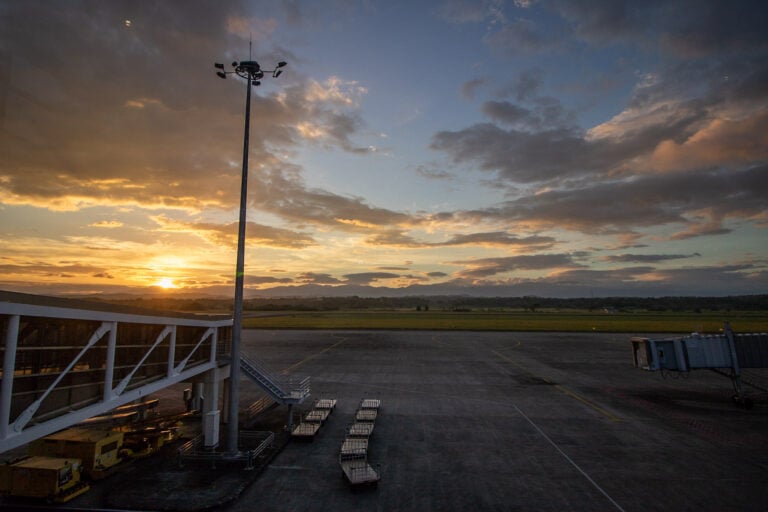
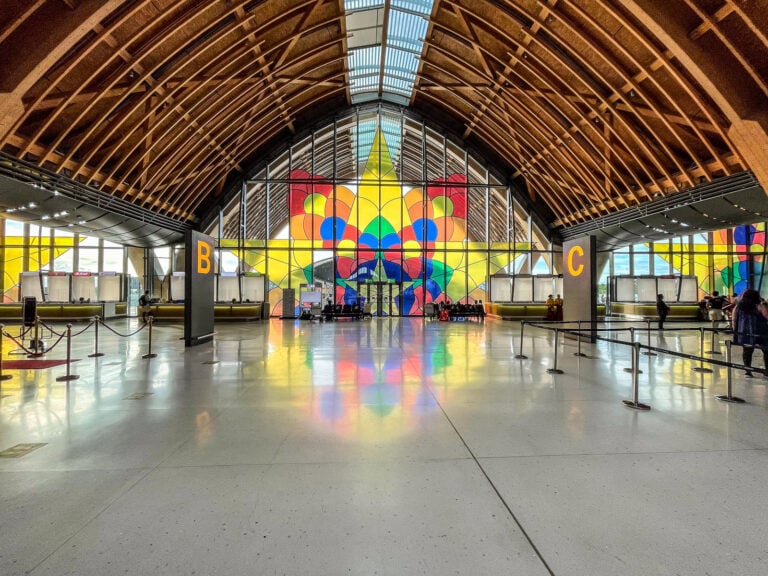
Caticlan sits across the channel from Boracay. Sayak sits on Siargao. Lio sits at El Nido. Busuanga serves Coron. Panglao’s airport is on Panglao. Mactan is in the middle of Cebu’s built up east coast, and Metro Manila has three runways inside it. In each of those cases, the beach in the photograph and the runway are inside the same circle.
The practical consequence is that a very large share of Philippine drone footage on the internet was taken inside a ten kilometre buffer, and a very large share of it was taken without the special permit that buffer requires. Common practice is not the same thing as legal, and the gap only becomes your problem at the moment somebody decides to enforce it.
Where a permit is not realistic, the honest options are to fly outside the circle or not to fly. Suroy.ph would rather say that than pretend the rule is softer than it reads.
Here is where the record needs correcting, and the correction is uncomfortable because both sides of it are the government.
The civil aviation authority’s service pages, the ones a traveller actually lands on, describe a seven kilogram threshold. Non commercial aircraft of seven kilograms and above must be registered. Below that, recreational flying needs no registration and no certificate. That framework descends from a memorandum circular issued in 2015.
The current regulation runs on a different structure entirely. Part 11 in its January 2026 edition, as amended in March 2025, splits operations into an open category at twenty five kilograms maximum takeoff mass or below, and a specific category above it. The figure seven kilograms does not appear in the text at all.
Those are two live regimes describing the same activity. Suroy.ph could not resolve which governs registration specifically, because the amending circulars that would settle it have been published as scanned images with no readable text layer, and registration itself is governed by a different part of the regulations that cross references rather than states.
What we can say is this. If you are flying a consumer drone, you are under both thresholds and the question is academic. If you are flying something heavier, do not rely on a number you read anywhere, including here. Write to the authority’s airworthiness division and get it in writing.
There is a related figure worth killing outright. Several widely read guides state that any drone over 250 grams must be registered in the Philippines. That threshold does not exist in Philippine regulation or in the authority’s own guidance. It is the American rule.
Registration costs ₱1,500 plus twelve percent VAT, so ₱1,680 all in. Not ₱1,000, which is another figure in circulation.
There is no online portal. The registry portal referenced in some guides is an information page, not an application system, and the claim that it accepts foreign passport numbers is not supported by anything the authority publishes.
The process runs like this. Reserve a registry mark, which takes about five working days to approve and produces a code in the form RP-U followed by a number and a letter. Assemble the file: a letter of intent, a notarised application on Form 1028-1, a colour photograph of the aircraft carrying its Philippine markings, documentary evidence of ownership such as an invoice or a notarised affidavit, import documents if it was bought abroad, business registration or a valid ID, an insurance policy, and the aircraft specifications. Pay. Then present the aircraft for physical inspection in Pasay City. Certificate issuance is quoted at nineteen working days after that.
The validity period of the certificate is not published. The authority’s page omits it and the circular that would govern it is one of the scanned ones. We are not going to invent a number for it.
Keep your purchase receipt and any customs paperwork from the way in, and the carry on rules cover how the batteries have to travel. Registration asks for import documents, and reconstructing them later is worse than keeping them.
Required for anyone flying commercially, and for anyone flying an aircraft of seven kilograms and above under the authority’s published framework.
Minimum age eighteen. You need an authorised training course, manufacturer training on the type, at least five hours on type, five hours outside controlled airspace, a written examination and a demonstration flight. The written exam is ₱230 per subject, the knowledge test report ₱140, and the application ₱3,360. Validity is five years. Processing is quoted at five working days after final submission.
The authority publishes nothing about whether foreign nationals can hold one. That silence is discussed below.
The authority’s definition is short and broad. Commercial means activities requiring the use of drones for revenue purposes. Non commercial means sports and recreational purposes. There is no middle category.
Cross into commercial and the requirements change shape completely: the aircraft must be registered regardless of weight, the pilot must hold a controller certificate, and the operation needs an operator certificate on top.
Which raises the question everybody actually has. Does posting footage on a monetised channel make a flight commercial?
Read literally, revenue purposes captures it. A monetised upload generates revenue from the footage. So does a paid client shoot, a stock licence and a sponsored post.
But the honest answer is that the authority has published no guidance on monetisation, advertising revenue, sponsorship or stock footage. Suroy.ph looked for a circular, an FAQ, an advisory or a public statement addressing it and found none. Anyone telling you definitively that a YouTube upload is or is not commercial under Philippine law is filling a silence with a guess.
The defensible position: if you are paid for the flight or the footage, the definition reaches you, and the certification package that follows is not something a visiting hobbyist is going to assemble in a two week trip. If you are flying for your own pleasure and the footage stays unmonetised, you are inside the recreational definition as written.
Worth noting for anyone trying to do this properly: the operator certificate page on the authority’s own site has been offline and marked as undergoing maintenance, publishing no requirements, fees or validity period at all. As of August 2026 there is no public specification of what an operator certificate requires.
There is a structural problem here that most guides miss entirely.
The regulations require an operator to have its principal place of business and registered office located in the Republic of the Philippines. Separately, a March 2025 memorandum circular is titled as amending three parts of the regulations specifically on the citizenship requirement for aircraft registration and for the issuance of operator certificates and certificates of authorisation. The circular’s text is one of the unreadable scans, so we cannot quote its operative language. The title alone is enough to make the direction clear.
The practical read. A foreign visitor flying a small drone recreationally is under the registration threshold and this does not touch them. A foreign visitor trying to fly commercially, or to register an aircraft in their own name, is probably looking at a door that does not open. If that is your plan, resolve it before you buy the ticket, not at the counter in Pasay.
National regulation is only the first layer. Protected areas and local governments add their own, and theirs are often stricter.
Mount Pulag prohibits drones outright. The protected area management board enforces it and has issued repeated advisories, the most recent dated February 2026. There is no permit that makes it fine. Do not bring one up.
Intramuros allows drones with a permit from the Intramuros Administration’s urban planning division, under conditions considerably tighter than the national rules: visual line of sight only, the area of operation must be clear of people, no flying over private property, and a ceiling of thirty metres. That is a quarter of the national altitude limit. The fee schedule is not published.
Davao City has a drone regulation ordinance requiring a permit, and it is enforced. In December 2024 a vlogger flying at San Pedro Square without one was issued a citation and had the aircraft seized and turned over to the city’s public safety office. That remains the clearest documented enforcement case in the country, and it was a local government action rather than a national one.
Protected areas generally. Under the protected areas framework, permitting sits with each site’s management board. In any national park or protected landscape, assume you need clearance from the board and ask before you travel rather than at the gate.
Boracay. Guides widely state that Malay municipality requires its own drone permit. Suroy.ph could not find a municipal ordinance, a task force issuance or an official page supporting that, only secondary sources repeating each other. Given how tightly Boracay has been regulated since the rehabilitation, a requirement is entirely plausible. We are not going to assert a rule we could not locate. Contact the Malay local government directly before you go, and note that Caticlan’s runway puts the whole island inside the ten kilometre buffer regardless, so a special permit is the binding issue either way.
Malacañang and the military camps. Universally described online as no fly zones, and certainly restricted in practice, though no primary document naming them could be found. It hardly matters. Both sit inside Metro Manila controlled airspace and inside the ten kilometre radius of at least one aerodrome, so a permit is required whatever else is true, and both are places where flying invites confiscation rather than a conversation.
Expect temporary restrictions around state events, elections, and large religious gatherings. These arrive as airspace notices rather than as press releases, and they are absolute while they last.
Badly covered everywhere, so here is what can actually be established.
The customs de minimis for arriving travellers is ₱10,000. Goods valued at or below that carry no duties or taxes. A new consumer drone is worth considerably more than ₱10,000, which means a boxed one is technically dutiable on arrival. In practice, used personal equipment travelling with its owner is normally waved through as personal effects. That is discretion, not entitlement, and the difference shows up on the day somebody decides to look.
Returning Filipinos have firmer ground. The personal effects allowance runs to ₱150,000, and up to ₱350,000 for returning residents and overseas workers depending on length of stay abroad, available three times a calendar year. A drone fits comfortably inside that.
The radio side is genuinely unsettled. Customs guidance lists telecommunications and radio equipment as regulated and requiring a National Telecommunications Commission import permit, and it does not mention drones anywhere. The commission has published no drone specific requirement and no exemption for the low power transmitters in consumer aircraft. Read literally, the transmitter falls inside the regulated definition. In practice no enforcement against arriving tourists is documented. That is a grey area, not a rule, and we are describing it as one.
On seizure: Suroy.ph found no documented case of customs confiscating a traveller’s drone at a Philippine airport. The confirmed seizure on the record was the Davao one, by a city government, on the ground rather than at the border. Guides suggesting customs routinely takes drones are not supported by anything findable.
Batteries follow the international dangerous goods rules your airline applies. Spares in carry on only, terminals taped or in sleeves, under 100 watt hours without fuss and 100 to 160 with airline approval. A March 2025 circular tightened portable electronic device carriage on Philippine flights specifically, which matters for domestic legs once you are inside the country.
The published range is ₱20,000 to ₱100,000 for each violation, under the Civil Aviation Authority Act. That is a single undifferentiated range. There is no tiering by offence type, no ₱200,000 band for serious violations, and no imprisonment or multi million peso privacy penalty attached to drone rules, despite all three circulating widely. Those appear to have been imported from unrelated legislation.
Certificates can also be suspended or cancelled for operating without complying with the regulations, operating negligently or carelessly in a way that endangers life or property, and operations posing a serious risk to air navigation.
Enforcement has historically been light. At one point the authority considered a moratorium on drone penalties altogether. That posture looks like it is changing: a new procedural circular on administrative enforcement took effect in January 2026, which is machinery you build when you intend to use it.
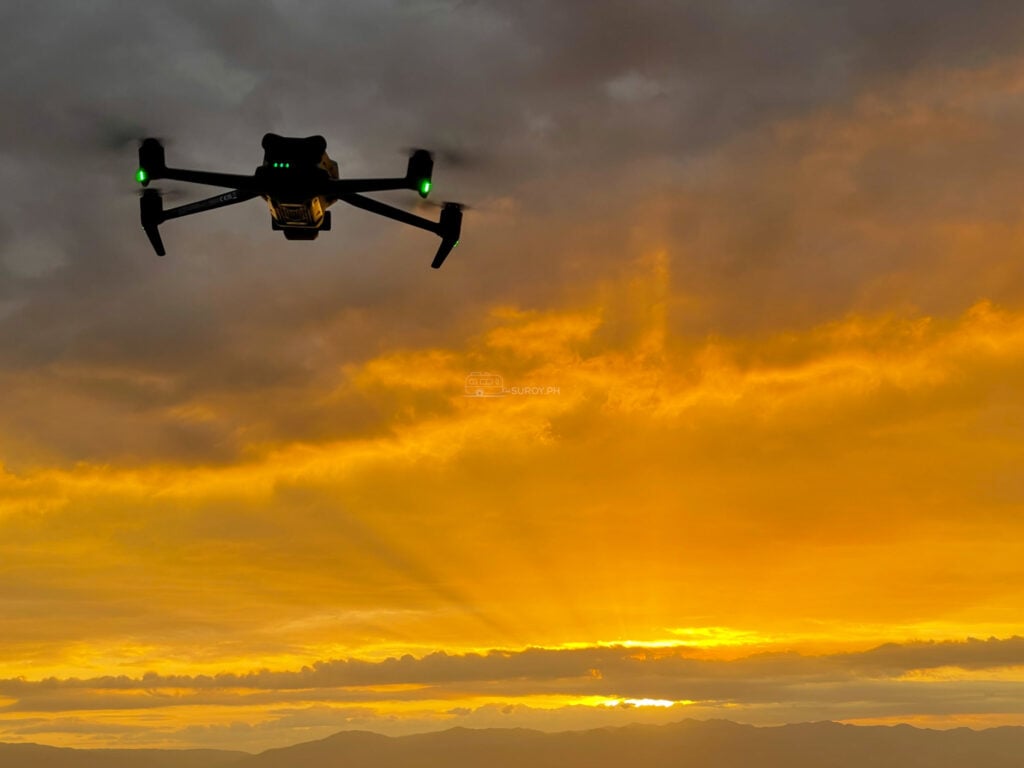
Everything aerial on this site is flown by us. The frames in this piece are the aircraft themselves, shot from the ground, because a guide about where you are allowed to put a drone should show the drone rather than the view from it.
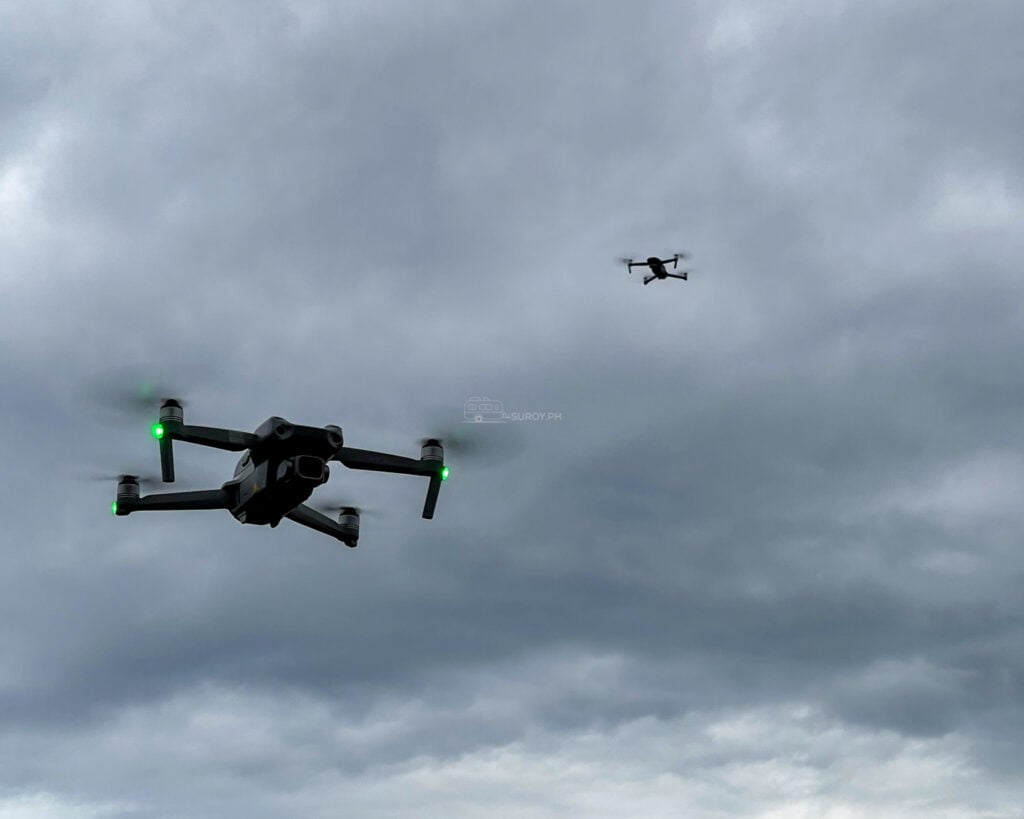
Three aircraft do the work. A Mavic 3, with its name printed on the arm and a Hasselblad on the gimbal. An Air 2, which is the one under the overcast above. And a ducted FPV quad, which is the small one. The heaviest of the three is under a kilogram, so nothing here comes within six kilos of the seven kilogram threshold, which is exactly why the registration question is the wrong one to lead with and the ten kilometre circle is the right one.


The operating limits above carry one line that reads like a formality and is not. Visual line of sight at all times. FPV removes the pilot’s eyes from the aircraft by design, because that is the entire point of the goggles. You are looking through a camera two hundred metres away and the thing you are flying is a dot somewhere behind you that you cannot see.

Part 11 says line of sight must be maintained. It does not say whose. Every regime that permits FPV at all resolves that the same way, with a second person standing beside the pilot whose only job is to watch the actual aircraft, scan for other traffic and talk. Europe writes that requirement down in plain language. The Philippine regulations do not spell it out, which means a spotter is not something you can point at a paragraph to justify. It is simply the only reading under which an FPV flight sits inside the rule rather than outside it.
Which is the practical answer. Fly it with somebody. One pilot in goggles, one pair of eyes on the sky.
Regulations and fees checked August 2026 against the January 2026 edition of Part 11 and the civil aviation authority’s published guidance.
Not for recreational flying. Under the civil aviation authority’s published guidance, registration applies to non commercial aircraft of seven kilograms and above, and to all commercial operations regardless of weight. Consumer drones are well under that.
120 metres above ground level, which is 393.7 feet. The 400 foot figure repeated on most sites is the American limit.
No closer than ten kilometres from any aerodrome without a special permit. This covers Boracay, Siargao, El Nido, Coron, Panglao and most of Metro Manila and Cebu.
₱1,500 plus twelve percent VAT, so ₱1,680. There is no online application. The process requires a notarised application, a registry mark reservation and physical inspection in Pasay City.
Recreationally, yes, within the operating limits. Commercially, almost certainly not, because a citizenship requirement applies to registration and operator certification.
₱20,000 to ₱100,000 per violation, with possible seizure. Local governments enforce their own ordinances separately, as Davao City does.
Yes. Customs de minimis is ₱10,000, so a new drone is technically dutiable, though used personal equipment is normally passed as personal effects. No case of customs seizing a traveller’s drone at a Philippine airport could be found.
Suroy is Cebuano for to roam. One of these prints the dictionary entry. The other puts it on the side of a van.

Suroy Definition
Statement Series
₱999

Retro Van
Statement Series
₱999
Rules, fees and penalties in this guide were read against Part 11 of the Philippine Civil Aviation Regulations, consolidated January 2026, and checked on 22 August 2026. Aviation rules change without announcement. Where a circular could not be read, this guide says so rather than guessing.